
Herbal Medicines in Autism Spectrum Disorder: A Scoping Review of Preclinical Evidence and Therapeutic Mechanisms
Ⓒ The Society of Pathology in Korean Medicine, The Physiological Society of Korean Medicine
Abstract
Herbal medicines present a promising therapeutic alternative for autism spectrum disorder (ASD), overcoming the limited efficacy and significant adverse effects associated with conventional drugs. This scoping review aims to summarize preclinical evidence on the use of herbal medicines in ASD treatment, focusing on types of animal models, intervention characteristics, behavioral outcomes, and mechanisms of action. A literature search was conducted in PubMed, Scopus, and Web of Science for studies published up to February 2025, following the Preferred Reporting Items for Systematic Reviews and Meta-Analyses extension for Scoping Reviews (PRISMA-ScR) guidelines. This review included studies that were published in English and focused on herbal medicines in animal models of ASD, with evaluation of ASD-related behaviors. Quality assessment of the included studies was performed according to the Animal Research: Reporting of In Vivo Experiments (ARRIVE) guidelines 2.0. Fifty-four studies met the inclusion criteria, with 72% published from 2021 to 2025, predominantly in Asian countries (83%). Chemically induced models, particularly valproic acid-induced models (43%), were the most utilized. Single compounds (69%) were investigated more frequently than herbal extracts (22%) or traditional formulations (7%). Oral administration (48%) and therapeutic strategies (80%) were the predominant treatments. Behavioral assessments focused on social (78%) and anxiety-like behaviors (74%), with the hippocampus (43%) and cerebellum (28%) being the most frequently examined. Antioxidant (48%) and anti-inflammatory (39%) activities were the principal therapeutic mechanisms. Safety reporting was deemed to be inadequate in 81% of studies. These findings indicate that herbal medicines improve ASD symptoms primarily through modulating oxidative stress and inflammation. Future studies should address safety profiling and expanded mechanistic investigations for clinical translation.
Keywords:
Autism spectrum disorder, Herbal medicine, Natural compounds, Preclinical evidence, Animal modelsIntroduction
Autism spectrum disorder (ASD) affects approximately one in 36 children worldwide, posing considerable challenges in social communication and presenting restricted repetitive patterns of behavior, interests, or activities1). The complex pathophysiology of ASD involves multiple mechanisms, including oxidative stress, neuroinflammation, neurotransmitter imbalance, and synaptic dysfunction2,3). Currently, only two Food and Drug Administration (FDA)-approved medications (namely, risperidone and aripiprazole) are available for the treatment of specific behavioral symptoms; however, they show limited efficacy and often cause significant adverse effects, such as weight gain, metabolic disturbances, and sedation4).
Globally, traditional medicine systems have historically employed various medicinal plants to treat neurological conditions5). Recent scientific investigations have demonstrated that numerous phytochemicals possess neuromodulatory properties relevant to the pathophysiology of ASD6). For instance, flavonoids from Ginkgo biloba have shown antioxidant and anti-inflammatory effects in preclinical studies7), whereas alkaloids from Uncaria rhynchophylla have been demonstrated to be capable of modulating N-methyl-D-aspartate receptors8). Clinical evidence has suggested that herbal medicines may act as effective adjunctive therapies that enhance the therapeutic benefits of conventional pharmacological treatments for ASD9). However, the number of randomized clinical trials evaluating the efficacy of herbal medicines in patients with ASD remains limited, and existing studies have generally involved small sample sizes (fewer than 50 participants per group), suggesting that ASD remains an underexplored area within the field of herbal medicine. In recent decades, the therapeutic potential of medicinal plants for ASD has attracted increasing attention. These studies have employed various animal models, including valproic acid (VPA)-induced models, BTBR mice, and maternal immune activation models, each representing different aspects of ASD pathophysiology10,11). Natural compounds have shown promising effects on both the core and associated symptoms of ASD via multiple mechanisms of action, including neurotransmitter regulation, oxidative stress reduction, and neuroplasticity enhancement12).
While several systematic reviews have previously explored the role of herbal medicines in ASD treatment9,13), the current literature lacks a comprehensive integration of animal models, herbal interventions, molecular mechanisms, and behavioral outcomes; additionally, intervention timing strategies and sex-specific considerations in preclinical studies remain poorly characterized14,15). To address these limitations, we conducted a scoping review of preclinical studies examining herbal medicines and natural compounds in animal models of ASD published until February 2025. Our analysis employed a comprehensive framework that integrated the key dimensions of animal models, intervention characteristics, molecular mechanisms, and behavioral outcomes16). This approach provides insights into how herbal medicines affect ASD pathophysiology and identifies gaps in current preclinical research. Our work specifically examined the intersection between intervention types and their mechanisms of action across diverse animal models while critically evaluating methodological quality and safety reporting to enhance the translational potential for clinical applications.
Materials and Methods
1. Search strategies
A literature search was performed to identify studies on the effects and mechanisms of action of traditional medicines and natural products on ASD, following the Preferred Reporting Items for Systematic Reviews and Meta-Analyses extension for Scoping Reviews (PRISMA-ScR)17). Studies were identified by searching multiple literature databases in PubMed, Scopus, and Web of Science from inception to February 2025.
The keywords and search strings used were as follows: (autism spectrum disorder OR autism) AND (herb OR herbal OR phytochemical OR plant extract OR botanical compound OR natural product OR compound OR flavonoid OR polyphenol OR alkaloid OR terpenoid OR essential oil OR nutraceutical OR phytotherapy OR medicinal plant OR ethnobotanical) AND (animal model OR animal study OR in vivo OR mouse OR rat). The search was limited to articles published in English.
2. Study selection
The inclusion criteria were as follows: studies published in scientific, academic, and peer-reviewed journals; studies on traditional medicines or natural products; studies using animal models of ASD with detailed methodological information; studies evaluating ASD-related behaviors; and studies in English. Studies were excluded if they were conference publications, clinical studies, systematic reviews, in vitro studies, or studies on outcomes without behavioral assessment. Duplicate articles were eliminated using EndNote version 20. Two independent reviewers screened the titles and abstracts of the identified studies; subsequently, a full-text review of potentially eligible articles was conducted. Any disagreements during the selection process were resolved through a consensus discussion, and a third reviewer was consulted when necessary.
3. Data extraction and analysis
Data were collected from each included study using a standardized data extraction form. The following data were extracted: publication details (authors, year, and country), animal model characteristics (species, strain, sex, and induction method), intervention details (compound/extract type, dose, route of administration, treatment timing, and duration), behavioral assessments (test types and outcomes), brain regions examined, molecular mechanisms investigated, and safety reports. The extracted data were categorized and analyzed to identify patterns and trends across studies. Descriptive statistics (frequencies and percentages) were calculated to characterize the distribution of the study characteristics and findings.
4. Quality assessment of included studies
The quality of the selected studies was evaluated using the Animal Research: Reporting of In Vivo Experiments (ARRIVE) guidelines 2.0 for reporting animal research16). The ARRIVE guidelines consist of 20 items: (1) study design, (2) sample size, (3) inclusion and exclusion criteria, (4) randomization, (5) blinding, (6), outcome measures, (7) statistical methods, (8) experimental animals, (9) experimental procedures, (10) results, (11) abstract, (12) background, (13) objectives, (14) ethical statement, (15) housing and husbandry, (16) animal care and monitoring, (17) interpretation/scientific implications, (18) generalizability/translation, (19) protocol registration, and (20) data access. Each study was rated as “2”, “1”, and “0” equivalent to “clearly sufficient,” “possibly sufficient,” and “clearly insufficient” for each item. Two independent reviewers performed the quality assessment to minimize subjective bias, and any discrepancies in scoring were resolved through consensus discussions with a third reviewer when necessary.
Results
1. Literature search outcomes
The study selection process is illustrated in Fig. 1. A total of 2,780 records were identified in PubMed, Web of Science, and Scopus databases. After eliminating duplicate studies, titles and abstracts of 2,162 articles were screened, among which 125 articles were selected for a detailed full-text review. Finally, 54 original articles met the inclusion criteria and were included in the final analysis.
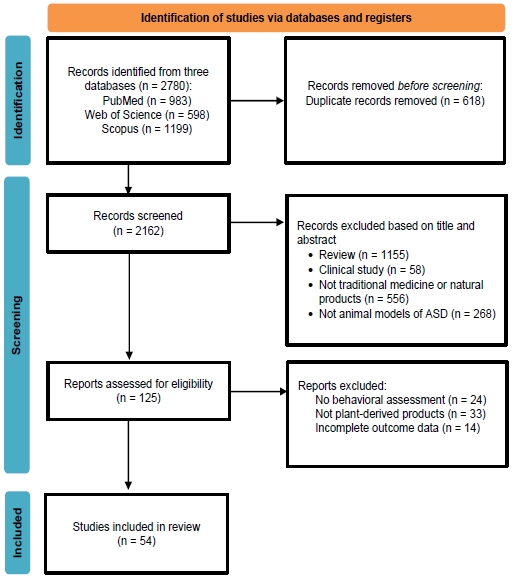
Flow diagram of literature search and study selection process.
2. Temporal and geographical distribution of included studies
Preclinical studies investigating herbal medicines for ASD exhibited a clear upward trajectory over the study period (Fig. 2A). Out of the 54 included studies, 39 (72.22%) were published within the most recent 5-year period (2021–2025). Year-by-year analysis revealed minimal research output (≤1 study annually) until 2014, followed by a gradual increase beginning in 2017. Research significantly accelerated from 2023 to 2024, with 11 studies (20.37%) published in 2023 and 16 studies (29.63%) published in 2024, collectively accounting for 50.00% of all included studies. Such recent acceleration likely reflects the growing scientific interest in alternative therapeutic approaches for ASD management.
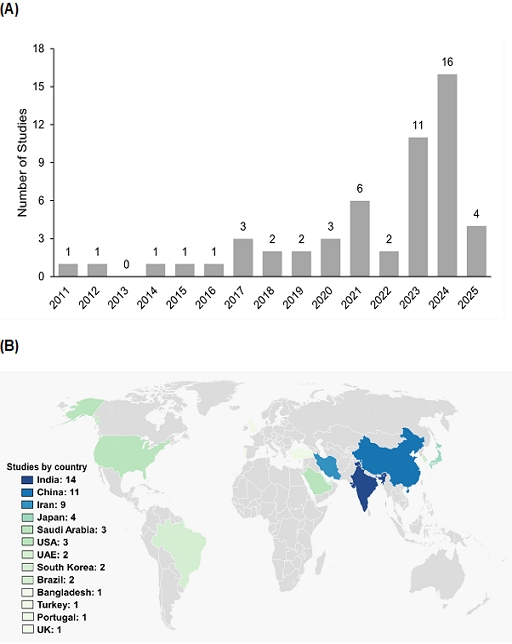
Temporal (A) and geographical (B) distribution of included studies. All studies published up to February 2025 were included in the analysis.
The geographical distribution of studies revealed a significant regional imbalance (Fig. 2B). Research from Asian countries was predominant (45 studies, 83.33%), followed by North America (three studies, 5.56%), Europe (two studies, 3.70%), and South America (two studies, 3.70%). Country-specific analysis identified India (14 studies, 25.93%), China (11 studies, 20.37%), and Iran (9 studies, 16.67%) as the leading contributors, collectively accounting for 62.97% of all studies. This distribution pattern may reflect the strong historical foundation of traditional herbal medicines in these regions.
3. Experimental procedures and outcomes
Tables 1-3 provide details of the experimental procedures and outcomes of the 54 studies included in this review, including animal models, intervention characteristics, and behavioral and biological assessments.

Characteristics of included studies using single compounds.
Characteristics of included studies using herbal extract.
Characteristics of included studies using traditional formulations.
The animal models used across the 54 studies were categorized into four types: genetic, chemically induced, stress-induced, and surgical (Fig. 3). Analysis of animal species revealed that mice were used more frequently (31 studies, 57.41%) than rats (23 studies, 42.59%). Chemically induced models were predominant (34 studies, 62.96%), with VPA models being the most frequent (23 studies, 42.59%). These included prenatal (18 studies, 33.33%) and postnatal (five studies, 9.26%) VPA injections. Propionic acid models were the next most common (eight studies, 14.81%), whereas other chemically induced models appeared in single studies. Genetic models appeared in 11 studies (20.37%), primarily BTBR mice (8 studies, 14.81%), followed by Scn1a+/− mutant mice (2 studies, 3.70%) and CDKL5R59X knock-in mice (1 study, 1.85%). Study 27 employed both BTBR mice and postnatal VPA models, and thus appeared in multiple categories. Stress-induced models were used in 8 studies (14.81%), including maternal immune activation (3 studies, 5.56%) and maternal separation stress (5 studies, 9.26%). One study (1.85%) used a surgical model of ovariectomized mice.
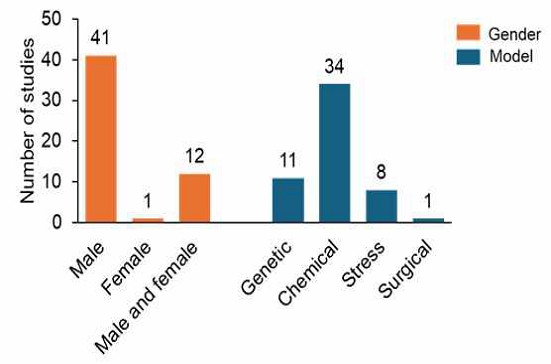
Gender analysis and types of ASD animal models.
Sex-specific analysis revealed a substantial imbalance, with 41 studies (75.93%) exclusively using male animals, 12 studies (22.22%) including both sexes, and only one study (1.85%) focusing solely on females (Fig. 3). This marked sex disparity suggests potential limitations in understanding sex-specific responses to herbal interventions in ASD models.
Fifty-four studies were classified into three categories according to the intervention type: single compounds, herbal extracts, and traditional formulations (Fig. 4A, Tables 1-3). Among 54 studies, two studies utilized both herbal extracts/herbal formulations and the derived bioactive compounds. Single compounds were the predominant research focus (40 studies, 74.07%), reflecting a modern pharmacological approach that emphasizes isolated active constituents. Single compounds reported in the included studies were divided into five subclasses: polyphenols, terpenoids, cannabinoids, alkaloids, and others. The most commonly used compounds are polyphenols, including flavonoids (e.g., apigenin, fisetin, puerarin), phenolic acids (e.g., syringic acid, vanillic acid), stilbenes (e.g., resveratrol), and other polyphenols (e.g., curcumin, quercetin). Resveratrol and cannabidiol (each with five studies, 9.26%) were the most frequently investigated, followed by quercetin (three studies, 5.56%) and fisetin and papaverine (two studies each, 3.70%). Herbal extracts constituted the second most studied category (12 studies, 22.22%), including diverse plant sources such as Portuguese blueberry anthocyanins, Bacopa monnieri, Cananga odorata essential oil, and Korean red ginseng. Traditional formulations appeared in four studies (7.41%), primarily East Asian traditional medicine prescriptions. Kami-shoyo-san was investigated in two studies (3.70%), whereas Yigansan and Qi Bi Anshen decoctions were examined in one study (1.85%). This distribution suggests a preference for reductionist approaches over traditional whole-herb preparations in preclinical ASD studies.
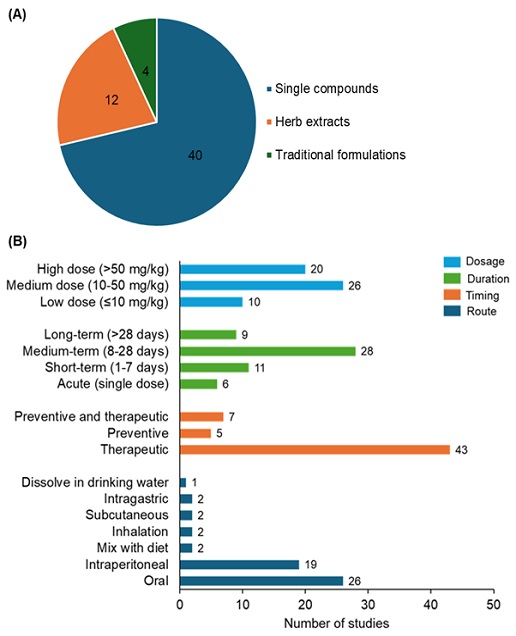
Treatment characteristics of included studies. (A) Intervention categories. (B) Treatment routes, timing, duration, and dosages.
Seven distinct routes of administration were identified in the 54 studies (Fig. 4B). Oral administration was the most prevalent (26 studies, 48.15%), likely owing to its non-invasive nature, clinical translatability, and high patient compliance in potential therapeutic applications. This preference may reflect the historical context of traditional herbal medicines. Intraperitoneal injection was the second most common route (19 studies, 35.19%), offering advantages, such as increased bioavailability, rapid systemic absorption, and precise dosage control in preclinical research settings. The remaining administration methods—mixing with diet, inhalation, subcutaneous injection, intragastric administration, and dissolution in drinking water—were employed in only 1–2 studies (1.85–3.70%). This diversity in administration routes highlights the different approaches for optimizing compound delivery in animal models of ASD.
Intervention timing strategies were classified into three categories: therapeutic, preventive, and combined preventive-therapeutic approaches (Fig. 4B). The analysis revealed that therapeutic approaches were predominantly employed (43 studies, 79.63%), followed by combined preventive-therapeutic approaches (seven studies, 12.96%) and purely preventive approaches (five studies, 9.26%). Notable patterns emerged when examining the intervention timing in relation to the animal model type. Genetic models were used exclusively in therapeutic intervention studies, reflecting their utility for evaluating treatments for established ASD phenotypes. Chemically induced models showed greater diversity in terms of timing strategies, with a small subset employing preventive approaches. Stress-induced models exhibited the broadest range of intervention timing approaches. These results suggest that research has primarily focused on treating established ASD symptoms rather than preventing their development.
Treatment durations across the 54 studies were categorized into four intervals: acute (single dose), short-term (1–7 days), medium-term (8–28 days), and long-term (>28 days) (Fig. 4B). Medium-term interventions were predominant (28 studies, 51.85%), reflecting the balance between sufficient intervention time and practical research parameters. Short-term interventions were employed in 11 studies (20.37%), which often targeted specific developmental windows or evaluated immediate therapeutic responses. Long-term interventions were described in 9 studies (16.67%), allowing for the assessment of sustained effects and better approximation of clinical treatment durations. Acute administration was performed in six studies (11.11%), primarily to examine the immediate pharmacological effects on behavioral outcomes. The limited number of long-term studies may present challenges in understanding the sustained efficacy of herbal interventions in ASD.
Dosage distribution analysis was conducted for 48 studies that reported doses in mg/kg (Fig. 4B). Three dosage categories were established: low (≤10 mg/kg), medium (>10–50 mg/kg), and high (>50 mg/kg). Medium doses were most frequently used (26 studies, 54.17%), followed by high doses (20 studies, 41.67%) and low doses (10 studies, 20.83%). Some studies used multiple dose ranges and were accordingly counted in multiple categories. Medium doses were predominant across all treatment duration categories (acute, short, medium, and long term). Short-term administration studies showed a relatively higher proportion of low-dose usage than other duration categories, although the sample size was insufficient to establish definitive correlations.
The behavioral tests employed across the 54 studies were classified into six categories, with most studies utilizing multiple assessment types to comprehensively evaluate intervention effects (Fig. 5). Social behavior tests were most frequently employed (42 studies, 77.78%), primarily three-chamber tests, social interaction tests, and sociability assessments, to evaluate core social deficits in ASD. Anxiety-like behavior tests constituted the second most prevalent category (40 studies, 74.07%), featuring open-field tests, elevated plus maze tests, and light-dark box paradigms. Repetitive behavioral, learning, and memory tests were performed in 25 studies (46.30%). Repetitive behavior assessments predominantly employ marble burying tests and self-grooming quantification to evaluate restricted, repetitive behavioral patterns characteristic of ASD. Learning and memory evaluations frequently utilize novel object recognition tests and the Morris water maze paradigm. Motor function tests were performed in ten studies (18.52%), primarily using the rotarod test to assess motor coordination and balance. Sensory tests were the least common (eight studies, 14.81%), including hot plate tests, prepulse inhibition paradigms, and nociceptive assessments. This distribution of assessment methods reflects a primary focus on the core social and repetitive behavioral domains of ASD, although limited attention to sensory abnormalities presents a notable gap in comprehensive phenotypic evaluation.
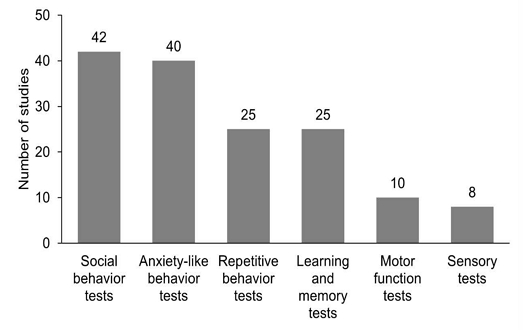
Behavioral test categories distribution.
Analysis of the brain regions investigated across 54 studies revealed distinct regional focus patterns (Fig. 6). The hippocampus was the most frequently studied region (23 studies, 42.59%) followed by the cerebellum (15 studies, 27.78%). Whole-brain analyses were conducted in nine studies (16.67%), providing broader neurobiological insights but lacking region-specific details. Various cortical regions were examined, including the prefrontal and general cortices (6 studies, 11.11%), cerebral cortex (4 studies, 7.41%), medial prefrontal cortex, and frontal cortex (3 studies, 5.56%). The striatum was investigated in 6 studies (11.11%), highlighting the importance of subcortical structures. The amygdala was examined in only two studies (3.70%). This regional distribution indicates a particular research interest in the hippocampus and cerebellum, with a secondary focus on the cortical regions and striatum across preclinical ASD studies involving herbal interventions. The limited investigation of the amygdala suggests a potential gap in understanding the effects of herbal medicines on social-emotional processing circuits in ASD models.
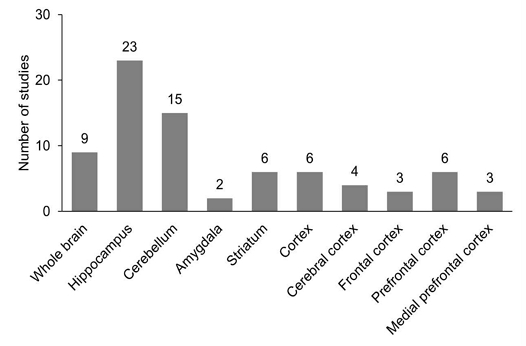
Brain regional analysis.
Analysis of the 54 studies revealed six principal mechanisms through which herbal medicines exert therapeutic effects in ASD models (Fig. 7 and Table 1). Antioxidant activity was the most prevalent mechanism (26 studies, 48.15%), characterized by decreased malondialdehyde (MDA) levels and increased levels of antioxidant enzymes (GSH, CAT, and SOD). Anti-inflammatory effects constituted the second most common mechanism (21 studies, 38.89%), evidenced by downregulation of pro-inflammatory cytokines (TNF-α, IL-1β, IL-6) and inflammatory mediators.
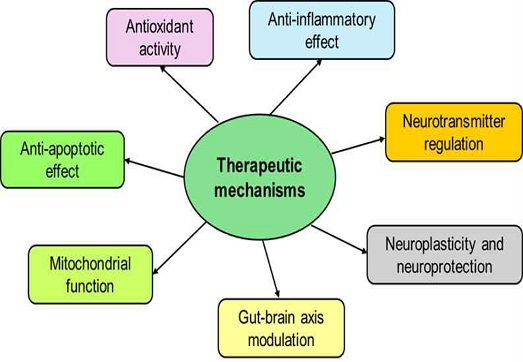
Mechanisms of action of herbal medicines.
Neurotransmitter regulation and neuroplasticity enhancement were observed in 8 studies (14.81%). Neurotransmitter regulation involves increased serotonin and GABA levels, with concurrent decreases in glutamate levels. Neuroplasticity enhancement is indicated by elevated levels of BDNF, p-CREB, and synaptic proteins. Anti-apoptotic effects were documented in six studies (11.11%), as reflected by reduced caspase-3 and Bax expression, and increased Bcl-2 levels.
Less frequently observed were improvements in mitochondrial function (four studies, 7.41%) and gut–brain axis modulation (three studies, 5.56%). Multiple studies have reported the simultaneous modulation of several pathways, rather than operating through singular mechanisms. This mechanistic profile suggests that herbal interventions may address the multifaceted pathophysiology of ASD through complementary pathways; however, certain mechanisms remain underexplored.
Analysis of adverse effect reporting across 54 studies revealed significant gaps in safety monitoring (Fig. 8). Most studies (44 studies, 81.48%) provided no information regarding adverse effects, indicating a substantial limitation in safety reporting. Nine studies (16.67%) reported no adverse effects during herbal medicine administration, whereas only one (1.85%) documented adverse effects. A single study that reported adverse effects investigated alpha-glycosyl isoquercitrin administered at doses of 0.25% and 0.5% over 77 days in a postnatal LPS-injected rat model18). The reported adverse effects include decreased body weight, reduced food and water consumption, and a mortality rate of 20–30%. This lack of safety monitoring presents a significant concern for the translational value of preclinical herbal medicine research in ASD.
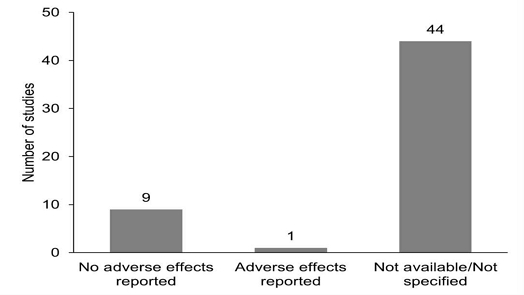
Adverse effects reporting.
Among the 54 included studies, the use of FDA-approved drugs for ASD in animal models was limited. Only one study used risperidone, whereas another study incorporated aripiprazole as a positive control drug24,56). The doses of natural compounds used in these studies were generally higher than those of positive control drugs. Ligustilide (10 mg/kg) and risperidone (2.5 mg/kg) were reported in one study to have comparable effects on social interaction, repetitive behaviors, and motor function, with ligustilide (30 mg/kg) showing superior efficacy over positive controls56). In another study, genistein (80 mg/kg) exhibited similar effects on ASD behavior and biochemical markers to aripiprazole (5 mg/kg)24).
4. Quality assessment of the included studies
The outcomes of the quality assessment are presented in Table 4. Fifty-four studies described the study design with details about experimental animals and procedures, as well as the measurement of experimental outcomes compared with the control groups. Fifty-four studies clearly demonstrated the study objectives and generalizability of the findings. Thirty studies (56%) did not include any statements regarding blinding in the experimental procedures, outcome evaluation, or data analysis. Fifty-four studies had sufficient information about sample size, randomization, and independent replications. Only one study (2%) did not provide an accurate summary in the abstract. Fifty-four studies provided statistical methods, but only one study (2%) clearly described the methods used to check the assumptions of the statistical tests. Eight studies (15%) described sufficient background and explained the reasons for animal model selection. Fifty-two studies (96%) provided ethical statements as well as housing and husbandry conditions. None of the studies (0%) provided a detailed description of the methods used to reduce animal suffering. Twenty studies (37%) interpreted the results with comments on the study limitations. Forty-nine studies (91%) registered protocols for animal experiments. Thirty-one studies (57%) provided statements regarding the data availability.
Quality assessment of the included study.
Discussion
This scoping review provides a comprehensive analysis of preclinical evidence on the use of herbal medicines and natural compounds in the treatment of ASD. Our findings revealed several patterns in research methodology, intervention strategies, and therapeutic mechanisms that could inform the interpretation of ASD treatment approaches.
Temporal distribution analysis demonstrated a notable acceleration in research activity, with 72.22% of the studies published within the most recent 5-year period (2021–2025). This surge likely reflects the growing recognition of the potential of herbal interventions to address the multifaceted pathophysiology of ASD alongside the increasing standardization of animal models. However, this recency also indicates that the field remains at a relatively nascent stage of development, suggesting caution in extrapolating these findings to clinical applications. The geographical distribution of the studies revealed a pronounced regional imbalance, with Asian countries contributing 83.33% of all the research. This pattern likely stems from the strong cultural and historical foundations of traditional medicine in these regions, particularly India, China, and Iran, which collectively represented 62.97% of the included studies. Cultural context significantly influences approaches to ASD treatment and intervention responses, highlighting the necessity for expanding research across diverse cultural settings. The limited representation of Western countries (9.26%) suggests a need for greater global collaboration to integrate diverse pharmacological approaches and ensure that the findings translate across different healthcare paradigms.
Our analysis of animal models revealed a clear preference for chemically induced models (62.96%), particularly VPA-induced models (42.59%). This prevalence likely stems from the relative ease of implementation and established face validity in replicating core ASD behavioral features10). However, considering the heterogeneous etiology of ASD, overreliance on a single model may limit the generalizability of the findings. The integrated use of diverse animal models is essential for a comprehensive understanding of the complex pathophysiological mechanisms underlying ASD. The underrepresentation of genetic (20.37%) and stress-induced (14.81%) models is noteworthy, as these models may better capture certain aspects of the complex pathophysiology of ASD. Furthermore, 75.93% of studies used male animals exclusively, thereby signifying a striking sex imbalance, which represents a significant methodological limitation. Neurobiological differences in ASD between sexes can influence treatment responses. Female patients with ASD often present with symptom patterns different from those observed in male patients, and neuroanatomical and neurochemical differences may affect responses to specific interventions72). This sex gap in preclinical research parallels the historic male bias in clinical ASD research and contradicts the increasing recognition of ASD in female patients.
Intervention analysis revealed a predominance of isolated compounds (68.52%) over herbal extracts (22.22%) and traditional formulations (7.41%). This emphasis on single compounds aligns with the reductionist approach of modern pharmacology, facilitating mechanistic understanding while potentially overlooking the synergistic effects inherent to whole herbs or traditional formulations. Multicomponent herbal preparations may modulate multiple pharmacological targets simultaneously, potentially offering broader efficacy and fewer side effects than single compounds.
The preference for oral administration (48.15%) demonstrates appropriate consideration for clinical translatability, as it is most analogous to typical human consumption patterns. The intervention timing analysis indicated a strong preference for therapeutic strategies (79.63%) over unknown “preventive" approaches (9.26%). However, the term "preventive" should be understood not as preventing ASD occurrence, but as an early intervention during critical neurodevelopmental periods to mitigate symptom manifestation or severity. Brain overgrowth during the first 1–2 years of life in patients with ASD represents a critical window for intervention in developmental trajectories. Early interventions for children with ASD aged <3 years provide opportunities to positively influence symptomatic pathways by leveraging heightened neuroplasticity during this period73). Additionally, the prevalence of medium-term interventions (51.85%) reflects a practical compromise between research feasibility and clinical relevance; nonetheless, the limited proportion of long-term studies (16.67%) suggests a restricted understanding of sustained treatment effects—a critical consideration, given the lifelong impact and chronic nature of ASD. Patients require lifelong support, underscoring the importance of investigating the effects of long-term interventions.
Behavioral assessment patterns demonstrated appropriate emphasis on social behavior (77.78%) and anxiety-like behavior (74.07%), aligning with the core and common comorbid symptoms of ASD as defined in the DSM-5 and ICD-1174). However, the relatively low rate of assessment of repetitive behaviors (46.30%) represents a notable imbalance. Restricted and repetitive behaviors extend beyond mere symptoms to serve as important outcome measurements for intervention efficacy and require systematic evaluation75). The limited attention paid to sensory abnormalities (14.81%) represents an even more concerning gap. Considering the explicit inclusion of sensory abnormalities in DSM-5 diagnostic criteria for ASD, this gap is particularly troubling. Sensory hypersensitivity or hyporesponsiveness is reported in approximately 90% of individuals with ASD and significantly affects social interaction abilities, anxiety levels, and overall quality of life76). Sensory processing abnormalities may constitute one of the core pathophysiological mechanisms underlying ASD77). Future studies should adopt more comprehensive behavioral assessment batteries that encompass the full spectrum of ASD manifestations, with enhanced measures related to sensory processing.
Regional brain analysis revealed focused attention on the hippocampus (42.59%) and cerebellum (27.78%), reflecting an increased recognition of the roles of these structures in ASD pathophysiology beyond the traditional focus on fronto-striatal circuits78). Cerebellar abnormalities influence social cognition and language development in patients with ASD. However, the limited investigation of the amygdala (3.70%) represents a notable gap, given its established role in social-emotional processing—a core deficit in ASD. The amygdala plays a crucial role in processing social stimuli and regulating emotions, which are directly related to core ASD symptoms79). Future research should adopt more balanced regional analyses and incorporate advanced techniques, including circuit-specific optogenetics, to elucidate region-specific treatment effects.
Mechanistic analyses identified antioxidant (48.15%) and anti-inflammatory (38.89%) activities as the predominant therapeutic pathways, which aligns with recent research on the roles of oxidative stress and neuroinflammation in ASD pathophysiology80). Systematic analyses have documented increased levels of oxidative stress biomarkers and decreased antioxidant defense capabilities in patients with ASD2). Additionally, inflammatory imbalances characterized by elevated levels of pro-inflammatory cytokines (IL-6, TNF-α) and reduced levels of anti-inflammatory cytokines (IL-10) have been observed in the serum of children with ASD81). Nevertheless, relatively limited research on neuroplasticity enhancement (14.81%), neurotransmitter regulation (14.81%), and gut–brain axis modulation (5.56%) represents a notable gap. Abnormal expression of synaptic proteins and impaired neuroplasticity have been observed in patients with ASD and represent important therapeutic targets82). Furthermore, gut microbiota dysbiosis is closely associated with behavioral and neurological alterations in ASD, suggesting that the gut–brain axis is a potential therapeutic target83). The comparative scarcity of studies investigating the effects of herbs on these domains represents a critical area for future research. The multi-mechanistic action exhibited by many herbal interventions may offer potential advantages over conventional pharmaceuticals that target single receptors or pathways in the treatment of complex neurodevelopmental disorders84). Multi-target drugs may prove to be more effective than single-target approaches for complex neuropsychiatric conditions such as ASD, highlighting the important clinical implications of the multifaceted action mechanisms of herbal medicines and natural compounds.
Safety profiles were inadequately reported, with 81.48% of studies providing no information on adverse effects. This concerning gap raises ethical concerns and limits the translational value of our findings. While herbal medicines are often presumed to be safe based on traditional usage, rigorous preclinical safety assessment remains essential, given the evidence of herb–drug interactions and variability in phytochemical compositions. The lack of systematic safety reporting is a significant barrier to clinical translation and requires immediate attention in future research.
Among the compounds reviewed, resveratrol, cannabidiol, and quercetin exhibit the most consistent therapeutic effects in multiple ASD models. These compounds were particularly efficacious in improving social interaction deficits and reducing repetitive behaviors, which are core symptoms inadequately addressed by current FDA-approved medications85). The observed multi-pathway modulation by these compounds suggests potential advantages over single-target pharmaceuticals, particularly when considering the complex pathophysiology of ASD. The established safety profiles of these compounds under other conditions further support their clinical potential; nevertheless, ASD-specific safety data remain limited. Translating these findings into clinical practice requires careful consideration of optimal formulations, dosages, and treatment durations, particularly in pediatric populations. Additionally, the potential of herbal interventions as adjunct therapies to established behavioral interventions should be further investigated to improve the treatment outcomes through complementary mechanisms.
Our review revealed that only a limited number of studies have incorporated FDA-approved drugs (i.e., risperidone and aripiprazole) for ASD as positive control drugs24,56). The use of clinically validated medications as reference drugs is crucial for establishing the comparative efficacy of herbal interventions. Without such comparisons, it is difficult to determine whether the effects of herbal medicines are similar to or superior to those of available pharmacological treatments. The natural compounds used in the included studies were typically administered at higher doses, producing effects that were either comparable to or moderately more effective than those of positive control drugs. Future research with appropriate dosage comparisons should include FDA-approved drugs as positive controls to enhance the reliability of the findings. The combination of conventional drugs and herbal medicines may offer a promising therapeutic approach for ASD treatment.
This review summarizes the preclinical evidence on the therapeutic potential of herbal medicines in the treatment of ASD, laying the foundation for their translation into clinical research and practice. In recent years, several clinical investigations have examined the efficacy of herbal medicines in pediatric patients with ASD, particularly focusing on traditional formulations reported to alleviate behavioral symptoms and improve sleep quality9,13). Although the number of high-quality randomized controlled trials remains limited, the existing findings offer encouraging evidence supporting the translational relevance of preclinical studies. To further bridge the gap between animal research and clinical application, future studies should focus on systematic evaluation of pharmacokinetics, safety profiles, and dose–response relationships of promising herbal candidates. Notably, our review reveals that in vivo studies employing traditional multi-herbal prescriptions remain relatively scarce compared to those investigating single compounds. Given that traditional formulations consist of multiple herbs with potential synergistic effects, future preclinical research should extend beyond single-compound investigations and incorporate standardized multi-herbal formulations to enhance clinical applicability. Furthermore, integrating modern analytical approaches, such as network pharmacology, molecular docking, transcriptomics, and metabolomics, may facilitate the identification of bioactive constituents and molecular targets, thereby strengthening the scientific basis for the clinical translation of herbal medicines in ASD treatment.
Conclusion
This review documents a substantial increase in preclinical evidence supporting the use of herbal medicines in ASD treatment, particularly the consistent efficacy of resveratrol, cannabidiol, and quercetin in multiple animal models. The use of these compounds leads to specific improvements in social interaction deficits and repetitive behaviors via the modulation of oxidative stress markers, inflammatory cytokines, and synaptic plasticity factors. Despite these promising results, critical methodological limitations, such as the predominance of male-only studies, overreliance on VPA-induced models, insufficient safety profiling in most studies, and limited investigation of neuroplasticity and gut–brain axis mechanisms, require attention.
Future investigations should prioritize comparisons between whole-herb extracts and isolated compounds to assess their synergistic effects, implement appropriate sex-balanced study designs, and evaluate dose-dependent responses across extended treatment timeframes to address the chronic nature of ASD. Standardized safety reporting protocols and expanded mechanistic investigations beyond the antioxidant and anti-inflammatory pathways could substantially improve the translational value of these findings for clinical applications. Additional focus on understudied but promising mechanisms, particularly gut–brain axis modulation and neuroplasticity enhancement, may reveal novel therapeutic targets for ASD interventions.
Acknowledgments
This work was supported by the Dongguk University Research Fund (2025) and the National Research Foundation of Korea (NRF-2021R1I1A2048979).
References
- Christensen DL, et al. Prevalence and Characteristics of Autism Spectrum Disorder Among Children Aged 8 Years-Autism and Developmental Disabilities Monitoring Network, 11 Sites, United States, 2020. Mmwr-Morbidity and Mortality Weekly Report. 2023:72(2).
-
Bjørklund G, Meguid NA, El-Bana MA, Tinkov AA, Saad K, Dadar M, Hemimi M, Skalny AV, Hosnedlová B, Kizek R, Osredkar J, Urbina MA, Fabjan T, El-Houfey AA, Kałużna-Czaplińska J, Gątarek P, Chirumbolo S. Oxidative Stress in Autism Spectrum Disorder. Mol Neurobiol. 2020:57(5):2314-32.
[https://doi.org/10.1007/s12035-019-01742-2]

-
Matta SM, Hill-Yardin EL, Crack PJ. The influence of neuroinflammation in Autism Spectrum Disorder. Brain Behav Immun. 2019:79:75-90.
[https://doi.org/10.1016/j.bbi.2019.04.037]
-
DeFilippis, M. and K.D. Wagner, Treatment of Autism Spectrum Disorder in Children and Adolescents. Psychopharmacol Bull. 2016:46(2):18-41.
[https://doi.org/10.64719/pb.4346]
-
Pan SY, Litscher G, Gao SH, Zhou SF, Yu ZL, Chen HQ, Zhang SF, Tang MK, Sun JN, Ko KM. Historical perspective of traditional indigenous medical practices: the current renaissance and conservation of herbal resources. Evid Based Complement Alternat Med. 2014:2014:525340.
[https://doi.org/10.1155/2014/525340]
-
Bhandari R, Paliwal JK, Kuhad A. Dietary Phytochemicals as Neurotherapeutics for Autism Spectrum Disorder: Plausible Mechanism and Evidence. Adv Neurobiol. 2020:24:615-46.
[https://doi.org/10.1007/978-3-030-30402-7_23]
-
Ban C, et al. Characterization of Ginkgo biloba Leaf Flavonoids as Neuroexocytosis Regulators. Molecules. 2020:25(8).
[https://doi.org/10.3390/molecules25081829]
-
Yang W, et al. Uncaria rhynchophylla and its Major Constituents on Central Nervous System: A Review on Their Pharmacological Actions. Curr Vasc Pharmacol. 2020:18(4):346-57.
[https://doi.org/10.2174/1570161117666190704092841]
-
Bang M, et al. Herbal Medicine Treatment for Children with Autism Spectrum Disorder: A Systematic Review. Evid Based Complement Alternat Med. 2017:2017:8614680.
[https://doi.org/10.1155/2017/8614680]
-
Nicolini C, Fahnestock M. The valproic acid-induced rodent model of autism. Exp Neurol. 2018:299(Pt A):217-27.
[https://doi.org/10.1016/j.expneurol.2017.04.017]
-
Meyza KZ, et al. The BTBR T+ tf/J mouse model for autism spectrum disorders-in search of biomarkers. Behav Brain Res. 2013:251:25-34.
[https://doi.org/10.1016/j.bbr.2012.07.021]
-
Deb S, et al. Natural Products and Their Therapeutic Effect on Autism Spectrum Disorder. Adv Neurobiol. 2020:24:601-14.
[https://doi.org/10.1007/978-3-030-30402-7_22]
-
Gasparotto FM, et al. Herbal Medicine as an Alternative Treatment in Autism Spectrum Disorder: A Systematic Review. Curr Drug Metab. 2018:19(5):454-9.
[https://doi.org/10.2174/1389200219666171227202332]
-
Ratajczak HV. Theoretical aspects of autism: biomarkers--a review. J Immunotoxicol. 2011:8(1):80-94.
[https://doi.org/10.3109/1547691X.2010.538749]
-
Matelski L, J. Van de Water. Risk factors in autism: Thinking outside the brain. J Autoimmun. 2016:67:1-7.
[https://doi.org/10.1016/j.jaut.2015.11.003]
-
Percie du Sert N, et al. The ARRIVE guidelines 2.0: updated guidelines for reporting animal research. BMJ Open Sci. 2020:4(1):e100115.
[https://doi.org/10.1186/s12917-020-02451-y]
-
Tricco AC, et al. PRISMA Extension for Scoping Reviews (PRISMA-ScR): Checklist and Explanation. Ann Intern Med. 2018:169(7):467-73.
[https://doi.org/10.7326/M18-0850]
-
Okano H, et al. Ameliorating effect of continuous alpha-glycosyl isoquercitrin treatment starting from late gestation in a rat autism model induced by postnatal injection of lipopolysaccharides. Chem Biol Interact. 2022:351:109767.
[https://doi.org/10.1016/j.cbi.2021.109767]
-
Jayaprakash P, et al. Apigenin Alleviates Autistic-like Stereotyped Repetitive Behaviors and Mitigates Brain Oxidative Stress in Mice. Pharmaceuticals (Basel). 2024:17(4).
[https://doi.org/10.3390/ph17040482]
-
Mehta R, Bhandari R, Kuhad A. Effects of catechin on a rodent model of autism spectrum disorder: implications for the role of nitric oxide in neuroinflammatory pathway. Psychopharmacology. 2021:238(11):3249-71.
[https://doi.org/10.1007/s00213-021-05941-5]
-
Jayaprakash P, et al. Curcumin Potentiates alpha7 Nicotinic Acetylcholine Receptors and Alleviates Autistic-Like Social Deficits and Brain Oxidative Stress Status in Mice. Int J Mol Sci. 2021:22(14).
[https://doi.org/10.3390/ijms22147251]
-
Mehra S, et al. Neuroprotective Efficacy of Fisetin Against VPA-Induced Autistic Neurobehavioral Alterations by Targeting Dysregulated Redox Homeostasis. J Mol Neurosci. 2023:73(6):403-22.
[https://doi.org/10.1007/s12031-023-02127-w]
-
Mehra S, et al. Gestational Fisetin Exerts Neuroprotection by Regulating Mitochondria-Directed Canonical Wnt Signaling, BBB Integrity, and Apoptosis in Prenatal VPA-Induced Rodent Model of Autism. Mol Neurobiol. 2024:61(7):4001-20.
[https://doi.org/10.1007/s12035-023-03826-6]
-
Kumar M, et al. Therapeutic efficacy of Genistein in activation of neuronal AC/cAMP/CREB/PKA and mitochondrial ETC-Complex pathways in experimental model of autism: Evidence from CSF, blood plasma and brain analysis. Brain Res. 2025:1846:149251.
[https://doi.org/10.1016/j.brainres.2024.149251]
-
Khalaj R, Moghaddam A Zare HM. Hesperetin and it nanocrystals ameliorate social behavior deficits and oxido-inflammatory stress in rat model of autism. Int J Dev Neurosci. 2018:69:80-7.
[https://doi.org/10.1016/j.ijdevneu.2018.06.009]
-
Alhusain AF, et al. Salubrious effects of proanthocyanidins on behavioral phenotypes and DNA repair deficiency in the BTBR mouse model of autism. Saudi Pharm J. 2024:32(11):102187.
[https://doi.org/10.1016/j.jsps.2024.102187]
-
Jiang P, et al. Puerarin attenuates valproate-induced features of ASD in male mice via regulating Slc7a11-dependent ferroptosis. Neuropsychopharmacology. 2024:49(3):497-507.
[https://doi.org/10.1038/s41386-023-01659-4]
-
Fan L, et al. Yigansan ameliorates maternal immune activation-induced autism-like behaviours by regulating the IL-17A/TRAF6/MMP9 pathway: Network analysis and experimental validation. Phytomedicine. 2024:128:155386.
[https://doi.org/10.1016/j.phymed.2024.155386]
-
de Mattos BDS, et al. Quercetin prevents alterations of behavioral parameters, delta-aminolevulinic dehydratase activity, and oxidative damage in brain of rats in a prenatal model of autism. Int J Dev Neurosci. 2020:80(4):287-302.
[https://doi.org/10.1002/jdn.10025]
-
Moghaddam AH, et al. Preventive effect of quercetin-Loaded nanophytosome against autistic-like damage in maternal separation model: The possible role of Caspase-3, Bax/Bcl-2 and Nrf2. Behav Brain Res. 2023:441:114300.
[https://doi.org/10.1016/j.bbr.2023.114300]
-
Bakheet SA, et al. Resveratrol Ameliorates Dysregulation of Th1, Th2, Th17, and T Regulatory Cell-Related Transcription Factor Signaling in a BTBR T + tf/J Mouse Model of Autism. Mol Neurobiol. 2017:54(7):5201-12.
[https://doi.org/10.1007/s12035-016-0066-1]
-
Xie W, et al. Resveratrol ameliorates prenatal progestin exposure-induced autism-like behavior through ERβ activation. Mol Autism. 2018:9:43.
[https://doi.org/10.1186/s13229-018-0225-5]
-
Zeng X, et al. Resveratrol regulates Thoc5 to improve maternal immune activation-induced autism-like behaviors in adult mouse offspring. J Nutr Biochem. 2024:129:109638.
[https://doi.org/10.1016/j.jnutbio.2024.109638]
-
Bhandari R, Kuhad A. Resveratrol suppresses neuroinflammation in the experimental paradigm of autism spectrum disorders. Neurochem Int. 2017:103:8-23.
[https://doi.org/10.1016/j.neuint.2016.12.012]
-
Shahrbabaki SSV, et al. Ameliorating age-dependent effects of resveratrol on VPA-induced social impairments and anxiety-like behaviors in a rat model of neurodevelopmental disorder. Neurotoxicology. 2023:96:154-65.
[https://doi.org/10.1016/j.neuro.2023.03.003]
-
Mahmoudian M, et al. Protective effects of rosmarinic acid against autistic-like behaviors in a mouse model of maternal separation stress: behavioral and molecular amendments. Naunyn Schmiedebergs Arch Pharmacol. 2024:397(10):7819-28.
[https://doi.org/10.1007/s00210-024-03143-2]
-
Mallan S, Singh S. Syringic acid alleviates valproic acid induced autism via activation of p38 mitogen-activated protein kinase: Possible molecular approach. Environ Toxicol. 2023:38(10):2400-15.
[https://doi.org/10.1002/tox.23876]
-
Farzan M, et al. Protective effects of vanillic acid on autistic-like behaviors in a rat model of maternal separation stress: Behavioral, electrophysiological, molecular and histopathological alterations. Int Immunopharmacol. 2023:118:110112.
[https://doi.org/10.1016/j.intimp.2023.110112]
-
Al-Amin MM, et al. Astaxanthin improves behavioral disorder and oxidative stress in prenatal valproic acid-induced mice model of autism. Behav Brain Res. 2015:286:112-21.
[https://doi.org/10.1016/j.bbr.2015.02.041]
-
Chen M, et al. Astragaloside IV ameliorates autism-like behaviors in BTBR mice by modulating Camk2n2-dependent OXPHOS and neurotransmission in the mPFC. J Adv Res. 2025.
[https://doi.org/10.1016/j.jare.2025.01.030]
-
Seyedinia SA, et al. Saffron and crocin ameliorate prenatal valproic acid-induced autistic-like behaviors and brain oxidative stress in the male offspring rats. Metab Brain Dis. 2023:38(7):2231-41.
[https://doi.org/10.1007/s11011-023-01275-7]
-
Anand P, Kaur A, Singh S. Fucoxanthin mitigates valproic acid-induced autistic behavior through modulation of the AKT/GSK-3β signaling pathway. European Journal of Pharmacology. 2024:967.
[https://doi.org/10.1016/j.ejphar.2024.176335]
-
Erten F. Lycopene ameliorates propionic acid-induced autism spectrum disorders by inhibiting inflammation and oxidative stress in rats. J Food Biochem. 2021:45(10):e13922.
[https://doi.org/10.1111/jfbc.13922]
-
Sherawat K, et al. Neuroprotective Potential of Tanshinone-IIA in Mitigating Propionic Acidinduced Experimental Autism-like Behavioral and Neurochemical Alterations: Insights into c-JNK and p38MAPK Pathways. Curr Mol Pharmacol. 2024:17:e18761429326799.
[https://doi.org/10.2174/0118761429326799241121104310]
-
Xiong Y, et al. Thymol improves autism-like behaviour in VPA-induced ASD rats through the Pin1/p38 MAPK pathway. Int Immunopharmacol. 2023:117:109885.
[https://doi.org/10.1016/j.intimp.2023.109885]
-
Kaplan JS, et al. Cannabidiol attenuates seizures and social deficits in a mouse model of Dravet syndrome. Proc Natl Acad Sci USA. 2017:114(42):11229-34.
[https://doi.org/10.1073/pnas.1711351114]
-
Pedrazzi JFC, et al. Acute cannabidiol treatment reverses behavioral impairments induced by embryonic valproic acid exposure in male mice. Pharmacol Biochem Behav. 2025:247:173919.
[https://doi.org/10.1016/j.pbb.2024.173919]
-
Li X, et al. Cannabidiol attenuates seizure susceptibility and behavioural deficits in adult CDKL5(R59X) knock-in mice. Eur J Neurosci. 2024:59(12):3337-52.
[https://doi.org/10.1111/ejn.16350]
-
Patra PH, et al. Cannabidiol improves survival and behavioural co-morbidities of Dravet syndrome in mice. Br J Pharmacol. 2020:177(12):2779-92.
[https://doi.org/10.1111/bph.15003]
-
Staben J, et al. Cannabidiol and cannabis-inspired terpene blends have acute prosocial effects in the BTBR mouse model of autism spectrum disorder. Frontiers in Neuroscience. 2023:17.
[https://doi.org/10.3389/fnins.2023.1185737]
-
Liu QQ, et al. Lotusine ameliorates propionic acid-induced autism spectrum disorder-like behavior in mice by activating D1 dopamine receptor in medial prefrontal cortex. Phytother Res. 2024:38(2):1089-103.
[https://doi.org/10.1002/ptr.8098]
-
Luhach K, et al. Effect of papaverine on developmental hyperserotonemia induced autism spectrum disorder related behavioural phenotypes by altering markers of neuronal function, inflammation, and oxidative stress in rats. Clin Exp Pharmacol Physiol. 2021:48(4):614-25.
[https://doi.org/10.1111/1440-1681.13459]
-
Luhach K, et al. Attenuation of neurobehavioural abnormalities by papaverine in prenatal valproic acid rat model of ASD. Eur J Pharmacol. 2021:890:173663.
[https://doi.org/10.1016/j.ejphar.2020.173663]
-
Pragnya B, Kameshwari JS, Veeresh B. Ameliorating effect of piperine on behavioral abnormalities and oxidative markers in sodium valproate induced autism in BALB/C mice. Behav Brain Res. 2014:270:86-94.
[https://doi.org/10.1016/j.bbr.2014.04.045]
-
Fujita Y, et al. Dietary intake of glucoraphanin during pregnancy and lactation prevents the behavioral abnormalities in the offspring after maternal immune activation. Neuropsychopharmacol Rep. 2020:40(3):268-74.
[https://doi.org/10.1002/npr2.12112]
-
Zhou L, et al. Ligustilide inhibits Purkinje cell ferritinophagy via the ULK1/NCOA4 pathway to attenuate valproic acid-induced autistic features. Phytomedicine. 2024:126:155443.
[https://doi.org/10.1016/j.phymed.2024.155443]
-
Karimi P, et al. Umbelliprenin via increase in the MECP2 and attenuation of oxidative stress mitigates the autistic-like behaviors in mouse model of maternal separation stress. Front Pharmacol. 2023:14:1300310.
[https://doi.org/10.3389/fphar.2023.1300310]
-
Serra D, et al. Attenuation of Autism-like Behaviors by an Anthocyanin-Rich Extract from Portuguese Blueberries via Microbiota-Gut-Brain Axis Modulation in a Valproic Acid Mouse Model. Int J Mol Sci. 2022:23(16).
[https://doi.org/10.3390/ijms23169259]
-
Sandhya T, Sowjanya J, Veeresh B. Bacopa monniera (L.) Wettst ameliorates behavioral alterations and oxidative markers in sodium valproate induced autism in rats. Neurochem Res. 2012:37(5):1121-31.
[https://doi.org/10.1007/s11064-012-0717-1]
-
Zhang N, Wang ST, Yao L. Inhalation of Cananga odorata essential oil relieves anxiety behaviors in autism-like rats via regulation of serotonin and dopamine metabolism. J Integr Med. 2023:21(2):205-14.
[https://doi.org/10.1016/j.joim.2023.01.006]
-
Banji D, et al. Amelioration of behavioral aberrations and oxidative markers by green tea extract in valproate induced autism in animals. Brain Res. 2011:1410:141-51.
[https://doi.org/10.1016/j.brainres.2011.06.063]
-
Park HY, et al. Humulus japonicus rescues autistic‑like behaviours in the BTBR T(+) Itpr3(tf)/J mouse model of autism. Mol Med Rep. 2021:23(6).
[https://doi.org/10.3892/mmr.2021.12087]
-
Gonzales EL, et al. Supplementation of Korean Red Ginseng improves behavior deviations in animal models of autism. Food Nutr Res. 2016:60:29245.
[https://doi.org/10.3402/fnr.v60.29245]
-
Amini-Khoei H, et al. Therapeutic Potential of Ocimum basilicum L. Extract in Alleviating Autistic-Like Behaviors Induced by Maternal Separation Stress in Mice: Role of Neuroinflammation and Oxidative Stress. Phytother Res. 2025:39(1):64-76.
[https://doi.org/10.1002/ptr.8360]
-
Amini F, et al. Hydroalcoholic extract of Passiflora incarnata improves the autistic-like behavior and neuronal damage in a valproic acid-induced rat model of autism. J Tradit Complement Med. 2023:13(4):315-24.
[https://doi.org/10.1016/j.jtcme.2023.02.005]
-
Al-Radadi NS, et al. Plant-mediated green synthesis of gold nanoparticles using an aqueous extract of Passiflora ligularis, optimization, characterizations, and their neuroprotective effect on propionic acid-induced autism in Wistar rats. Saudi Pharm J. 2024:32(2):101921.
[https://doi.org/10.1016/j.jsps.2023.101921]
-
Gouda B, et al. Extraction, Phytochemical profile, and neuroprotective activity of Phyllanthus emblica fruit extract against sodium valproate-induced postnatal autism in BALB/c mice. Heliyon. 2024:10(15):e34992.
[https://doi.org/10.1016/j.heliyon.2024.e34992]
-
Yang X, et al. Supplementation with stigma maydis polysaccharide attenuates autism-like behaviors and improves gut function in valproic acid-induced autism model male rats. Int J Dev Neurosci. 2024:84(6):567-80.
[https://doi.org/10.1002/jdn.10354]
-
Guo Q, et al. Kami-shoyo-san ameliorates sociability deficits in ovariectomized mice, a putative female model of autism spectrum disorder, via facilitating dopamine D(1) and GABA(A) receptor functions. J Ethnopharmacol. 2019:236:231-9.
[https://doi.org/10.1016/j.jep.2019.03.010]
-
Guo Q, et al. Kami-shoyo-san improves ASD-like behaviors caused by decreasing allopregnanolone biosynthesis in an SKF mouse model of autism. PLoS One. 2019:14(1):e0211266.
[https://doi.org/10.1371/journal.pone.0211266]
-
Zhang M, et al. Luteolin in the Qi Bi Anshen decoction improves propionic acid-induced autism-like behavior in rats by inhibiting LRP1/MMP9. Phytomedicine. 2023:118:154965.
[https://doi.org/10.1016/j.phymed.2023.154965]
-
Napolitano A, et al. Sex Differences in Autism Spectrum Disorder: Diagnostic, Neurobiological, and Behavioral Features. Front Psychiatry. 2022:13:889636.
[https://doi.org/10.3389/fpsyt.2022.889636]
-
Sullivan K, Stone WL, Dawson G. Potential neural mechanisms underlying the effectiveness of early intervention for children with autism spectrum disorder. Res Dev Disabil. 2014:35(11):2921-32.
[https://doi.org/10.1016/j.ridd.2014.07.027]
-
First MB, et al. An organization- and category-level comparison of diagnostic requirements for mental disorders in ICD-11 and DSM-5. World Psychiatry. 2021:20(1):34-51.
[https://doi.org/10.1002/wps.20825]
-
Troyb E, et al. Restricted and Repetitive Behaviors as Predictors of Outcome in Autism Spectrum Disorders. Journal of Autism and Developmental Disorders. 2016:46(4):1282-96.
[https://doi.org/10.1007/s10803-015-2668-2]
-
Balasco L, Provenzano G, Bozzi Y. Sensory Abnormalities in Autism Spectrum Disorders: A Focus on the Tactile Domain, From Genetic Mouse Models to the Clinic. Front Psychiatry. 2019:10:1016.
[https://doi.org/10.3389/fpsyt.2019.01016]
-
Habata K, et al. Relationship between sensory characteristics and cortical thickness/volume in autism spectrum disorders. Translational Psychiatry. 2021:11(1).
[https://doi.org/10.1038/s41398-021-01743-7]
-
Delmonte S, et al. Functional and structural connectivity of frontostriatal circuitry in Autism Spectrum Disorder. Front Hum Neurosci. 2013:7:430.
[https://doi.org/10.3389/fnhum.2013.00430]
-
Seguin D, et al. Amygdala subnuclei development in adolescents with autism spectrum disorder: Association with social communication and repetitive behaviors. Brain Behav. 2021:11(8):e2299.
[https://doi.org/10.1002/brb3.2299]
-
Usui N, Kobayashi H, Shimada S. Neuroinflammation and Oxidative Stress in the Pathogenesis of Autism Spectrum Disorder. Int J Mol Sci. 2023:24(6).
[https://doi.org/10.3390/ijms24065487]
-
Nadeem A, et al. Imbalance in pro-inflammatory and anti-inflammatory cytokines milieu in B cells of children with autism. Mol Immunol. 2022:141:297-304.
[https://doi.org/10.1016/j.molimm.2021.12.009]
-
Chen Z, et al. Neuroplasticity of children in autism spectrum disorder. Front Psychiatry. 2024:15:1362288.
[https://doi.org/10.3389/fpsyt.2024.1362288]
-
Hughes HK, Rose D, Ashwood P. The Gut Microbiota and Dysbiosis in Autism Spectrum Disorders. Curr Neurol Neurosci Rep. 2018:18(11):81.
[https://doi.org/10.1007/s11910-018-0887-6]
-
Devarkar VD. Traditional Herbal Approaches to the Management of Autism Spectrum Disorder (ASD): A Review. Plantae Scientia. 2025:8(1):9-14.
[https://doi.org/10.32439/ps.v8i1.9-14]
-
Aishworiya R, et al. An Update on Psychopharmacological Treatment of Autism Spectrum Disorder. Neurotherapeutics. 2022:19(1):248-62.
[https://doi.org/10.1007/s13311-022-01183-1]