
알츠하이머병 생쥐모델에서 인삼과 생지황 추출물의 효과
Ⓒ The Society of Pathology in Korean Medicine, The Physiological Society of Korean Medicine
Abstract
This study evaluated the effects of Ginseng Radix and Rehmanniae Radix extracts on cognitive function and Alzheimer's disease(AD)-related biomarkers in APPswe/PSEN1dE9 transgenic mice. Behavioral testing, AChE activity assays, immunohistochemistry for β-amyloid, Tau protein, and CD68, as well as Western blot analyses, were performed. Ginseng Radix significantly improved cognitive performance in behavioral tests. Both Ginseng Radix and Rehmanniae Radix extracts reduced AChE activity, suggesting their potential to delay AD progression. Immunohistochemical analysis showed decreased β-amyloid and CD68 expression with Rehmanniae Radix, while combined treatment reduced Tau-protein levels. Western blot results further confirmed β-amyloid suppression by Ginseng Radix and Tau inhibition by the combined treatment. These findings suggest that Ginseng Radix may be more effective in enhancing cognitive function, while Rehmanniae Radix may play a greater role in modulating AD-related pathology.
Keywords:
Ginseng Radix, Rehmanniae Radix, Alzheimer's disease, Behavioral test, AChE, Immunohistochemical analysis, Western blot서 론
현재 한국의 고령인구는 2025년 20 %(1000만 명)로 OECD 국가들에 비해 낮지만, 빠르게 증가하여 2050년에는 40.1 %(1,891만 명)로 증가되어 초고령화 사회가 예측된다1). 2008년도 국내 치매 유병율은 9.5 %로 그 해 65세 이상 인구의 42만 명이 치매 환자임을 말하며, 이러한 추세로 2027년에는 치매환자가 100만 명 이상으로 예상된다2). 이에 따라 고령화 사회로 접어들어 노인성 질환인 치매가 중요한 사회 문제로 부각되고 있다.
치매의 종류에는 알츠하이머병, 파킨슨병, 혈관성, 루이소체, 일산화탄소 중독성, 전두측두, 마비성, 외상으로 인한 치매 등이 있다2,3). 이 중 Alois Alzheimer가 보고한 알츠하이머병(AD)은 가장 빈도 높은 유형이다4). AD는 뇌의 위축에 의한 신경세포의 점진적 퇴행과 소실이 생기는 질환으로 주요 증상은 현저한 기억력 감퇴와 행동장애를 일으켜 일상생활 능력이 저하되는 신경퇴행성 질환이며4,5), 기억과 학습에 관련 있는 콜린성 신경세포 퇴행은 아세틸콜린 부족을 초래하며 이는 아세틸콜린 분해효소(AChE)의 증가로 더욱 악화된다6).
현재 AD의 치료에 흔히 사용되는 가역성 아세틸콜린효소억제제(reversible acetylcholinesterase inhibitor, AChEI)7)는 AD의 진행만 늦추고 치료는 안되며, 위장 장애와 간독성의 부작용으로 인해 치료에 어려움이 있다8,9). 따라서 AD 환자의 저하된 기억력과 인지기능을 개선하기 위해 부작용 적고 효과가 높은 치료약물의 개발에 많은 연구를 하고 있으며, 국내에서는 AD환자의 기억력과 인지기능 개선을 위한 천연 약물과 기능성 물질을 검증하려는 연구가 이루어지고 있다.
한 등10)은 AD와 관련된 36개 연구결과를 분석하여 95개의 중재약물 중에서 원지(遠志), 석창포(石菖蒲), 당귀(當歸), 인삼(人蔘) 등이 활용도가 높았으며, 처방으로는 형방지황탕(荊防地黃湯)과 귀비탕(歸脾湯)이 많이 사용되었음을 보고하였다. 김11)의 연구에서는 인삼과 더불어 AD 치료에 자주 이용되는 천왕보심단 가감방, 육미지황탕 가감방, 가미영신환, 경옥고 가감방 등에 공통적으로 포함된 약재인 생지황이 알츠하이머 모델 생쥐의 기억력 및 인지기능 향상을 보고한 바 있다.
이에 본 연구는 APPswe/PSEN1dE9 생쥐를 이용해 인삼 및 생지황 에탄올 추출물을 김11)의 후속 연구로 3배 농도에서 8주간 투여하여 기억력 및 인지기능 향상 효과를 확인한 제1저자의 2019년 우석대학교 박사학위논문을 바탕으로 작성되었다.
재료 및 방법
1. 실험동물
본 실험은 알츠하이머 병태 모델 생쥐(APPswe/PSEN1dE9, ♂, 12 주령, Jackson Laboratory, Bar Harbor, ME, USA)를 분양하여 1주일간 적응시킨 후, 사육조건(온도 22±2 ℃, 습도 60±10 %, 명암주기 12시간)에서 자유급식 하고 우석대학교 실험동물윤리위원회 승인(WS2018-1)에 따라 행동실험을 실시하였다.
2. 실험 재료와 방법
인삼(Ginseng Radix)과 생지황(Rehmanniae Radix)은 ㈜옴니허브(Daegu, Korea)에서 구입하여 분말화 한 뒤, 70 %, 80 %, 95 % 에탄올로 실온에서 1일간 침지· 3회 추출하고(여과지: 5 ㎛), 여과액을 감압농축한 후, 동결건조 분말(수득율: 인삼 27.63 %, 생지황 13.81 %)을 얻어 사용하였다.
각 군에 5마리씩 배정하고, 대조군에는 생리식염수, G군에는 인삼(1383 mg/kg), R군에는 생지황(690 mg/kg), GR군에는 인삼(690 mg/kg)과 생지황(345 mg/kg)을 혼합해 주 5회, 8주간 투여하였다.
단기기억 및 공간인지 능력 평가를 위해, 120° 각도의 Y자형 기구 37(가로)×3(세로)×15(높이) cm, 흰색 polyvinyl plastic을 사용하였다. 생쥐를 A, B, C 중 한 구역에 놓고, 약물 투여 전과 4주, 8주 후에 5분간 자유롭게 이동하게 한 뒤, SMART VIDEO TRACKING software (ver. 3.0.05, Panlab, Spain)로 행동을 분석하였다. 꼬리까지 완전히 진입 횟수와 갔던 구역에 다시 진입한 횟수(number of arm entries)를 기록하였다. 각각 세 개의 구역에 ABC, CAB, BCA의 순으로 진입한 수를 변경 횟수(alternation number)로 정의하여 1점을 부여하고, 연속하여 진입하지 않은 경우는 점수를 부여하지 않았으며, 3개의 각 구역 모두에 차례로 진입한 비율을 계산해서 자발적 변경 행동률(spontaneous alternation, %)을 다음 식으로 산출하였다.12)
생쥐의 어두운 곳 선호하는 특성을 이용해 학습 및 기억 능력을 평가하는 실험13)으로 두 구역으로 나눈 shuttle box(Panlab, Spain)를 사용하여, 밝은 곳은 25(가로)×25(세로)×24(높이) cm, 100W 조명과 어두운 곳은 19.5(가로)×10.8(세로)×12(높이) cm인 길로틴 문으로 연결되며, 어두운 곳으로 진입 시 문이 닫히고 0.5 mA 전기 자극(2초)을 가하였다. 이후 생쥐가 밝은 방에 머무는 시간이 증가하는 것으로 인지기능을 평가하였다. 약물 투여 전, 4주, 8주 후에 밝은 방에 넣고 10초간 탐색하게 한 뒤 문을 열고 어두운 곳으로 진입까지의 지연시간(latency time)을 최대 300초까지 측정하였다14).
8주 후에 12시간 절식 시켜 diethyl ether로 마취하여 심장채혈하였다. 실온에서 30분간 방치 후 원심분리(3,000 rpm, 4 ℃, 10분)하여 혈청 분리 후, 혈중 성분 및 AChE 활성 분석에 활용하였다. 채혈 후 생리식염수로 관류·방혈하였으며, 일부는 4 % paraformaldehyde로 30분간 관류·고정 후 뇌는 적출하여 20 % phosphate buffered sucrose에 보관하였다. 동결절편기(Leica, Jung CM3000, Germany)로 35 ㎛ 두께의 관상 절편을 제작하여 12-well에 보관하고 자유부유법으로 면역조직화학 염색하였다. 나머지 뇌조직은 PBS로 세척 후 해마를 분리·계량하여 –70 ℃에 보관하고 western blot에 사용하였다.
(1) 혈액 분석
혈청의 glucose, triglyceride, total cholesterol, HDL-cholesterol, AST는 아산제약(Korea)의 enzymatic kit로 분석하고, microplate reader(Molecular Devices, VERSAmax, USA)로 측정하였다.
(2) 혈중 AChE 활성
AChE 측정은 colorimetric assay kit(K764-100, Biovision, USA)로 분석하였다. 표준곡선 및 시료를 well에 분주한 후 assay buffer로 총량을 50 μL로 조정 후, reaction mixture(50 μL)를 첨가하여 37 ℃에서 30분간 반응시킨 뒤 570 nm에서 흡광도 측정하였다.
기억 및 인지기능 관련 생체표지자들 발현을 관찰하기 위해 VECTASTAIN® ABC kit(Vector Lab., USA)로 면역조직화학적 염색을 실시하였다. 동결 절편은 0.1 M phosphate buffer로 세척하고 MeOH(0.3 % H2O2)로 10분 반응시켜 내인성 과산화효소를 제거하고 0.1 M PB로 5분, 3회 세척하고, normal goat serum으로 30분간 비특이적 결합을 차단하였다. 1차 항체(rabbit anti β-amyloid, 1:400; rabbit anti Tau, 1:200; mouse anti CD68, 1:30; Abcam, USA)로 처리하고 4 ℃, 24시간 반응시켜 PB로 3회 세척 후 Hsu15)등의 방법으로 2차 항체인 biotinylated anti-rabbit (or mouse) IgG(1:200, Vector lab. Inc., USA)를 상온, 30분간 반응시켰다. 0.1 M PB로 5분씩, 3회 세척 후 VECTASTAIN® ABC reagent (1:50, Vector lab. Inc., USA)를 30분 반응시킨 후 0.1 M PB로 5분, 3회 세척 후 DAB 발색제(H2O2 : final 0.005 %)를 첨가, 10∼20분 염색 후 신경세포와 신경섬유를 관찰하였다. 반응시킨 후 탈수, 투명화, 봉입 후 광학현미경(×50)으로 해마(hippocampus)의 염색 강도를 음성(–), 약 양성(+), 중등 양성(++), 강 양성(+++)으로 반정량적으로 관찰·평가하였다.
각각의 해마조직 20 mg을 저울(Entris224i-1S, Sartorius, Germany)로 계량한 뒤, RIPA buffer(N653, AMRESCO, USA)와 protease inhibitor cocktail(87785, Thermo Scientific, USA)을 혼합하여 homogenizer로 균질화하였다. 30분간 얼음 위 방치 후 4 ℃, 15,000 rpm, 10분간 원심분리하여 상층액은 Bradford법으로 단백질 정량하였다. 단백질 40 μg을 10 % acrylamide gel에 로딩하여 SDS-PAGE로 분리 후, PVDF membrane (0.2 μm)에 1시간(4 ℃) tranfer하고, 5 % skim milk로 1시간 실온에서 blocking하였다. 1차 항체 rabbit anti β-amyloid (1:3000, Abcam Inc.), rabbit anti Tau (1:3000, Abcam Inc.), mouse anti β-actin(C4) (1:1000, Santa Cruz Biotechnology Inc.)은 3% BSA에 희석하여 4 ℃, overnight 후, TBS-T(0.05 % Tween 20)로 4회 세척한 후 HRP-conjugated 2차 항체(anti-mouse 또는 anti-rabbit, 1:3000, Bio-Rad Lab Inc., USA)를 3% BSA에 희석하여 1시간 반응시켰다. 세척 후 ECL 법으로 밴드를 검출하고 영상 이미지 분석 시스템으로 촬영·분석하였다17).
3. 통계처리
결과는 평균±표준편차 (Mean±SD)로, 통계분석은 SPSS version 22.0(SPSS Inc.)를 사용하였다. 실험군별 차이는 one-way ANOVA를 적용한 후 Duncan's multiple range test로 사후 분석하였고, 주별 변화는 Wilcoxon's signed-ranks test로 분석하였다(p<0.05).
결 과
1. Y-maze test 결과
대조군과 R군에서는 투여 전보다 8주 후 총 입장횟수(total arm entries)가 유의미하게 감소하였으며, 투여 전후 비교에서도 대조군과 R군은 총 입장횟수가 통계적으로 유의미한 차이를 나타냈다(p<0.05). 반면 G군과 GR군에서 8주째에 통계적으로 유의미한 변화가 없었으나(Fig. 1), 대조군보다는 생쥐의 총 입장횟수가 증가한 것으로 관찰된다.
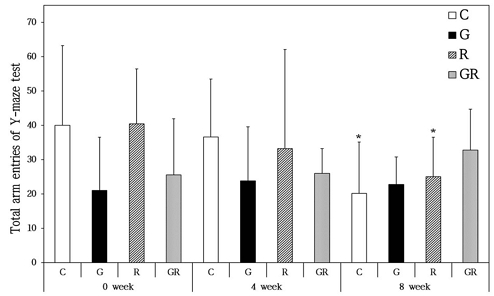
The Effects of Ginseng Radix and Rehmanniae Radix Extracts on APPswe/PSEN1dE9 Mice in the Total Arm Entries for Y-maze Test. C, Control Group; G, Ginseng Group; R, Rehmanniae Group; GR, Ginseng & Rehmanniae Group. * : Mean significantly different between all the experimental groups at p<0.05 by Wilcoxon's signed-ranks test.
실험 후 대조군과 R군에서는 투여 전보다 투여 후 8주째에 변경 횟수(alternation number)가 감소하였으며, 투여 전후를 비교에서 대조군은 통계적으로 유의미한 감소를 나타냈다(p<0.05). 반면, R군은 통계적으로 유의미하지 않았다. G군과 GR군에서는 8주째에 통계적으로 유의미한 변화는 없었으나(Fig. 2), 변경횟수는 증가하는 경향을 보인다.
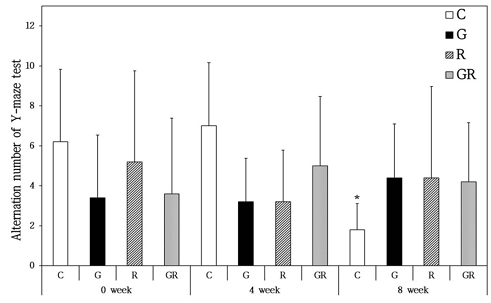
The Effects of Ginseng Radix and Rehmanniae Radix Extracts on APPswe/PSEN1dE9 Mice in the Alternation Number for Y-maze Test. C, Control Group; G, Ginseng Group; R, Rehmanniae Group; GR, Ginseng & Rehmanniae Group. * : Mean significantly different between all the experimental groups at p<0.05 by Wilcoxon's signed-ranks test.
실험 후 대조군에서는 투여 전보다 8주 후 자발적 변경 행동률(spontaneous alternation)이 감소하였으나 유의미한 차이는 없었다. 반면, G군, R군, GR군에서는 투여 전보다 8주에 통계적으로 유의미한 변화는 없었으나(Fig. 3), 자발적 변경 행동률이 증가하여 인지기능이 개선되는 경향을 보였다.
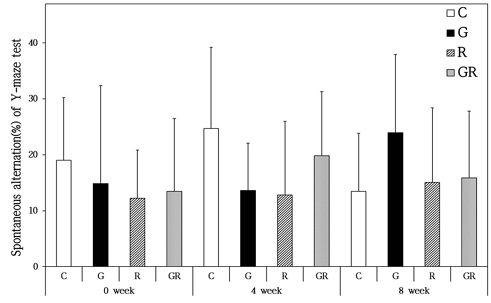
The Effects of Ginseng Radix and Rehmanniae Radix Extracts on APPswe/PSEN1dE9 Mice in the Spontaneous Alternation(%) for Y-maze Test. C, Control Group; G, Ginseng Group; R, Rehmanniae Group; GR, Ginseng & Rehmanniae Group. * : Mean significantly different between all the experimental groups at p<0.05 by Wilcoxon's signed-ranks test.
2. 수동회피실험(Passive avoidance test) 결과
대조군과 모든 실험군에서 최초 학습 후 지연시간이 향상되었으며, 4주와 8주에 G군, R군, GR군 지연시간이 대조군에 비하여 통계적으로 유의미하게 증가되어(p<0.05) 학습과 기억능력이 향상된 것으로 판단된다. 투여 전과 비교한 결과, 대조군, R군과 GR군은 4주에 지연시간이 유의미하게 증가하였으나(p<0.05), 8주는 유의미한 차이를 보이지 않았다. 반면, G군은 4주째와 8주째 모두에서 지연시간이 유의미하게 증가하여(p<0.05), 지속적인 인지기능 개선효과가 나타난 것으로 관찰된다(Fig. 4).
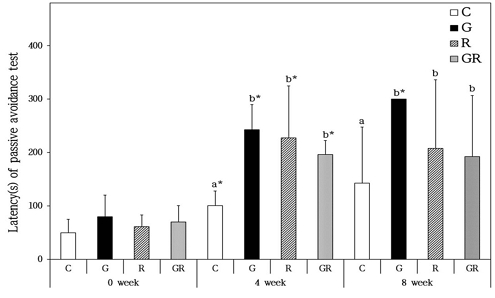
The effects of Ginseng Radix and Rehmanniae Radix extracts on APPswe/PSEN1dE9 mice in the latency(s) for passive avoidance test. C, Control Group; G, Ginseng Group; R, Rehmanniae Group; GR, Ginseng & Rehmanniae Group. Different superscript letter(a,b) mean significantly different between all the experimental groups at p<0.05 by Duncan's multiple range test. * : Mean significantly different between all the experimental groups at p<0.05 by Wilcoxon's signed-ranks test.
3. 혈액학적 분석 결과
실험 종료 후 혈청 성분 분석 결과는 Table 1에 나타내었다. 혈중 glucose 농도는 GR군이 133.38±1.00 mg/㎗로 가장 높고 대조군에서 77.79±1.21 mg/㎗로 가장 낮았다. triglyceride는 대조군에 비해 GR군이 151.77±1.84 mg/㎗로 가장 낮았다. total cholesterol은 R군이 103.05±1.23 mg/㎗로 가장 높고, G군이 92.46±0.47 mg/㎗로 가장 낮았으며, HDL- cholesterol은 GR군이 67.41±0.79 mg/㎗로 가장 높고, G군이 60.06±0.39 mg/㎗로 가장 낮았다. AST는 G군에서 16.05±0.18 mg/㎗로 가장 높고, GR군이 15.59±0.08 mg/㎗로 가장 낮았다.

Blood Analysis Measurement Results(Mean±SD)
실험 종료 후 혈청 내 AChE의 변화는 신경세포 정보전달 및 기억과 학습에 관련된 acetylcholine량을 확인하기 위한 방법이다. 혈중 acetylcholinesterase는 대조군이 231.50±9.47 mU/mL로 가장 높았고 G군, R군, GR군은 각각 140.90±11.83, 130.13±13.99, 137.34±30.36 mU/mL로서 통계적으로 유의미하게 감소한 것은(p<0.05) acetylcholine이 증가되어 기억과 학습능력이 유의미하게 개선된 것으로 판단된다(Fig. 5).
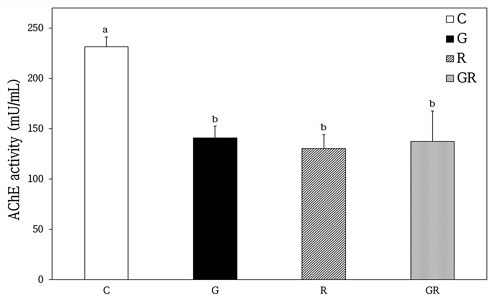
Concentration acetylcholinesterase activity in serum for APPswe/PSEN1dE9 mice. C, Control Group; G, Ginseng Group; R, Rehmanniae Group; GR, Ginseng & Rehmanniae Group. Values are expressed mean ± SD. Different superscript letter(a,b) mean significantly different between all the experimental groups at p<0.05 by Duncan's multiple range test.
4. 뇌조직의 면역조직화학적 염색 결과
(1) anti β-amyloid
실험 종료 후 해마의 β-amyloid의 신경세포 내 변화를 확인하기 위해 면역조직화학적 염색을 실시하였다(Fig. 6). 대조군은 DG에서 강 양성(+++)을, CA1과 PoDG에서 중등 양성(++)을 나타냈다. G군은 CA1, PoDG, DG에서 전체적으로 경도 양성(+)을 나타내었다. R군은 CA1에서만 중등 양성(++)을 나타내고 나머지 부위는 음성(-)이었다. GR군은 CA1, DG에서 중등 양성(++), PoDG 에서는 음성(-)을 나타냈다(Table 2).
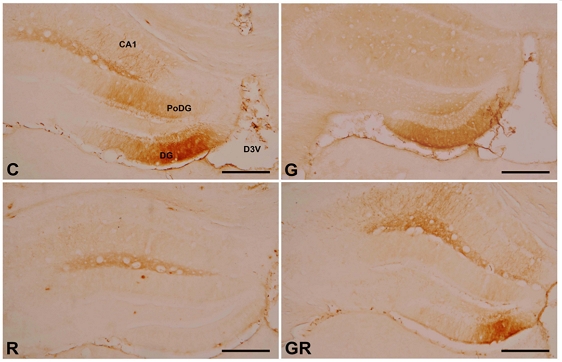
Photomicrograph on expression of β-Amyloid positive cells in the hippocampus of APPswe/PSEN1dE9 mice (β-amyloid immunohistochemistry, ×50), Bar size-300㎛. C, Control Group; G, Ginseng Group; R, Rehmanniae Group; GR, Ginseng & Rehmanniae Group. CA1 : Cornu Ammonis Area 1, D3V : Dorsal 3rd Ventricle DG : Dentate Gyrus, PoDG : Polymorphic layer of the Dentate Gyrus
The Change of β-amyloid Immunoreactive Neurons in Hippocampus of APPswe/PSEN1dE9 Mice
(2) anti Tau-protein
실험 종료 후 해마에서 Tau-protein의 신경세포 내 변화를 확인하기 위해 Tau-protein 항체를 사용하여 면역조직화학적 염색을 실시하였다(Fig. 7). 대조군은 CA2와 CA3에서 강한 양성(+++)을, CA1에서는 경도 양성(+), DG에서는 음성(-)을 보였다. G군은 CA3에서 중등 양성(++)을, CA1과 CA2에서 경도 양성(+), DG에서는 음성(-)을 나타냈다. R군은 CA1, CA2, CA3에서 모두 경도 양성(+)을, DG에서는 음성(-)을 보였다. GR군은 CA1에서만 경도 양성(+)이 관찰되었으며, CA2, CA3, DG에서는 모두 음성(-)을 나타냈다(Table 3).
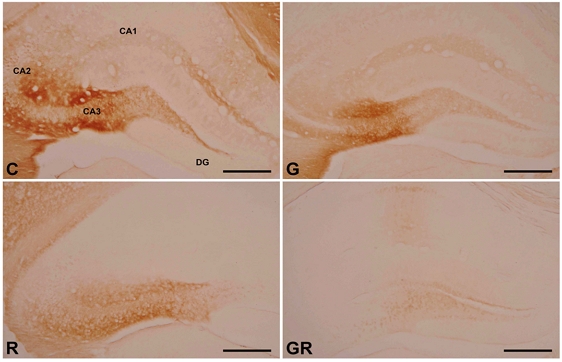
Photomicrograph on expression of Tau-protein positive cells in the hippocampus of APPswe/PSEN1dE9 mice(Tau immunohistochemistry, ×50), Bar size-300㎛. C, Control Group; G, Ginseng Group; R, Rehmanniae Group; GR, Ginseng & Rehmanniae Group. CA1 : Cornu Ammonis Area 1, CA2 : Cornu Ammonis Area 2 CA3 : Cornu Ammonis Area 3, DG : Dentate Gyrus
The Change of Tau-protein Immunoreactive Neurons in Hippocampus of APPswe/PSEN1dE9 Mice
(3) anti CD68
실험 종료 후 해마에서 CD68 미세아교세포 활성화 표지자의 변화를 확인하기 위해 CD68 항체를 이용한 면역조직화학적 염색을 시행하였다(Fig. 8). 대조군은 CA1, PoDG, DG에서 강한 양성(+++)을, CA3에서는 경도 양성(+)을 보였다. G군은 DG에서 중등 양성(++), CA1, CA3, PoDG에서는 모두 경도 양성(+)을 나타내었다. R군은 CA1, CA3, PoDG, DG에서 모두 경도 양성(+)을 보였으며, GR군은 CA1, PoDG, DG에서 중등 양성(++), CA3에서는 경도 양성(+)을 나타냈다(Table 4).
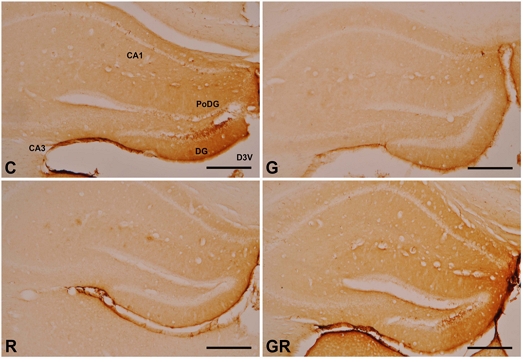
Photomicrograph on expression of CD68-positive cells in the hippocampus of APPswe/PSEN1dE9 mice(CD68 immunohistochemistry, ×50), Bar size-300㎛. C, Control Group; G, Ginseng Group; R, Rehmanniae Group; GR, Ginseng & Rehmanniae Group. CA1 : Cornu Ammonis Area 1, CA3 : Cornu Ammonis Area 3 DG : Dentate Gyrus, PoDG : Polymorphic layer of the Dentate Gyrus D3V : Dorsal 3rd Ventricle
The Change of CD68 Immunoreactive Neurons in Hippocampus of APPswe/PSEN1dE9 Mice
(1) anti β-amyloid
실험 종료 후 해마에서 β-amyloid 단백질 발현량을 확인하기 위해 western blot을 시행하였다(Fig. 9). 대조군은 1.68±0.16로 가장 높은 발현을 보였으며, G군은 1.02±0.09로 가장 낮았다. R군과 GR군은 1.11±0.10, 1.10±0.15를 나타냈으며, 모든 실험군에서 β-amyloid 단백질 발현이 대조군 대비 통계적으로 유의미하게 감소하였다(p<0.05).
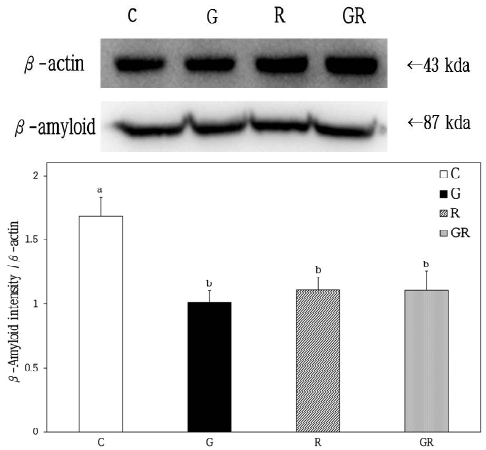
Western blot analysis expression on β-amyloid-positive cells in the hippocampus of APPswe/PSEN1dE9 mice. C, Control Group; G, Ginseng Group; R, Rehmanniae Group; GR, Ginseng & Rehmanniae Group. Different superscript letter(a,b) mean significantly different between all the experimental groups at p<0.05 by Duncan's multiple range test.
(2) anti Tau-protein
실험 종료 후 해마에서 Tau-protein을 확인하기 위해 western blot을 시행하였다(Fig. 10). 대조군은 1.27±0.05로 가장 높은 발현을 보였으며 G군, R군, GR군 순으로 1.06±0.07, 0.86±0.08, 0.71±0.16을 나타내어 모든 실험군들에서 Tau-protein은 대조군과 비교하여 통계적으로 유의미하게 감소하였다(p<0.05).
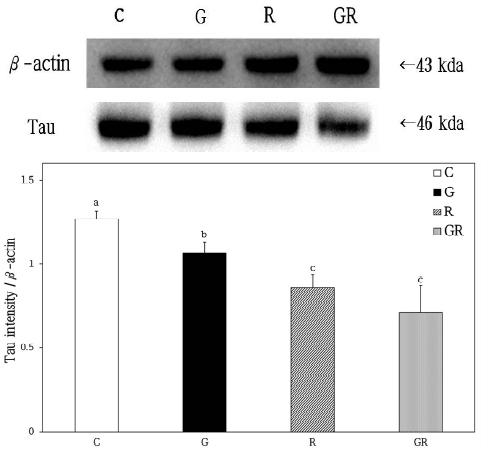
Western blot analysis expression on Tau-protein-positive cells in the hippocampus of APPswe/PSEN1dE9 mice. C, Control Group; G, Ginseng Group; R, Rehmanniae Group; GR, Ginseng & Rehmanniae Group. Different superscript letter(a,b) mean significantly different between all the experimental groups at p<0.05 by Duncan's multiple range test.
고 찰
알츠하이머병은 기억력 감퇴, 인식능력 및 지능의 점진적 퇴화를 특징으로 하는 대표적인 퇴행성 신경질환이다18). AD의 행동 및 정신심리학적 증상은 기억력저하, 언어장애, 지남력 손상과 같은 인지기능장애 및 우울, 망상, 불안, 배회, 공격성 등의 행동을 포함하며, 이는 환자뿐 아니라 보호자에게도 심리적, 경제제적 부담을 초래한다19). 이에 따라 인지기능 개선에 효과적인 천연물 유래 치료제 개발에 대한 관심이 증가하고 있다.
인삼(Panax ginseng C.A. Meyer)은 다년생 식물의 건조근으로20), 사포닌, 폴리아세틸렌, 페놀류, 알칼로이드, 다당체 등 생리활성 물질을 가지고 있고21), 항암, 항산화, 신경보호, 항스트레스, 혈관개선, 면역조절 등 다양한 약리작용이 보고되고 있다22,23).
생지황(Rehmannia glutinosa Gaertn.)은 현삼과(Scrophulariaceae)에 속한 약용식물로 지황의 뿌리이며24). 항산화, 혈당 강하, 자율신경계 조절 등 생리활성 효과에 대한 연구가 진행 증이다25).
기존 연구가 인삼 또는 생지황 단독 투여와 행동실험 중심 평가에 치중한 반면, 본 연구는 치매 동물 모델에서 인삼, 생지황, 혼합물(GR)의 인지기능 개선 효능을 비교하여 AD 질환 치료 가능성을 확인하고자 행동 실험과 분자·세포생물학적 분석을 통합하여 추출물별 개선 효과와 상호 보완 가능성이 있는지를 AD 초기 모델 생쥐에 8주간 투여하고, 인지기능 및 관련 생체지표의 영향을 비교하였다.
기억력 및 인지능력 평가를 위한 행동분석방법26,27) 중에서 이번 연구에서는 Y-미로실험과 수동회피실험을 적용하였다. Y-maze test는 학습 없이 자발적 공간 탐색 행동을 기반으로 단기 기억(short-term memory)과 공간인지 능력(spatial cognition)을 평가하는 실험으로, 자발적 변경 행동률은 공간인지능력의 지표로 간주된다28,29). 이번 실험은 총 입장과 변경 횟수, 자발적 변경 행동률을 주요 분석 지표로 사용하였다.
총 입장 횟수는 투여 4주째에 G군, R군, GR군 모두 대조군보다 감소하였으나, 8주째에는 G군, R군, GR군 모두 대조군보다 증가하였다. 투여 전과 8주 후 비교 시, 대조군과 R군에서 통계적으로 유의미한 차이를 나타내었다(p<0.05). 이는 AD 환자는 동기결여 및 쾌감손실을 특징으로 하는 우울증을 동반하며30,31), 이에 따라 대조군에서 신체활동이 감소해 총 입장횟수가 줄어들었으나 투여군들은 유의미하지는 않지만 증가하는 경향을 보였다.
변경횟수는 4주째에 모든 실험군 G군, R군, GR군에서 대조군보다 감소하였으나, 8주째는 모두 증가하였다. 투여 전과 8주 후 비교 시 대조군에서 유의미한 변화(p<0.05)가 나타났다. 자발적 변경 행동률은 4주째에는 대조군보다 감소하였고, 8주째에는 증가하는 경향을 보였으나, 투여 전후 비교에서는 통계적으로 유의미한 차이가 없었다. 그리고 G군에서 자발적 변경 행동률은 증가 하였으나, 8주 투여 후 개선 효과는 유의미한 수준에 도달하지 못하였다.
수동회피실험은 생쥐의 장기기억능력을 평가하는 대표적인 방법으로32), 해마에서의 조건화된 기억과 변연계 관련 기억을 측정하는데 주로 활용된다33). 본 실험에서 G군, R군, GR군은 투여 4주 및 8주 시점 모두에서 대조군 대비 유의미하게 지연시간이 증가하였다(p<0.05). 이 결과는 인삼 투여 시 학습 효과가 향상되었다는 기존 연구와 일치하며34), 인삼의 8주 투여가 학습 및 기억능력의 긍정적 변화로 시사한다. 행동실험을 종합하면, R군은 공간 기억과 탐색 행동 측면에서, G군은 회피학습 및 장기 기억 측면에서 각각 의미 있는 효과를 보였으며, GR군은 단독보다 특별한 상승효과를 나타내지 않았지만, 이러한 결과는 각 추출물이 인지 기능의 특정 영역에 선택적으로 작용할 가능성을 시사하며, 행동실험별 특성에 따른 해석이 필요함을 보여준다.
혈중 성분 결과는, R군과 GR군의 total cholesterol가 대조군보다 높았으며, 이는 HDL cholesterol의 증가에 기안한 것으로 판단된다. 또한 혈청 내 ACh 변화는 G군, R군, GR군에서 모두 감소하여 대조군에 비해 유의미한 억제 효과가 나타났다(p<0.05). 이는 AChE 억제를 통해 acethylcholine 농도를 증가시키고, 손상된 콜린성 신경전달을 개선하여 AD 진행을 지연시키는데 효과적임을 시사한다35-37). 이는 행동 실험에서 인삼은 인지 기능과 기억력 개선 효과, 생지황은 AChE 억제와 신경조직 보호 효과를 보여, 두 추출물이 해마와 전두엽의 시냅스 가소성 증진, 항산화, 효소 억제 및 세포 보호 등 서로 다른 경로를 통해 작용할 가능성을 시사한다. 이러한 효과는 인삼의 진세노사이드(Rb₁, Rg₁, Re)와 다당체가 β-amyloid 축적 억제, 신경 보호, 항산화 및 항염 작용을 통해 인지 기능 개선에 기여하는 것과, 생지황의 catalpol 등 아이리도이드 배당체가 AChE 억제와 신경 보호, 항산화 및 항염 작용을 통해 유사한 효과를 나타내는 것과 일치한다.
AD발병 기전은 아직 명확하지 않으나, β-amyloid protein 침착에 따른 amyloid plaques 형성, Tau-portein 축적, 산화적 손상, acetylcholine 감소 등이 주요 원인으로 제시되고 있다38-40). 또한 뇌 특정 부위의 신경세포(neuron) 소실로 인한 미세아교세포(microglial cell) 활성화는 세포사멸을 유도하며, 이로 인해 CD68과 같은 염증 관련 표지자가 증가한다41). AD는 뇌의 기억과 관련된 해마에서 시작되며, 해마는 치상회와 암몬각 두 신경세포층이 겹쳐져 있는 형태이다. 4개의 암몬각에서 cornu Ammonis 1(CA1) 세포층과 cornu Ammonis 3(CA3)세포층은 최근 기억 형성과 관련이 깊어 해마의 시냅스 가소성 연구에 널리 이용되고 있다42).
AD 생쥐 해마의 면역조직화학적 염색을 반정량적 분석한 결과, β-amyloid는 대조군에서 가장 강하게 +7 발현되었으며, R군, G군 GR군은 +2, +3, +4 순으로 나타났다. Tau-protein은 대조군에서 +7로 가장 강하게, GR군, R군, G군은 +1, +3, +4의 수준을 보였다. CD68은 대조군에서 +10으로 강하게 나타났으며, R군, G군, GR군은 +4, +5, +7로 나타났는데 이는 R군과 G군에서 미세아교세포의 활성 감소와 염증반응 완화 효과를 나타내었다. 또한 해마의 β-amyloid, Tau-protein의 신경세포 내 변화를 western blot으로 정량한 결과, β-amyloid는 G군, R군, GR군에서 각각 60.7 %, 66.1 %, 65.5 %로, Tau-protein은 각각 83.5 %, 67.7 %, 55.9 %로 대조군 대비 유의미하게 감소하였다(p<0.05). Tau-protein의 감소 양상은 위의 면역조직화학적 염색 결과와도 유사하였다. AD 관련 지표인 β-amyloid, Tau-protein, CD68의 면역조직화학적 분석 결과, 모든 실험군에서 대조군보다 GR군, G군, R군 순으로 발현이 약하게 감소하였다. 이는 AChE의 활성 측정 결과와도 유사하며, R군, GR군, G군, C군 순으로 뇌 신경세포의 손상이 적었음을 시사한다.
선행 연구들과 본 실험 결과를 비교한 결과, AD 모델 생쥐에서 인삼 및 생지황 추출물이 행동분석과 면역조직화학적 분석을 통해 기억력과 인지기능 향상, β-amyloid, Tau-protein, CD68, AChE 활성 등의 AD 관련 지표를 감소시키는 경향이 있는 것으로 나타났다.
이러한 결과는 인삼과 생지황의 고농도로 장기 투여 시 AD 치료에 일정한 가능성을 시사하는 것으로 보이며, 기억력과 인지기능 개선 관련 기능성물질로서 추가적인 검증 연구가 필요하다.
결 론
본 연구는 알츠하이머 모델 생쥐에 인삼, 생지황 및 혼합 에탄올 추출물을 8주간 투여하여 기억력 및 인지기능 개선 효과를 확인하는 실험으로 다음과 같은 결론에 도달하였다.
행동분석을 통해 인삼과 생지황이 AD로 인한 장·단기 기억력과 인지기능 저하를 개선하는데 긍정적 효과가 있었으며, 특히 인삼이 상대적으로 두드러질 수 있음을 시사한다.
AChE 분석 결과, 인삼과 생지황은 AChE의 농도를 감소시켜 ACh 분해를 억제함으로써 AD 진행 지연과 관련될 가능성이 관찰되었다.
면역조직화학적 분석 결과로, AD 관련 유발물질인 β-amyloid, Tau-protein은 생지황 및 인삼과 생지황 혼합물 투여 시 염색 강도가 감소하였고, 염증지표인 CD68은 생지황 투여군에서 감소 가능성이 관찰되었다.
Western blot의 결과에서는 β-amyloid와 Tau-protein의 단백질 발현이 인삼 및 혼합물 투여 시 유의하게 억제되었다.
다만, 여러 용량의 약물약동학·분포, 용량-반응·시간경과 등의 확인도 부족하였으며, 후속 연구에서는 장기·용량 반응 평가, 병용 투여 상호작용 분석 등을 포함한 검토가 요구된다.
위 결과로, 인삼과 생지황 투여는 인지기능 개선 및 AD 관련 병리인자 개선에 긍정적 경향을 보였으며, 인지기능 개선은 인삼 투여 시 비교적 뚜렷한 경향을 보였으며, AChE 활성 분석과 면역조직화학적 결과는 생지황이 인지기능 개선에 일정 부분 기여할 가능성을 시사하였다.
References
- Statistics Korea. Future Population Projections for Korea: 2022–2072. 2023.
-
Kim KN, Bae HS, Hwang WW, Cho SH. Study on the application of oriental medical evaluation to dementia. J of Orient. Neuropsychiatry. 2014:25(4):383-8.
[https://doi.org/10.7231/jon.2014.25.4.383]

-
Park MS, Kim YM. Study on syndrome differentiation of dementia. Korean J. Orient. Physiol. Pathol. 2014:28(3):251-62.
[https://doi.org/10.15188/kjopp.2014.06.28.3.251]
-
Goedert M, Spillantini MG. A century of Alzheimer’s disease. Science. 2006: 314(5800):777-81.
[https://doi.org/10.1126/science.1132814]
-
Qaseem A, Snow V, Cross JT J, Forciea MA, Hopkins R, Shekelle P, Adelman A, Mehr D, Schellhase D, Campos-Outcalt D, Santaguida D, Owens DK. Current pharmacologic treatment of dementia: a clinical practice guideline from the American college of physicians and the American academy of family physicians. Ann Intern Med. 2008: 148(5):370-8.
[https://doi.org/10.7326/0003-4819-148-5-200803040-00008]
-
Kuhl DE, Koeppe RA, Minoshima S, Snyder SE, Ficaro EP, Foster NL, Frey KA, Kilbourn MR. In vivo mapping of cerebral acetylcholinesterase activity in aging and Alzheimer's disease. Neurology. 1999: 52(4):691-9.
[https://doi.org/10.1212/WNL.52.4.691]
- Oh SG. Neurotransmitters and brain disease. Seoul: sin-ilsangsa, 2005:456-64.
-
Giacobini E. Present and future of Alzheimer therapy. J Neural Transm Suppl. 2000:59:231-42.
[https://doi.org/10.1007/978-3-7091-6781-6_24]
- Shin HS. Inhibitory Effects of tacrine derivatives on activity of prostanoids biosynthesis, prostaglandin biosynthesis: a potential use for degenerative brain disease treatment. Yakhak Hoeji. 2005:49(1):103-8.
- Han DY, Park NE, Kim SH, Chung DK. The effect of oral administration of herbal medicines on memory in Alzheimer's disease animal models: a review of animal study reports published in Korea. J Orient. Neuropsychiatry. 2017:28(4):359-37.
- Kim, SH. A Comparative study on behavior analysis and biological factors in Alzheimer’s disease mice(APPswe/PSEN1dE9) treated with Ginseng and Rehmannia glutinosa extracts. Doctoral dissertation. Woosuk University. 2018.2-4.
-
Sarter M, Bodexutz G, Stephens DN. Attenuation of scopolamine-induced impairment of spontaneous altermation behavior by antagonist but not inverse agonist and beta-carboline. Psycopharmacology. 1998:94(4):491-5.
[https://doi.org/10.1007/BF00212843]
-
Shahidi S, Motamedi F, Bakeshloo SA, Taleghani BK. The effect of reversible inactivation of the supramammillary nucleus on passive avoidance learning in rats. Behav. Brain Res. 2004:152(1):81-7.
[https://doi.org/10.1016/j.bbr.2003.09.033]
- Seo JH, Woo SY, Kim YT, Kim MY, Park YM, Jin ZH, Bu YM, Kim HC. Enhancing effect of multiherb extracts HT008-1 on memory and cognitive function. Kor. J. Herbology. 2007:22(4):51-8.
-
Hsu SM, Raine L, Fanger H. Use of avidin-biotin-peroxidase comlpex(ABC) in immunoperoxidase techniques: a comparison between ABC and unlabeled antibody(PAP) procedures. The Journal of Histochemistry and Cytochemistry. 1981:29(4):577-80.
[https://doi.org/10.1177/29.4.6166661]
-
Burnette WN. “Western blotting”: Electrophoretic transfer of proteins from sodium dodecyl sulfate-polyacrylamide gels to unmodified nitrocellulose and radiographic detection with antibody and radioiodinated protein A. Anal Biochem. 1981:112(2):195-203.
[https://doi.org/10.1016/0003-2697(81)90281-5]
-
Towbin H, Staehelin T, Gordon J. Electrophoretic transfer of proteins from polyacrylamide gels to nitro-cellulose sheets: procedure and some applications. Proc Natl Acad Sci USA. 1979:76(9):4350-4.
[https://doi.org/10.1073/pnas.76.9.4350]
-
Goedert M, Spillantini MG. A century of Alzheimer’s disease. Science. 2006:314(5800):777-81.
[https://doi.org/10.1126/science.1132814]
-
Cerejeira J, Lagarto L, Mukaetova-Ladinska EB. Behavioral and psychological symptoms of dementia. Front Neurol. 2012:3:1-21.
[https://doi.org/10.3389/fneur.2012.00073]
-
Ha DC, Ryu GH. Chemical components of red, white and extruded root ginseng. J Korea Soc Food Sci Nutr. 2005:34:247-54.
[https://doi.org/10.3746/jkfn.2005.34.2.247]
- Park CK, Jeon BS, Yang JW. The chemical components of Korean Ginseng. Food Industry and Nutrition. 2003:8:10-24.
- Park HJ, Son CG. Systematic analysis of Ginseng-focused research worldwide. J Korean Oriental Med. 2008:29(1):60-6.
-
Lee MH, Choi SW, Kim EJ. Differential anti-carcinogenic effect of mountain cultivated Ginseng and Ginseng on mouse skin carcinogenesis. J Korean Soc Food Sci Nutr. 2012:41(4):462-70.
[https://doi.org/10.3746/jkfn.2012.41.4.462]
- Park NK, Kim SL, Hur HS, Park CH. Development of R. radix preparata with new variety "Jiwhang1". Korean J. Int. Agric. 2002:14:3-39.
- Kim SH, Yook TH, Kim JU. Rehmanniae Radix, an effective treatment for patients with various inflammatory and metabolic diseases: results from a review of korean publications. J. Pharmacopunct. 2017:20(2):81-8.
- Wang SB, Ahn EM, Jung JW. The fruits of Crataegus pinnatifida bunge ameliorates learning and memory impairments induced by scopolamine. Kor. J. Herbology. 2009: 24(4):165-71.
- Han JS. Memory tests in animals. Dementia and neurocognitive disorders. 2004:3:77-81.
-
Chudasama Y, Dalley JW, Nathwani F, Bouger P, Robbins TW. Cholinergic modulation of visual attention and working memory: dissociable effects of basal forebrain 192-IgG-saporin lesions and intraprefrontal Infusions of scopolamine. Learn Mem. 2004:11(1):78-86.
[https://doi.org/10.1101/lm.70904]
-
Dellu F, Mayo W, Cherkaoui J, Le Moal M, Simon H. A two-trial memory task with automated recording: study in young and aged rats. Brain Res. 1992:588(1):132-9.
[https://doi.org/10.1016/0006-8993(92)91352-F]
-
Jang YJ, Kim MJ, Moon YK , Lim SW, Kim DK. Changes in dementia risk along with onset age of depression: a longitudinal cohort study of elderly depressed patients. BMC Psychiatry. 2025:(25):247.
[https://doi.org/10.1186/s12888-025-06683-w]
- Kimmy Maguire, Maureen Cranley, Ronald W. Grossberg. Managing Symptoms of Depression, Apathy, Psychosis, and Agitation in People Living with Alzheimer Disease. Practical Neurology 2025:7-12
-
Van der Zee EA, Biemans BA, Gerkema MP, Daan S. Habituation to a test apparatus during associative learning is sufficient to enhance muscarinic acetycholine receptor-immunoreactivity in rat suprachiasmatic nucleus. J Neurosci Res. 2004:78(4):508-19.
[https://doi.org/10.1002/jnr.20300]
-
Lozenzini CA, Baldi E, Bucherelli C, Sacchetti B, Tassoni G. Role of dorsal hippocampus in acquisition, consolidation and retrieval of rat's passive avoidance response: a tetrodotoxin functional inactivation study. Brain Research. 1996:730(1-2):32-9.
[https://doi.org/10.1016/0006-8993(96)00427-1]
-
Park KC, Jin Hui, Renhua Zheng, SH Kim, Lee SE. Cognition enhancing effect of panax ginseng in Korean volunteers with mild cognitive impairment: a randomized, double-blind, placebo-controlled clinical trial. Transl Clin Pharmacol. 2019;27(3):92-7.
[https://doi.org/10.12793/tcp.2019.27.3.92]
-
Jifa Zhang, Yinglu Zhang, Jiaxing Wang, Yilin Xia, Jiaxian Zhang, Lei Chen. Recent advances in Alzheimer’s disease: mechanisms, clinical trials and new drug development strategies. Signal Transduction and Targeted Therapy. 2024:(9):211.
[https://doi.org/10.1038/s41392-024-01911-3]
-
Park CH, Kim SH, Choi W, Lee YJ, Kim JS, Kang SS, Suh YH. Novel anticholinesterase and antiamnesic activities of dehydroevodiamine, a constituent of Evodia rutaecarpa. Planta Med. 1996:62:405-9.
[https://doi.org/10.1055/s-2006-957926]
-
Maryam N. Alnasser, Ghadir M. Alboraiy, Eman M. Alsowig, Fatimah M. Alqattan. Cholinesterase Inhibitors from Plants and Their Potential in Alzheimer’s Treatment: Systematic Review. Brain Sciences. 2025:15(2):1-32
[https://doi.org/10.3390/brainsci15020215]
-
Zheng Qiuyang, Wang Xin. Alzheimer's disease: insights into pathology, molecular mechanisms, and therapeutic strategies. Protein & Cell. 2025:16(2):83-120.
[https://doi.org/10.1093/procel/pwae026]
-
Fayuk D, Yakel JL. Regulation of nicotinic acetylcholine receptor channel function by acetylcholinesterase inhibitors in rat hippocampal CA1 interneurons. Molecular Pharmacol. 2004:66(3):658-66.
[https://doi.org/10.1124/mol.104.000042]
-
Watanabe T, Yamagata N, Takasaki T, Sano K, Hayakawa K, Katsurabayashi S, Egashira N, Mishima K, Iwasaki K, Fujiwara M. Decreased acetylcholine release is correlated to memory impairment in the Tg2576 transgenic mouse model of Alzheimer's disease. Brain Res. 2009:1249:222-8.
[https://doi.org/10.1016/j.brainres.2008.10.029]
-
Fukuyama R, Izumoto T, Fushiki S. The cerebrospinal fluid level of glial fibrillary acidic protein is increased in cerebrospinal fluid from Alzheimer's disease patients and correlates with severity of dementia. European Neurology. 2001:46(1):35-8.
[https://doi.org/10.1159/000050753]
-
Fukutani Y, Cairns NJ, Shiozawa M, Sasaki K, Sudo S, Isaki K, Lantos PL. Neuronal loss and neurofibrillary degeneration in the hippocampal cortex in late-onset sporadic Alzheimer's disease. Psychiatry Clin. Neurosci. 2000:54(5):523-9.
[https://doi.org/10.1046/j.1440-1819.2000.00747.x]