
Dual Role of Tanshinone IIA on the Differentiation and Function of Bone Cells: Regulation of Ca2+-oscillation in Osteoclasts
Ⓒ The Society of Pathology in Korean Medicine, The Physiological Society of Korean Medicine
Abstract
Tanshinone IIA (TIIA), known as a major constituent of Salvia miltiorrhiza Bunge, exhibits anti-inflammatory and anti-osteoporotic activities. In this study, we investigated the effects of TIIA and its regulatory mechanism on osteoclast and osteoblast differentiation. TIIA significantly inhibited the formation of TRAP(+)-mature osteoclasts and resorption pits in a dose-dependent manner. The expression of the osteoclast differentiation marker genes and activation of JNK, p38, and IκB were remarkably suppressed by TIIA during osteoclastogenesis. In addition, TIIA removed RANKL-induced Ca2+ oscillations through sequential inactivation of Bruton's tyrosine kinase (BTK) and phospholipase C gamma (PLCγ1 and 2). Consequently, the expression of pivotal transcription factors in osteoclastogenesis, c-Fos and nuclear factor of activated T-cells cytoplasmic 1 (Nfatc1), was remarkably decreased. By contrast, TIIA stimulated the expression of osteoblast differentiation markers and transcription factors including Runx2, resulting in increased nodule formation. Interestingly, TIIA dose-dependently suppressed osteoclast formation in coculture with bone marrow cells (BMs) and osteoblasts via inhibiting the expression of Rankl and Csf-1 (M-csf) on osteoblasts. These findings indicate that TIIA serves as a dual modulator of bone remodeling, suppressing osteoclast-mediated resorption while enhancing osteoblast-mediated formation, thereby supporting its potential as a therapeutic candidate for resorptive bone diseases.
Keywords:
Tanshinone IIA, Osteoclast, Osteoblast, Bone diseases, DifferentiationIntroduction
Osteoclasts, responsible for bone matrix resorption, are essential for maintaining bone remodeling and homeostasis. They originate from bone marrow-derived precursors in response to stimulation by receptor activator of nuclear factor-κB ligand (RANKL) and macrophage colony-stimulating factor (M-CSF). In contrast, osteoblasts are bone-forming cells that produce organic matrix components such as collagen and modulate osteoclastogenesis by expressing RANKL, M-CSF, and osteoprotegerin (OPG). RANKL, produced mainly by osteoblasts, binds to its receptor RANK on osteoclast precursors, initiating both canonical and costimulatory signaling pathways1,2). In the canonical pathway, RANK recruits TNF receptor-associated factor 6 (TRAF6), which activates mitogen-activated protein kinases (MAPKs) and promotes the expression of activator protein-1 (AP-1) components like c-Fos, as well as the NF-κB pathway, ultimately leading to the activation of NFATc1, the key transcription factor for osteoclast differentiation. In the costimulatory pathway, immunoreceptor tyrosine-based activation motif (ITAM)-containing adaptors such as FcRγ and DAP12 activate Bruton's tyrosine kinase (BTK) and phospholipase Cγ (PLCγ), resulting in intracellular Ca²⁺ oscillations that further enhance NFATc1 expression3).
In recent years, the pharmacological modulation of osteoclast and osteoblast activity has gained increasing attention for the treatment of skeletal disorders such as osteoporosis, osteoarthritis, and periodontitis. Natural compounds from traditional medicinal plants have emerged as attractive candidates due to their multifaceted biological activities and relatively favorable safety profiles4). Among these, Tanshinone IIA (TIIA), a bioactive lipophilic compound isolated from the roots of Salvia miltiorrhiza Bunge (Danshen), has demonstrated broad pharmacological effects, including anti-inflammatory, antioxidant, anti-proliferative, and cardio- and neuroprotective properties5-7). Previous studies have shown that TIIA suppresses the expression of pro-inflammatory cytokines such as IL-1β, IL-6, and TNF-α in an estrogen receptor-dependent manner and inhibits the NF-κB signaling pathway through suppression of MAPKs in LPS-stimulated macrophages8,9). TIIA has also been shown to attenuate oxidative stress by modulating antioxidant enzymes including superoxide dismutase (SOD), catalase, and glutathione peroxidase (GPx), thereby exerting cytoprotective effects in various cellular contexts10,11). TIIA has been widely reported as a promising therapeutic candidate for metabolic bone diseases, owing to its dual regulatory actions on osteoclasts and osteoblasts. TIIA has been shown to inhibit osteoclastogenesis by targeting the RANKL-induced signaling cascade, suppressing the activation of NF-κB, ERK, and Akt pathways, and down-regulating the expression of key osteoclastogenic transcription factors such as c-Fos and NFATc1, thereby impairing osteoclast differentiation and bone resorption activity12,13). Moreover, TIIA reduces actin ring formation and the expression of osteoclast-specific markers, including calcitonin receptor and integrin β3, further diminishing osteoclastic bone-resorptive function. Concomitantly, TIIA enhances osteoblast differentiation and survival through multiple mechanisms. It activates ERK1/2-Runx2 signaling in periodontal ligament stem cells and synergizes with BMP-2-induced osteogenesis by promoting p38 and Smad-dependent transcriptional activation of Runx2 in mesenchymal progenitor cells14,15). Additionally, TIIA inhibits cyclooxygenase-2 (COX-2) and prostaglandin E2 synthesis in osteoblasts, mitigating inflammation-induced bone loss16). In vivo studies corroborate these findings, demonstrating that TIIA administration enhances bone mass, collagen content, and biomechanical strength in osteoporotic mouse models, while reducing osteoblast apoptosis and oxidative damage via NF-κB pathway suppression17). Collectively, these findings indicate that TIIA may be a promising therapeutic agent for bone-degenerative diseases, including osteoporosis, rheumatoid arthritis, and periodontitis18). Although emerging reports suggest that TIIA may exert protective effects against bone loss by modulating osteoclast and osteoblast functions. However, the underlying molecular mechanisms, particularly regarding RANKL-mediated signaling pathways including Ca²⁺ oscillations and the transcriptional regulation of osteoclastogenesis, have not been fully elucidated.
In this study, we investigated the effects of TIIA on both osteoclast and osteoblast differentiation and function using in vitro models. We focused on dissecting the costimulatory (BTK/PLCγ/Ca²⁺ oscillations) signaling pathways as well as canonical (MAPKs and NF-κB) pathways in osteoclast precursors, and examined TIIA’s effect on osteoblast-mediated osteoclastogenesis in coculture systems. Furthermore, we assessed TIIA’s anabolic effects on osteoblast differentiation by analyzing key transcription factors and matrix protein expression. Our findings provide new evidence that TIIA acts as a dual-action regulator of bone remodeling and support its therapeutic potential for bone-resorptive diseases.
Materials and Methods
1. Experimental animals and reagents
We used the C57BL/6N mice which were purchased from Orient Bio Inc. (Seungnam, Korea) for preparing bone marrow-derived osteoclast precursors and stromal cells (BMSCs) in this study. All experiments using mice were performed following the protocol (WKU19-17) approved by the Animal Care and Use Committee of Wonkwang University. All agents used for cell culture were purchased from HyClone (Rockford, IL, USA). Soluble recombinant mouse RANKL and recombinant human macrophage colony-stimulating factor (M-CSF) were provided by T. Kim (KIOM, Daejeon, Korea). Tanshinone IIA (TIIA, Cat. # T4952) was purchased from Sigma-Aldrich (Seoul, Korea) and dissolved in dimethyl sulfoxide (DMSO, Sigma-Aldrich) to prepare a stock solution. All antibodies against proteins used in this study were purchased from conventional vendors which were previously described19).
2. Assessment of cell viability
Cell viability was measured by using EZ-Cytox enhanced cell viability assay kit (Itsbio, Korea), following the manufacturer’s protocol. Bone marrow cells (BMs) prepared from the tibiae and femora of 6∼8 weeks-old C57BL/6N mice were cultured to produce adherent bone marrow-derived macrophages (BMMs) in α-minimal essential medium (α-MEM) supplemented with 10% FBS and M-CSF (30 ng/mL) for 3 days. BMMs were seeded with various TIIA (0, 0.2, 0.5, 1, 2, 5 and 10 μg/mL) concentrations in 96-well culture plates at a density of 1 × 10⁴ cells/well and were cultured for 3 days with M-CSF (30 ng/mL), or alternatively, BMMs were cultured with 5 μg/mL TIIA under M-CSF treatment for 4 days. For osteoblasts, calvaria-derived primary osteoblasts (2 × 10⁴ cells/well) plated in 96-well culture plate were cultured with various TIIA (0, 0.5, 1, 2, and 5 μg/mL) concentrations in osteogenic media containing L-ascorbic acid (50 μg/mL) and 10 mM β-glycerophosphate for 28 days. The EZ-Cytoxreagent was added to cultured cells for 4 h at 37°C, following the manufacturer's protocol at indicated culture days. Absorbance was measured at 450 nm using a Sunrise™ enzyme-linked immunoassay (ELISA) plate reader (Tecan, Switzerland).
3. In vitro osteoclast culture, actin ring, and pit formation
Osteoclast differentiation and formation were performed as previously described19). For in vitro stromal cell-free osteoclastogenesis, BMMs were cultured at various TIIA (0, 0.2, 0.5, 1,2, and 5 μg/mL) concentrations under the presence of M-CSF (30 ng/mL) and RANKL (100 ng/mL) for 4 days with replacing media on day 3. For cocultures to generate osteoclasts, BMs in 96-well plates (1 × 10⁵ cells/well) were cocultured with preosteoblastic calvaria cells (1 × 10⁴ cells/well) in α-MEM containing 50 nM 1α,25-(OH)2D3 supplemented with or without TIIA (0, 0.2, 0.5, 1,2, and 5 μg/mL) for 7 days. Fresh media with or without TIIA was replaced every 3 days. As previously described19), cells fixed with 10% formalin and permeabilized with EtOH/Acetone (1:1) were stained with rhodamine-phalloidin from Molecular Probes (Eugene, OR, USA) to label the F-actin ring, and sequentially followed by tartrate-resistant acid phosphatase (TRAP) solution assay to measure TRAP activity at the absorbance of 405 nm using ρ-nitrophenyl phosphate (Sigma-Aldrich, Seoul, Korea) and TRAP staining assay to assess the formation of TRAP-positive multinucleated cells (TRAP(+)-MNCs, ≥3 nuclei). To examine bone resorptive activity of osteoclasts, BMMs were plated on a Cosmo Bio 48-well bone resorption assay plate (Tokyo, Japan) and cultured with/without TIIA (5 μg/mL) under M-CSF and RANKL treatment for 7 days. The resorption pit area was cleared using bleach and analyzed using Image J software (NIH 1.52).
4. In vitro osteoblast differentiation
Assessment of osteoblast differentiation including measurement of alkaline phosphatase (ALP) activity and nodule formation was done as previously described20). In brief, primary calvaria-derived osteoblast cells were cultured to confluence in 24-well culture plates with osteogenic medium (MEM-α supplemented with 10% FBS, 10 mM β-glycerophosphate, and 50 μg/mL of L-ascorbic acid) for indicated periods. The osteogenic medium containing TIIA (0.5 μg/mL) or not was replaced every 3 days. For measurement of ALP activity, cultured cells were washed twice with Tris-buffered saline (TBS) and followed by staining with an ALP substrate mixture (BCIP and NBT) for 10 min. To assess mineralized nodule formation, preosteoblastic calvaria cells were cultured for indicated periods, and then cells were washed twice with TBS. The cells were then stained with alizarin red S (10 mg/mL) for 10 to 20 min at room temperature. After washing with distilled water and air-drying, the stained cells were detected under light microscopy.
5. Real-time quantitative PCR
Real-time PCR was performed to assess osteoclast or osteoblast differentiation as shown previously20). Briefly, for osteoclasts, BMMs were cultured in α-MEM supplemented with 10% FBS under M-CSF (30 ng/mL) and RANKL (100 ng/mL) treatment for 4 days containing with or without TIIA (5 μg/mL). For osteoblasts, preosteoblastic calvarial cells were cultured in osteogenic medium for 24 days with or without TIIA (0.5 μg/mL) treatment. Additionally, calvaria-derived osteoblasts (7 × 10⁴ cells/well) were cultured in a 24-well culture plate with 50 nM 1α,25-(OH)2D3 for 7 days in the presence or absence of TIIA (2 μg/mL). Total RNA was extracted using TRIzol reagent (Invitrogen, Carlsbad, CA, USA) from the cultured cell at the indicated time points. One microgram of total RNA was transcribed to the first-strand cDNA, following the manufacturer's instructions, by Maxima reverse transcriptase from Thermo Scientific (Seoul, Korea) with random primers. The VeriQuest SYBR Green qPCR Master mix from Affymetrix (Santa Clara, CA, USA) was used for a real-time PCR operated by StepOnePlus™ Real-Time PCR Systems from Applied Biosystems (Forster City, CA, USA). Normalization of all results from real-time PCR was performed with that of glyceraldehyde 3-phosphate dehydrogenase (Gapdh). The primers used in this study were listed in Table 1.

The nucleotide sequences of primers used in this study.
6. Western blot analyses
BMMs were cultured with or without TIIA (5 μg/mL) under M-CSF (30 ng/mL) and RANKL (100 ng/mL) treatment for the indicated times. For measurement of short-term intracellular signaling, BMMs supplemented with M-CSF (30 ng/mL) were pretreated with TIIA (5 μg/mL) for 2 h, and then stimulated with RANKL (100 ng/mL). After washing with cold PBS, the cells were lysed with radioimmunoprecipitation assay (RIPA) buffer (25 mM Tris-HCl, pH 7.6, 150 mM NaCl, 1% NP-40, 1% sodium deoxycholate, and 0.1% sodium dodecyl sulfate (SDS)) containing 1 mM phenylmethylsulfonyl fluoride (PMSF), protease inhibitor cocktail (Roche, Mannheim, Germany), and phosphatase inhibitor tablets (Thermo Scientific, Seoul, Korea). The supernatant (cell lysate) was harvested by centrifugation at 14,000×g for 10 min at 4°C for immunoblotting. SDS-polyacrylamide gel electrophoresis (SDS-PAGE) was performed with total cell lysate (30 μg) and then the proteins were transferred to polyvinylidene difluoride (PVDF) membranes (Amersham Hybond-P, GE-Healthcare Life Science, USA). Blotted membrane was blocked with 5% skim milk in Tris-buffered saline with Tween 20 (TBST; 50 mM Tris-HCl, pH 7.6, 150 mM NaCl, and 0.1% Tween-20) for 2 h, and then the primary antibody (1:1000 dilution) and the secondary antibody (HRP-conjugated IgG, 1:5000 dilution) in TBST were sequentially treated. The enhanced chemiluminescence (ECL) detection system (Thermo Scientific, USA) according to the manufacturer’s instructions was used to detect immunoreactive proteins. The detected proteins were quantitated using Image J software (NIH 1.52).
7. Measurement of Intracellular Ca2+ concentration ([Ca2+]i)
To assess the effect of TIIA on Ca2+-modulation, [Ca2+]i was determined by using the fluorescent Ca2+ indicator (Fura-2, AM) as previously described19). To induce osteoclast differentiation, BMMs were cultured on coverslips under RANKL (100 ng/mL) treatment for 24 h. Then, Fura-2 (5 μM) was added into cell culture for 50 min at 37°C. After reaction, unloaded fura-2 was washed out by continuous perfusion of HEPES-buffered medium (10 mM HEPES, pH 7.4, 140 mM NaCl, 5 mM KCl, 1 mM MgCl2, 1 mM CaCl2, and 10 mM glucose). TIIA (5 μg/mL) diluted in HEPES-buffered medium was rapidly treated on cells for specific times. Fura-2 in the cells was excited with dual wavelengths (340 and 380 nm), and the emitted wavelength (510 nm) was captured using a CCD camera. Captured images were digitized and presented as F340/380 ratio. MetaFluor software (Molecular Devices, Downingtown, PA, USA) was used to analyze captured images.
8. Statistical Analyses
Data in this study were analyzed using the Student’s t-test, and are presented as mean ± SD. A p-value <0.05 was considered statistically significant. All experiments were repeated at least twice, and representative data are shown.
Results
1. Analysis of the effect of TIIA on cell viability and osteoclastogenesis
Prior to assessing the effect on osteoclastogenesis, the cytotoxicity of TIIA on osteoclast precursors (BMMs) had been examined. When BMMs in the presence of M-CSF were cultured with various TIIA concentrations for 3 days, cell cytotoxicity was not detected up to 5 μg/mL TIIA, but it dramatically increased at 10 μg/mL (Fig. 1A). Additionally, BMMs supplemented with M-CSF were cultured in 5 μg/mL TIIA for 4 days and cell viability was daily monitored. There was no significant difference between the daily cell viabilities of the control (0 µg/mL) and TIIA-treated (5 µg/mL) cells (Fig. 1B). Thus, according to these cytotoxicity results, 5 µg/mL TIIA was selected and treated for most experiments in this study. Then we investigated the effect of TIIA on RANKL-induced osteoclast differentiation and activation. BMMs were cultured with various concentrations of TIIA in the condition of M-CSF and RANKL treatment for 4 days. To measure osteoclast differentiation and formation, the TRAP solution assay and TRAP staining were performed. TIIA gradually inhibited the differentiation and formation of TRAP(+)-multinucleated cells (MNCs, over 3 nuclei), considered as mature osteoclasts, in a concentration-dependent manner (Fig. 1C and D). The decrease in osteoclastogenesis commenced at 1 μg/mL and was almost abolished in 5 μg/mL TIIA. Consistently, total TRAP activity from mono-, di-, and multi-nuclear TRAP(+)-osteoclasts, was also steadily reduced from 1 to 5 μg/mL TIIA concentrations (Fig. 1E). To verify TIIA impact on the bone-resorbing activity of osteoclasts, in vitro F-actin ring and pit formation were examined in osteoclasts cultured with or without TIIA treatment. The formation of F-actin ring, which is needed for resorption of bone matrix, was significantly diminished in TIIA-treated osteoclasts compared to untreated control cells. Consistent with the results of actin ring formation, pit formation by TIIA-treated osteoclasts on the hydroxyapatite-coated plate was also markedly decreased in contrast to that of untreated control cells (Fig. 1F). Consequently, the reduction of bone-resorbing activity via modulation of the F-actin ring and pit formation is attributable to alleviated differentiation and formation of TRAP(+)-mature osteoclasts. Taken together, these data demonstrate that TIIA obviously has an inhibitory effect on osteoclast differentiation, formation, and activation.
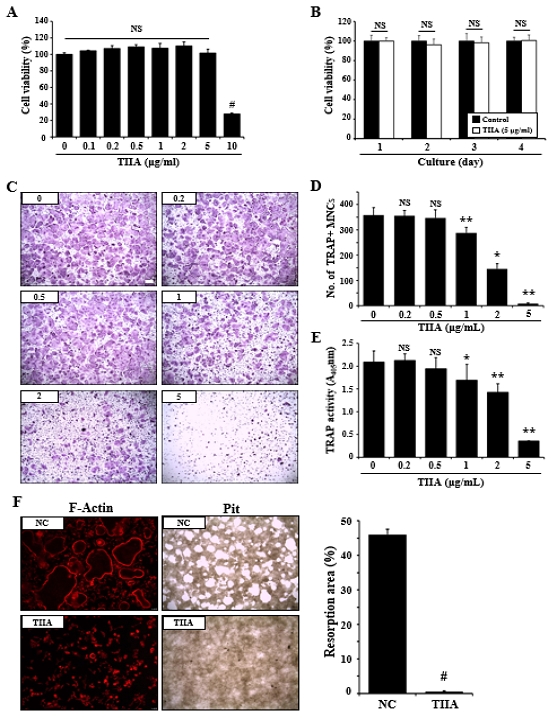
Effects of Tanshinone IIA (TIIA) on cell viability, and RANKL-induced osteoclast formation and activation. A. Bone marrow-derived macrophages (BMMs) were cultured in the presence of M-CSF (30 ng/mL) with the indicated concentrations of TIIA for 3 days. B. BMMs were cultured with 5 μg/mL of TIIA under M-CSF treatment for 4 days. Cell viability was examined as described in materials and methods. C-F. BMMs were cultured in the presence of RANKL (100 ng/mL) and M-CSF (30 ng/mL) with the indicated concentrations of TIIA for 4 days. C. The cells were fixed and stained for tartrate-resistant acid phosphatase (TRAP). D. TRAP(+)-multinucleated cells (MNCs) with ≥3 nuclei were counted as mature osteoclasts. E. Total TRAP activity from TRAP(+)-mono-, di-, and multi-nuclear cells were assayed at an absorbance of 405 nm (A405). F. F-actin rings in osteoclasts were stained with rhodamine-phalloidin (left panel) at 4 days and osteoclast resorptive activity was measured by pit formation on hydroxyapatite-coated plates at 7 days in culture conditions with or without 5 μg/mL TIIA (right panel). Data are presented as the mean ± SD and are representative of three independent experiments. *p < 0.05, **p < 0.01, and #p < 0.001 versus the untreated control (0 μg/mL TIIA). NS: not significant. Scale bar, 200 μm.
2. Assessment of TIIA inhibitory effects on the expression of osteoclast differentiation factors and modulation of intracellular signaling
Regarding the results of Fig. 1, the inhibitory effect of TIIA on osteoclast differentiation and activation was verified at the molecular level. The expression of osteoclast differentiation marker genes including Acp5 (Trap), Oscar, CtsK, Atp6v0d2, Tm7sf4 (Dc-stamp), and Nfatc1, was measured by real-time PCR, and the expression of crucial transcription factors, such as c-Fos and NFATc1, for osteoclastogenesis was observed using immunoblot analysis. TIIA significantly suppressed the expression of all tested marker genes (Fig. 2A). Moreover, the expression of c-Fos and NFATc1 was remarkably inhibited by TIIA treatment compared to untreated control during the indicated culture times (Fig. 2B). Next, we examined how TIIA decreases c-Fos and NFATc1 expression on RANKL-mediated osteoclastogenesis. First, NF-κB and MAPKs activation as the canonical intracellular signaling pathways induced by the RANKL/RANK interaction were evaluated. BMMs cultured in M-CSF treatment were pretreated with/without TIIA (5 μg/mL). Then the cells were induced by RANKL (100 ng/mL) treatment and the activation of MAPKs and IκBα were measured using western blot analysis. Except for ERK, activation of the tested other MAPKs like JNK and p38, and phosphorylation of IκBα were appreciably suppressed by TIIA treatment (Fig. 2C). Overall, these results support that TIIA negatively regulates RANKL-mediated osteoclastogenesis regarding the previous results (Fig. 1). In addition, the inhibitory effect of TIIA is caused by suppression of c-Fos/NFATc1 expression, the key transcription factors for osteoclast differentiation, activation, and formation, via down-regulation of MAPKs and IκBα.
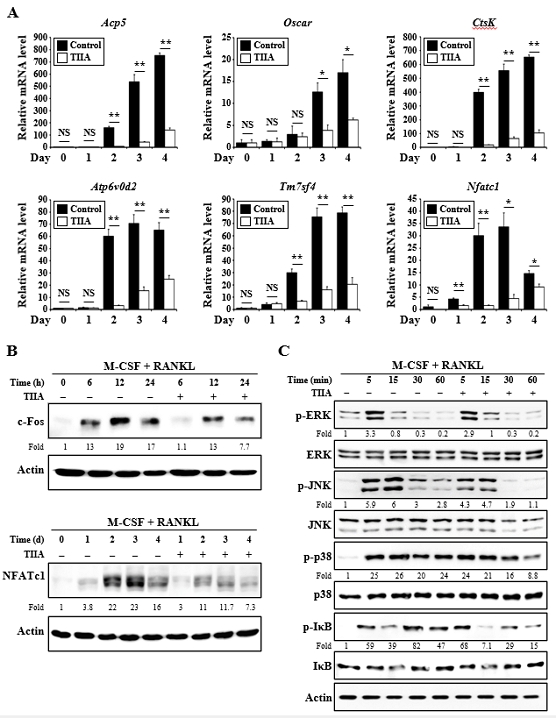
Effects of TIIA on the expression of osteoclast differentiation marker genes and RANKL-induced intracellular signaling. BMMs were cultured with RANKL (100 ng/mL) and M-CSF (30 ng/mL) treatment in the presence or absence of TIIA (5 μg/mL) for 4 days or indicated culture times. A. The expression of osteoclast differentiation marker genes was examined by real-time PCR according to the protocol in Materials and Methods. Relative mRNA levels were expressed as fold change of mRNA level compared between TIIA-treated cells and untreated control cells. B. Whole cell lysates (30 μg) were subjected to SDS-PAGE and the expression of proteins was analyzed by western blot. Specific antibodies were used for the detection of c-Fos (upper panel) and NFATc1 (lower panel) expression, respectively. C. BMMs cultured in the presence of M-CSF (30 ng/mL) were pretreated with TIIA (5 μg/mL) for 2 h and then stimulated with RANKL (100 ng/mL) stimulation to produce intracellular signaling. The whole-cell lysate was prepared at the indicated times and analyzed by SDS-PAGE and immunoblotting. The activation of MAPKs (ERK, JNK, and p38) and IκBα were detected using their respective specific antibodies. Fold change normalized by actin or non-phosphoryated form is presented in the lower panel. Data are expressed as the mean ± SD and are representative of at least two independent experiments. *p < 0.05 and **p < 0.01 versus the untreated control group (0 μg/mL TIIA), NS: not significant.
3. Modulation of Ca2+ signaling by TIIA on RANKL-mediated osteoclastogenesis
RANKL/RANK interaction is also able to induce intracellular Ca2+ signaling leading to NFATc1 expression and activation, as a costimulatory signal pathway which is another important intracellular signaling for osteoclastogenesis. Therefore, it was tested whether TIIA affects RANKL-mediated Ca2+ oscillations. BMMs stimulated with RANKL were promptly treated with TIIA. Typical Ca2+ oscillations exhibited in RANKL-stimulated cells was changed as soon as TIIA treatment commenced. Intracellular Ca2+ concentration frequency instantly vanished by TIIA treatment (Fig. 3A). Next, the modulation of BTK and PLCγ activation responsible for intracellular Ca2+ oscillations by RANKL treatment was examined. The phosphorylation of BTK and PLCγ1/ 2 were normally stimulated by RANKL treatment. RANKL-induced activation of BTK and PLCγ1/2 in TIIA pretreated cells was progressively decreased, unlike untreated control cells (Fig. 3B). Collectively, these data indicate that TIIA regulates not only MAPKs, specifically JNK and p38, and IκBα activation but also Ca2+ oscillations via modulation of BTK/PLCγ activation. Conclusively, it leads to suppress c-Fos and NFATc1 induction, crucial transcription factors in osteoclastogenesis, followed by inhibition of RANKL-stimulated osteoclast differentiation, activation, and formation.
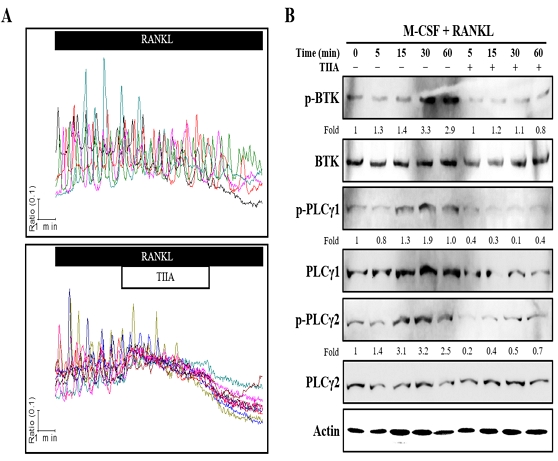
Effects of TIIA on the modulation of RANKL-induced intracellular Ca2+ oscillations and signaling. A. BMMs stimulated by RANKL for 24 h were acutely treated with TIIA (5 μg/mL) at the indicated times and the change in intracellular Ca2+ concentration was compared with that of untreated control cells. RANKL-stimulated Ca2+ oscillations were measured using the fluorescence Ca2+ indicator (Fura-2, AM). B. The activation of BTK and PLCγ1/2, which are mediators in RANKL-induced Ca2+ signaling, were assessed using their specific phosphorylated or nonphosphorylated respective antibodies. Fold change normalized by their non-phosphorylated proteins is presented in the lower panel. Data are presented as the mean ± SD and are representative of at least two independent experiments.
4. Investigation of TIIA effect on the osteoclastogenic function of osteoblasts via coculture conditions
In vivo, osteoclasts and osteoblasts directly interact and osteoblasts support osteoclast differentiation and formation via induction of RANKL and M-CSF expression. Therefore, we further explored whether TIIA could affect the osteoclastogenic ability of osteoblasts in mimic conditions in vivo. Calvaria-derived osteoblasts were cocultured with bone marrow cells (BMs) in the presence of 1α,25-(OH)2D3. Consistent with previous results of stromal cell-free BMM culture in presence of M-CSF and RANKL, TIIA dose-dependently inhibited osteoclast differentiation and formation in coculture conditions (Fig. 4A-C). These results show that TIIA also could suppress osteoblast-supported osteoclastogenesis is in the coculture system. Regarding this inhibitory effect in coculture conditions, we doubted whether TIIA is also targeted to osteoblasts as well as osteoclasts. Accordingly, we evaluated the expression of 1α,25-(OH)2D3-treated osteoblast-derived osteoclastogenic factor genes, such as Csf1 (M-csf), Tnfsf11 (Rankl), and Tnfrsf11b (Opg) (Fig. 4D). Although the expression of Csf1 showed a sharply decreased pattern on Day 1, the expression of Tnfsf11 and Csf1 was increased, and the expression of Tnfrsf11b was significantly decreased in a time-dependent manner, respectively. However, TIIA treatment dramatically suppressed Tnfsf11 expression and mildly decreased Csf1 expression. On the other hand, there was no effect on the expression of Tnfrsf11b, the decoy receptor gene for RANKL. These data demonstrate that the inhibitory effect of TIIA on coculture conditions has resulted from not only the repression of osteoclast itself but also the suppression of the osteoblast-derived osteoclastogenic activity.
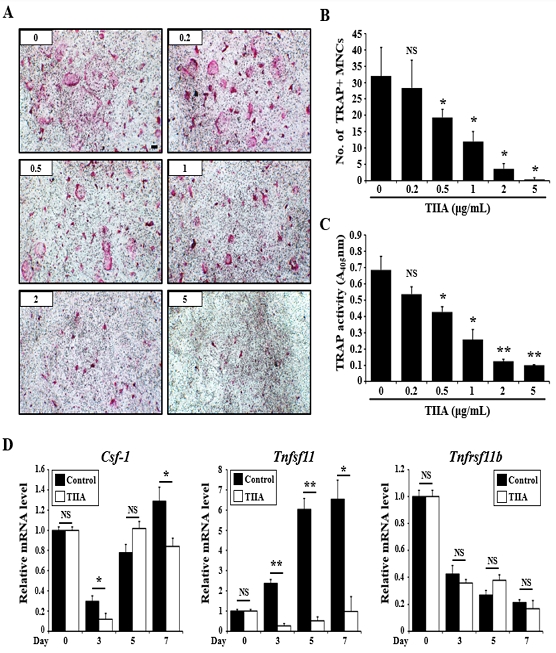
Effects of TIIA on osteoblast-mediated osteoclastogenesis and the expression of osteoblast-derived osteoclastogenic factors in coculture conditions. A-C. BMs (1 × 10⁵ cells/well) were cocultured with calvaria-derived osteoblastic cells (1 × 10⁴ cells/well) in the presence of 50 nM 1α,25-(OH)2D3 with or without TIIA (0, 0.2, 0.5, 1, 2, and 5 μg/mL) for 7 days. A. Cultured cells were fixed and TRAP staining was conducted to detect osteoclasts. B. Mature osteoclasts were considered by a count of TRAP(+) MNCs with ≥3 nuclei. C. Total TRAP activity was assessed by the TRAP solution assay as described in Materials and Methods. D. Calvaria-derived osteoblasts were cultured with 50 nM 1α,25-(OH)2D3 for the indicated treatment periods in the presence or absence of TIIA (2 μg/mL). The expression of osteoblast-derived osteoclastogenic factors was examined by real-time PCR. The mRNA expression levels were normalized to Gapdh and presented as relative mRNA levels. The data are expressed as the mean ± SD and are representative of at least two independent experiments. NS, not significant. *p < 0.05, **p < 0.01 versus the untreated control (0 μg/mL TIIA). Scale bar, 200 μm.
5. Examination of TIIA effect on osteoblast differentiation and function
Since bone metabolism and remodeling are performed by collaboration between osteoclasts and osteoblasts, we next investigated whether osteoblast differentiation could be affected by the presence of TIIA. First, we assessed the viability of calvaria-derived primary osteoblast cells to respond to TIIA treatment. Although cell viability showed a slight decrease in 1 μg/mL TIIA treatment on day 14, cell viability at under 1 μg/mL TIIA concentrations was comparable to untreated control cells in all tested periods (Fig. 5A). For osteoblast differentiation, calvaria-derived primary osteoblastic cells were cultured in supplement of osteogenic factors such as L-ascorbic acid and β-glycerophosphate. Differentiated cells were stained to examine ALP activity or mineralized nodule formation at indicated culture days. ALP activity and the formation of mineralized nodules considerably increased in TIIA-untreated control culture under osteogenic factors (Fig. 5B). However, ALP activity between cultures with or without TIIA treatment was comparable. Nevertheless, interestingly, the formation of mineralized nodules was slightly augmented in TIIA-treated conditions compared with that of untreated control cells (Fig. 5B). Consistent with the above results, the expression of Alp was not altered by TIIA treatment during osteoblast differentiation. However, TIIA treatment enhanced the expression of the other genes related to osteoblast differentiation (Fig. 5C). The expression of the bone matrix protein genes, such as Spp1, Bglap, and Col1a1, has exhibited more enhanced patterns in TIIA treated cultures than of untreated control cells on late differentiation culture periods. Moreover, TIIA treatment markedly improved the expression of Runx2 and Sp7, which are known as important transcription factors for osteoblast differentiation and function, compared with that of nontreated control cells. These results indicate that TIIA could improve bone formation via promoting the expression of osteoblast differentiation-related factors and bone matrix production. Therefore, it seems that TIIA possesses the dual effect on bone metabolism and remodeling not only as a positive regulator for osteoblast differentiation but also as an inhibitor for osteoclastogenesis.
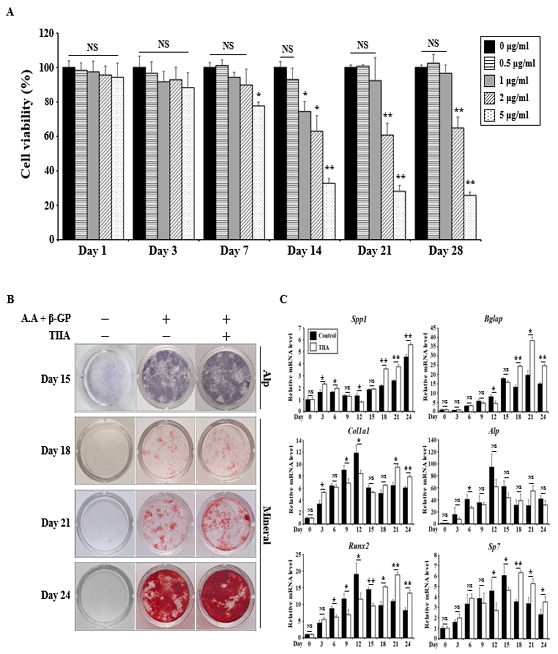
Effects of TIIA on osteoblast cell viability, differentiation, and mineralized nodule formation. Calvaria-derived primary osteoblasts were cultured in osteogenic medium with various concentrations of TIIA (0, 0.5, 1, 2, and 5 μg/mL) or fixed TIIA (0.5 μg/mL) for 28 days. A. Cell viability was examined as described in Materials and Methods. B. Osteoblast differentiation and activity were assessed by ALP staining with substrate mixture (BCIP/ NBT) and mineralized nodule with Alizarin Red S. C. Regarding the confirmation of osteoblast differentiation at the molecular level, the expression of osteoblast differentiation markers and transcription factor genes were examined by real-time PCR. mRNA levels were normalized to Gapdh and expressed as a fold change relative to control. Data are demonstrated as the mean ± SD and are representative of at least two independent experiments. *p < 0.05 and **p < 0.01 versus the untreated control group (0 μg/mL TIIA), NS: not significant.
Discussion
The current study elucidates the dual role of Tanshinone IIA (TIIA) in bone metabolism, highlighting its capacity to inhibit osteoclastogenesis while promoting osteoblast differentiation, thereby demonstrating its potential as a dual-action regulator for bone resorption and formation. The bidirectional modulation of TIIA on osteoclasts and osteoblasts offers a promising therapeutic approach for treating osteolytic bone diseases, where the imbalance between bone resorption and formation is pathologically significant. TIIA exhibited a potent inhibitory effect on RANKL-induced osteoclast differentiation and bone-resorbing function in a dose-dependent manner. The suppression of TRAP-positive multinucleated cell formation, F-actin ring development, and resorption pit formation underscores its capacity to functionally impair osteoclast maturation and activity (Fig. 1). This suppression was mechanistically linked to the down-regulation of key osteoclastogenic genes such as Acp5, Ctsk, Oscar, Tm7sf4, and Nfatc1, and further confirmed by the decreased expression of pivotal transcription factors c-Fos and NFATc1 (Fig. 2). These findings align with previous reports indicating that TIIA exerts anti-osteoclastic activity by modulating the MAPK and NF-κB pathways, leading to decreased NFATc1 activation, which is pivotal for osteoclast differentiation9,13,21). Importantly, the study revealed that TIIA disrupts the RANKL-induced costimulatory signaling pathway by inhibiting BTK and PLCγ1/2 phosphorylation, thereby attenuating intracellular Ca²⁺ oscillations, which constitute an essential signal for NFATc1 activation (Fig. 3). The inhibition of BTK and PLCγ-mediated Ca²⁺ oscillations by TIIA represents a novel mechanistic insight, as these signals are known to synergistically enhance NFATc1 transcriptional activity during osteoclastogenesis22,23). The TIIA-mediated abolition of Ca²⁺ oscillations thus represents a novel mechanism for its inhibitory action, suggesting its interference with the ITAM-dependent signaling cascade that integrates RANKL and immunoreceptor-derived signals.
In addition to its osteoclast-inhibitory role, TIIA also enhanced osteoblast differentiation, as evidenced by increased mineralized nodule formation and upregulation of osteoblast-related genes such as Bglap, Col1a1, and Spp1, along with key transcription factors Runx2 and Sp7 (Fig. 5). While ALP activity remained unaffected, the promotion of matrix maturation and mineralization suggests that TIIA acts preferentially on the late stages of osteoblast differentiation. This selective promotion of osteoblastic activity, without cytotoxic effects at effective doses, adds therapeutic value by potentially enhancing bone formation in clinical settings. Further supporting its dual action, TIIA was found to reduce osteoblast-mediated osteoclastogenesis in coculture experiments by down-regulating the expression of osteoclastogenic cytokines Tnfsf11 (Rankl) and Csf1 (M-csf) in 1α,25-(OH)₂D₃-treated osteoblasts. Interestingly, TIIA did not affect the expression of Tnfrsf11b (Opg), suggesting a targeted suppression of pro-osteoclastogenic rather than anti-osteoclastogenic signals from osteoblasts. This finding highlights TIIA’s ability to modulate the bone microenvironment through both direct and indirect pathways.
Conclusions
Collectively, these results position TIIA as a potential therapeutic agent with dual modulatory effects on bone cell populations. Its ability to decouple bone resorption from bone formation provides a pharmacological advantage over current antiresorptive therapies, which often impair both osteoclast and osteoblast functions, thereby limiting bone remodeling. Future in vivo studies and clinical trials will be essential to validate the efficacy and safety of TIIA in models of osteoporosis, rheumatoid arthritis, and periodontitis.
Acknowledgments
This paper was supported by Wonkwang University in 2024.
References
-
Walsh MC, Kim N, Kadono Y, Rho J, Lee SY, Lorenzo J, Choi Y. Osteoimmunology: interplay between the immune system and bone metabolism. Annu Rev Immunol, 2006;24:33-63.
[https://doi.org/10.1146/annurev.immunol.24.021605.090646]

-
Takayanagi H. Osteoimmunology: shared mechanisms and crosstalk between the immune and bone systems. Nat Rev Immunol 2007;7(4):292-304.
[https://doi.org/10.1038/nri2062]
-
Walsh MC, Choi Y. Biology of the RANKL-RANK-OPG System in Immunity, Bone, and Beyond. Front Immunol 2014;5:511.
[https://doi.org/10.3389/fimmu.2014.00511]
-
Riaz M, Khalid R, Afzal M, Anjum F, Fatima H, Zia S, Rasool G, Egbuna C, Mtewa AG, Uche CZet al. Phytobioactive compounds as therapeutic agents for human diseases: A review. Food Sci Nutr 2023;11(6):2500-29.
[https://doi.org/10.1002/fsn3.3308]
-
Wang X, Morris-Natschke SL, Lee KH. New developments in the chemistry and biology of the bioactive constituents of Tanshen. Med Res Rev 2007;27(1):133-48.
[https://doi.org/10.1002/med.20077]
-
Guo R, Li L, Su J, Li S, Duncan SE, Liu Z, Fan G. Pharmacological Activity and Mechanism of Tanshinone IIA in Related Diseases. Drug Des Devel Ther 2020;14:4735-48.
[https://doi.org/10.2147/DDDT.S266911]
-
Ansari MA, Khan FB, Safdari HA, Almatroudi A, Alzohairy MA, Safdari M, Amirizadeh M, Rehman S, Equbal MJ, Hoque M. Prospective therapeutic potential of Tanshinone IIA: An updated overview. Pharmacol Res 2021;164:105364.
[https://doi.org/10.1016/j.phrs.2020.105364]
-
Fan GW, Gao XM, Wang H, Zhu Y, Zhang J, Hu LM, Su YF, Kang LY, Zhang BL. The anti-inflammatory activities of Tanshinone IIA, an active component of TCM, are mediated by estrogen receptor activation and inhibition of iNOS. J Steroid Biochem Mol Biol 2009;113(3-5):275-80.
[https://doi.org/10.1016/j.jsbmb.2009.01.011]
-
Jang SI, Kim HJ, Kim YJ, Jeong SI, You YO. Tanshinone IIA inhibits LPS-induced NF-kappaB activation in RAW 264.7 cells: possible involvement of the NIK-IKK, ERK1/2, p38 and JNK pathways. Eur J Pharmacol 2006;542(1-3):1-7.
[https://doi.org/10.1016/j.ejphar.2006.04.044]
-
Yang GL, Jia LQ, Wu J, Ma YX, Cao HM, Song N, Zhang N. Effect of tanshinone IIA on oxidative stress and apoptosis in a rat model of fatty liver. Exp Ther Med 2017;14(5):4639-46.
[https://doi.org/10.3892/etm.2017.5162]
-
Li YI, Elmer G, Leboeuf RC. Tanshinone IIA reduces macrophage death induced by hydrogen peroxide by upregulating glutathione peroxidase. Life Sci 2008;83(15-16):557-62.
[https://doi.org/10.1016/j.lfs.2008.08.003]
-
Kwak HB, Yang D, Ha H, Lee JH, Kim HN, Woo ER, Lee S, Kim HH, Lee ZH. Tanshinone IIA inhibits osteoclast differentiation through down-regulation of c-Fos and NFATc1. Exp Mol Med 2006;38(3):256-64.
[https://doi.org/10.1038/emm.2006.31]
-
Kim HH, Kim JH, Kwak HB, Huang H, Han SH, Ha H, Lee SW, Woo ER, Lee ZH. Inhibition of osteoclast differentiation and bone resorption by Tanshinone IIA isolated from Salvia miltiorrhiza Bunge. Biochem Pharmacol 2004;67(9):1647-56.
[https://doi.org/10.1016/j.bcp.2003.12.031]
- Liu X, Niu Y, Xie W, Wei D, Du Q. Tanshinone IIA promotes osteogenic differentiation of human periodontal ligament stem cells via ERK1/2-dependent Runx2 induction. Am J Transl Res 2019;11(1):340-50.
-
Kim HJ, Kim SH. Tanshinone IIA enhances BMP-2-stimulated commitment of C2C12 cells into osteoblasts via p38 activation. Amino Acids 2010;39(5):1217-26.
[https://doi.org/10.1007/s00726-010-0557-8]
-
Kwak HB, Sun HM, Ha H, Kim HN, Lee JH, Kim HH, Shin HI, Lee ZH. Tanshinone IIA suppresses inflammatory bone loss by inhibiting the synthesis of prostaglandin E2 in osteoblasts. Eur J Pharmacol 2008;601(1-3):30-7.
[https://doi.org/10.1016/j.ejphar.2008.10.034]
-
Zhu S, Wei W, Liu Z, Yang Y, Jia H. Tanshinone‑IIA attenuates the deleterious effects of oxidative stress in osteoporosis through the NF‑kappaB signaling pathway. Mol Med Rep 2018;17(5):6969-76.
[https://doi.org/10.3892/mmr.2018.8741]
-
Ekeuku SO, Pang KL, Chin KY. The Skeletal Effects of Tanshinones: A Review. Molecules 2021;26(8).
[https://doi.org/10.3390/molecules26082319]
-
Park KH, Gu DR, Kim MS, Lee SH. Inhibitory Effect of Rosae Multiflorae Fructus Extracts on the Receptor Activator of NF-kappaB Ligand-Induced Osteoclastogenesis through Modulation of P38- and Ca(2+)-Mediated Nuclear Factor of Activated T-Cells Cytoplasmic 1 Expression. J Bone Metab 2020;27(1):53-63.
[https://doi.org/10.11005/jbm.2020.27.1.53]
-
Park KH, Gu DR, So HS, Kim KJ, Lee SH. Dual Role of Cyanidin-3-glucoside on the Differentiation of Bone Cells. J Dent Res 2015;94(12):1676-83.
[https://doi.org/10.1177/0022034515604620]
-
Asagiri M, Takayanagi H. The molecular understanding of osteoclast differentiation. Bone 2007;40(2):251-64.
[https://doi.org/10.1016/j.bone.2006.09.023]
-
Negishi-Koga T, Takayanagi H. Ca2+-NFATc1 signaling is an essential axis of osteoclast differentiation. Immunol Rev 2009;231(1):241-56.
[https://doi.org/10.1111/j.1600-065X.2009.00821.x]
-
Shinohara M, Takayanagi H. Novel osteoclast signaling mechanisms. Curr Osteoporos Rep 2007;5(2):67-72.
[https://doi.org/10.1007/s11914-007-0005-1]