
Thioacetamide 유도 간 독성 모델에서 맥문동 추출물의 보호 효과
Ⓒ The Society of Pathology in Korean Medicine, The Physiological Society of Korean Medicine
Abstract
This study, we aimed to analyze the effect of treatment of Liriope platyphylla(L.platyphlla) extract on the protection of hepatotoxicity in a model of thioacetamide (TAA)-induced liver toxicity. Male 6-week-old Sprague Dawley (SD) rats (Raonbio, Gyeonggi, Korea) weighing 206.4±9.0 g were used after acclimatization for 1 week. The rats were categorized into six groups: normal control (Nomal), hepatotoxicity-induced (TAA), positive control (TAA+Sylimarin (SLM) 50 mg/kg,bw), and low, medium, and high concentration of Liriope platyphylla extract (TAA+LPE 100, 200, 300 mg/kg,bw) (n=7). The animals were orally administered 1 mL of the test substance once/day at a fixed time for a total of 14 days, and five experimental groups, except the normal control group, were intraperitoneally administered 0.1 mL of TAA (200 mg/kg,bw) to induce acute liver toxicity. As a result, liver weight was significantly increased in all TAA treated groups compared to the normal control group (p<0.001). H&E staining of liver tissue showed vacuolization of nuclei and cytoplasm, hepatocyte necrosis, and vesicular lesions of liver tissue in the TAA alone group (p<0.05), which were ameliorated by Liriope platyphylla extract treatment. Furthermore, a significant concentration-dependent decrease in caspase-3 expression was observed in the SLM group compared to TAA alone (p<0.05). Based on the results of this study, if further research is conducted on the antioxidant effect and mechanism of action, it is expected that SLM can be effective as a hepatoprotectant for liver function of natural products.
Keywords:
Antioxidant, Extract, Hepatotoxicity, Liriope platyphylla, Thioacetamide서 론
간은 체내 생리기능을 유지하는 중요한 기관으로 대사, 분비, 제거 등의 작용을 통해 해독의 기능을 하며, 손상이 일어날 경우 간염, 간경변, 간암, 간 부전 등의 질환으로 이어질 수 있다.1,2) 간 손상의 요인으로는 흡연, 알코올 섭취, 식습관, 바이러스 간염, 정신적 스트레스, 약물 복용 등 다양한 원인에 의해 간 조직의 기능 장애 및 구조 변화를 일으키는 것으로 알려져 있다.3) 통계청 자료에 따르면 성별 및 연령에 따른 사망원을 조사한 결과, 간 질환은 남성의 사망원인에서 6위를 차지 하였으며 30-60대의 사망원인 5위 안에 포함되는 질환으로 나타났다.4) 지난 10년간의 국내 사망원인 통계에 따르면, 2022년 간암과 간질환으로 인한 사망률이 평균 14.7%에 이르며 지속적으로 증가하는 추세를 보이고 있다.5)
간 손상으로 인해 생성된 활성산소는 표적 세포에 산화적 스트레스를 일으킴으로써, 핵산과 단백질을 손상시키고 직·간접적으로 염증 반응을 유도한다.6) 초기 간 손상은 가역적이며, 부분적으로 손상되더라도 정상적인 기능을 제공하기 때문에 조기 발견이 어려운 특징을 가져 만성 질환으로 이어질 가능성이 높다.7) 만성화 될 경우 높은 사망률을 보이는 간경변과 간세포암으로 발전될 수 있기 때문에8), 치료보다는 예방이 중요한 간섬유화 및 간염증에 대한 보호제 연구가 활발히 진행되고 있다. 그러나, 현재까지 서양엉겅퀴[Silybum marianum (L.) Gaertn.]에서 유래한 silymarin 외에 뚜렷한 간 보호 효능 약물 개발 및 상업화가 크게 진전되지 않고 있다.9)
Thioacetamide (TAA)는 만성간염, 간경화, 간암등의 만성 간질환 실험모델 독성 유도 물질로 사용되고 있다10). TAA에 의해 유도된 간경변의 경우 ccl4, DMNA와 다르게 사람의 간 질환 병변과 형태학적, 생화학적으로 특징이 유사하며 조직학적 소견이 인간 간경변과 유사하다고 보고되었다10,11). TAA의 단회투여 후에는 급성 간괴사가 보고되었으며, 간괴사의 병인으로 간 세포막 효소들의 변화, microchondria의 변화, bile canalicular membrane과 tight junctions의 변화가 관찰되었다12). 또한 TAA는 저용량에서는 세포 자멸(apoptosis)를 유발하나 용량을 올리면 지방 과산화와 소엽중심성 괴사를 유발한다13). 이러한 기전으로는 cytochrome p450 효소에 의해 생성되는 활성산소종인 thioacetamide-S oxide를 매개로 하여 공유결합에 의한 간 세포의 손상과 괴사가 나타나는 것으로 알려져 있다10,13). 또한 간세포에 Ca2+ 비정상적 유입으로 인한 산화적 인산화 작용 억제로 간 세포 호흡대사가 억제된다는 연구 3)로 소개되고있다12).
맥문동(Liriope platyphylla, LPE)은 백합과의 다년생 초본 약용식물로 한국, 중국, 대만. 일본 등에 분포하고 있으며 짧은 방추형 뿌리가 한약재로 이용된다.14) 맥문동 뿌리의 주요 약리 성분으로는 스테로이드계 사포닌 (spicatoside, ophiopogonin A-D)와 스테롤로(β-sitosterol, stigmasterol), homoisoflavonoid 계열(ophiopogonanone, ophiopogonone 등)이 있으며, 이 성분들은 항산화 활성을 비롯한 혈당 강하, 항염, 항균, 면역조절, 간 보호, 자양 강장 및 진해, 거담, 이뇨 효과 등의 효능이 있다고 알려져 있다.14,15)
맥문동의 효능을 입증하듯, 곰팡이균에 대한 항균작용16), 알레르기성 천식에 대한 항염, 항산화 작용에 대한 효능 평가 연구가 지속적으로 이루어지고 있다17). 그러나, 단독원료로써 간 기능 보호와 관련된 특허는 등록되어있지 않으며, 아직까지 간 건강개별인정형 원료로 등록되지 않아, 신규성이 있어 간 기능 보호 효능에 대하여 추가적인 연구가 필요하다고 생각된다.
이에 본 연구에서는 Thioacetamide으로 간 독성을 유도한 모델에서 맥문동 추출물의 처리에 따른 변화를 추적함으로써, 간독성 보호의 영향과의 상관관계를 분석하고자 한다.
재료 및 방법
1. 시험물질 제조
본 연구에 사용된 청양군 맥문동은 꽃뫼영농조합법인을 통해 구입하였으며, 잔뿌리와 심지를 제거하여 시료로 사용될 뿌리를 선별 작업하였다. 선별된 맥문동의 뿌리는 수세하여 이물질을 제거하였고 이후 건조시켜 가루로 분쇄하였다. 건조된 맥문동 시료 (100 g)와 10배 부피의 50% 에탄올 (1000 mL)을 1 L 삼각플라스크에 넣은 후 60℃에서 7시간 가온 및 추출하였다. 이후 추출액 중 상층액을 필터 처리한 후 분리한 여과액을 60℃에서 7시간 동안 2차 추출하였다. 반복적인 추출 및 여과 과정을 거친 맥문동 추출액을 감압농축기(LABOROTA 20ER, Heidolph Instruments Co.,Germany)를 이용해 60℃에서 30 Brix 이상으로 감압농축하였다. 이후 동결 건조기(LYOPH-PRIDE 20R, Ilsin biobase, Korea)를 사용하여 48시간 건조하여 최종 맥문동 추출물을 얻었다. 동결 건조된 시료는 밀봉하여 사용 전까지 실온에 보관하였다(Fig. 1).
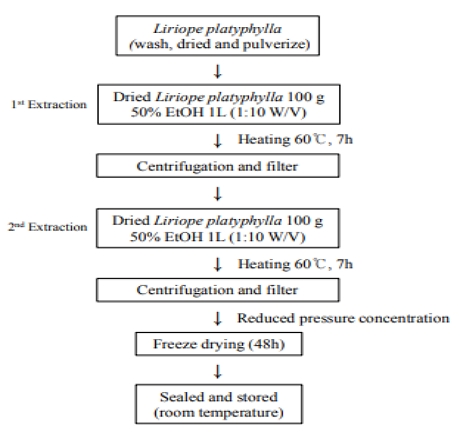
Preparation of Liriope platyphylla ethanol extract.
2. 실험동물 및 사육환경
실험동물은 체중 206.4±9.0 g의 수컷 6주령 Sprague Dawley(SD) Rat(라온바이오(주), 경기, 한국)를 1주간 사육환경에 적응시킨 후 실험에 이용하였다. 동물 사육은 온도 23±1℃, 습도 50±5%, 환기 횟수 10회/시간, 조도 150-300 lux으로 밤낮 주기가 12시간씩 유지되는 항온, 향습 조건에서 사육하였다. 실험동물의 관리와 관련된 모든 과정 및 절차는 대전대학교 동물실험 윤리위원회(Institutional animal care and use committee : IACUC)의 승인을 받아 실시하였으며 윤리적 규범에 따른 3R 원칙을 준수하여 수행하였다(DJUAB2021-010).
3. 실험동물군 분리 및 약물 투여
실험동물은 난괴법(randomized complete block design)에 의해 6그룹으로 나누었다. 정상대조군(Nomal), 간독성 유발군(TAA), 양성대조군(TAA+SLM 50 mg/kg,bw), 맥문동 추출물 저/중/고 농도 투여군(TAA+LPE 100, 200, 300 mg/kg,bw)으로 분류하였다(n=7). 실험 기간인 총 14일 동안 일정한 시간에 1회/1일 시험물질 1 mL를 경구투여 하였고, 정상대조군을 제외한 5개의 실험군은 급성 간 독성 유발을 위해 TAA (200 mg/kg,bw) 0.1 mL을 복강투여 하였다(Fig. 2).
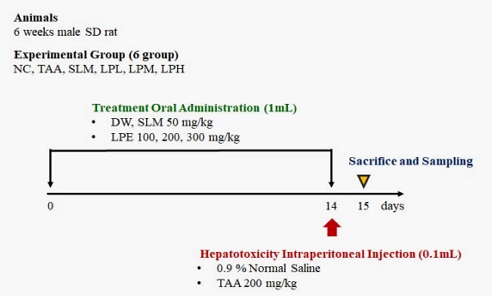
Examination flow of acute hepatotoxicity animal experiment. All test substance were injected orally for 14 days. The NC rat were treated with 0.9% normal saline. To induce hepatotoxicity, TAA is injected interaperitoneally 24 hour prior to sacrifice. all animals were sacrificed on day 15. LPE: Liriope platyphylla; NC, normal control; TAA, thioacetamide induced hepatotoxicity with 0.9% normal saline; SLM, thioacetamide induced hepatotoxicity with silymarin 50 mg/kg,bw; LPL: thioacetamide induced hepatotoxicity with Liriope platyphylla ethanol extract 100 mg/kg,bw; LPM: thioacetamide induced hepatotoxicity with Liriope platyphylla ethanol extract 200 mg/kg,bw; LPH: thioacetamide induced hepatotoxicity with Liriope platyphylla ethanol extract 300 mg/kg,bw in male SD rat.
4. 주요 장기의 절대 및 상대 중량에 미치는 영향
간 독성 모델에서 약물 투여 및 간 독성 유발에 따른 장기(간, 비장)의 절대 및 상대 중량변화를 측정하였다. 상대 중량의 경우 부검 당일 측정한 동물 체중과 절제한 간, 비장의 무게를 이용하여 계산하였다.
5. 혈액학 지표에 미치는 영향
Thioacetamide (TAA), silymarin (SLM)의 투여 및 맥문동 에탄올 추출물 투여에 따른 급성염증, 조직 손상 등의 다양한 염증 상태를 평가하기 위하여 혈액학적 관련 지표(적혈구, 백혈구, 혈소판)를 측정하였다. 복대동맥으로부터 EDTA tube에 채혈 후 자동혈액 분석기(Advia 2120i, SIEMENS, Germany)를 이용하여 분석하였다.
6. 조직병리학적 평가
조직병리학적 평가를 위해 간 조직의 육안 병변을 관찰 후 통상적인 조직 표본 제작과정을 거쳐 슬라이드 제작 후 병리 조직학적 검사를 수행하였다. 제작된 조직슬라이드는 hematoxylin & eosin (H&E) 염색 후 광학현미경 200배에서 검경하였다. 슬라이드 표본에서 중심정맥 및 간 문맥 주변의 조직학적 염증 양상을 4단계로 나누어 세포질의 공포화, 핵의 농축과 대소부동, 수포성 변성 및 괴사의 항목으로 평가하였다. 중심정맥 및 간 문맥 주변에 염증세포가 없는 경우를 0점, 염증세포가 소엽의 2/3 이상의 면적을 차지하는 경우를 3점으로 분류하여 점수화하였다.

Histopathological score index for hepatotoxicity
7. 간 독성 유발 세포의 apoptosis 확인
면역조직화학 염색을 통해 점막 내 apoptosis 정도를 평가하기 위해 caspase-3의 분포 변화를 확인하였다. 통상적인 방법으로 제작된 조직블럭을 박절 및 탈파라핀 과정을 거친 후 Masson Trichrome (MT)염색을 실시하였다. bouin’s 용액(BBC biochemical co., USA)에 옮겨 60℃에서 15분간 매염한 후 50-70% 알코올에 순차적으로 피크린산을 제거하였다. 이후 weigert’s iron hematoxylin 용액에(Sigma, USA) 10분 동안 핵 염색을 수행한 후 biebrich scarlet-acid fuchsin 용액(Sigma, USA)으로 5분간 대조염색 하였다. phosphomolybdicacid-phosphotungstic acid 용액(Sigma, USA)을 사용하여 1차 분별 후 light green 용액(Sigma, USA)으로 10분 동안 아교섬유 염색을 진행하였다. 간 조직세포의 섬유화 양성률을 정량화 하기 위해 광학현미경(BX43, Olympus co., Japan)으로 검경하여 image J program (Wayne rasband, National institutes of health, bethesada, MD, USA)을 사용해 섬유화된 면적을 측정하였다.
결 과
1. 간의 절대 중량 및 상대 중량
NC군의 간 절대 중량은 TAA를 투여 한 모든 군에서 유의하게(p<0.05) 증가한 것으로 나타났다. 또한 TAA 단독 투여군 대비 SLM 군에서 7.7% 감소, LPL 군에서 9.3%, LPH 군에서 10.6%의 감소를 보였다(p<0.05).
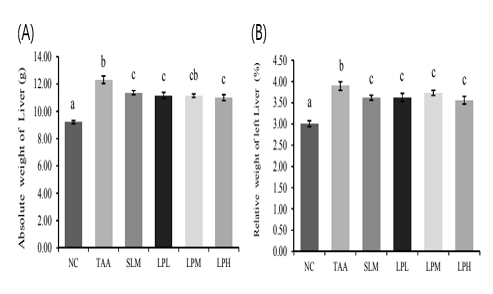
Effects of LPE on liver weight in hepatotoxicity induced SD rat. Absolute organ weight of liver (A), Relative organ weight of liver (B). Differences between the six group were validated by Duncan’s multi range test after analysis with one way ANOVA. Group with different significance were classified by different letters. (A): F: 6.807, p: 0.023, Duncan: a<c<cb<b, (B): F: 5.068 p: 0.031, Duncan: a<c<b, significantly different between each group. Graph data are shown as the mean ± SE (n=7). Notes on group designation at the same as in Fig. 2.
2. 간 독성에 따른 혈액학적 지표 측정
적혈구 수치의 경우 정상 대조군 대비 TAA를 투여한 모든 군에서 증가 되었으며, 특히 TAA 단독 투여군에서 유의한 차이가 관찰되었다(p<0.001). SLM군 및 맥문동 추출물 투여군의 경우 적혈구 수의 증가를 보였으나 유의성은 나타나지 않았다. 헤모글로빈의 경우 정상대조군 대비 TAA 단독 투여군에서 유의한(p<0.001) 증가가 나타났으며, SLM군 및 맥문동 추출물 투여군의 경우 적혈구 수치와 비례하여 농도가 증가하였지만 유의성은 나타나지 않았다. 혈소판 수치의 경우 정상대조군과 비교하였을 때 TAA 단독 투여군에서 8.2% 감소가 나타났으며(p<0.05), SLM군은 TAA 단독 투여군 대비 11.5%(p<0.01), 맥문동 추출물 저농도 투여군은 10.1% 증가된 혈소판 수를 보였다(p<0.05). 백혈구 수의 경우 정상대조군 대비 TAA를 투여한 모든 군에서 감소를 보였으며, 특히 TAA 단독 투여군의 경우 63.0%의 감소가 나타났다(p<0.001). SLM군은 TAA 단독 투여군과 비교하였을 때 백혈구 수가 45.0% 증가 하였으며(p<0.05), 맥문동 추출물 중농도 투여군의 경우 13.4%의 증가를 보였으나 유의성은 나타나지 않았다(Table 2).
Effects of LPE on RBC, Hb, PLT, and WBC changes in hepatotoxicity induced SD rat
3. 간 조직 내 염증에 미치는 영향
간 중심정맥 주변 조직세포의 병리학적 변화를 관찰하기 위해 Hematoxylin & eosin (H&E) 염색을 하였다(Fig. 4). 정상대조군과 대비하여 그룹별 염증세포의 침윤 정도를 관찰 한 결과, TAA 단독 투여군에서 2.33점으로 높은 세포핵 농축을 보였고, TAA 단독 투여군과 비교하였을 때 SLM군에서 57.1%, 맥문동 추출물 고농도 투여군에서 42.9% 감소된 염증성 소견을 관찰하였다(p<0.05)(Table 3). 대소부동한 핵과 세포질의 공포화, 간세포 괴사, 간 조직의 수포성 병변을 검경한 결과 TAA 단독 투여군에서 모두 증가하였으며, 맥문동 추출물 고농도 투여군에서 각각 52%, 29.4%, 44.4% 감소하여 통계적으로 유의한 감소가 관찰되었다(p<0.05)(Table 3).
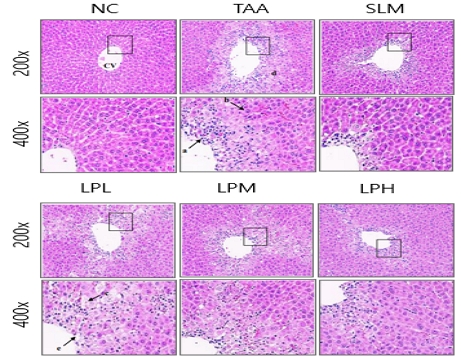
Effects of LPE on histological changes by liver H&E staining in hepatotoxicity induced SD rat (x200, x400). At the end of experiment, liver tissues were obtained, fixed in 10% neutral buffer formalin (NBF) solution, paraffin embedded, sectioned at a thickness of 4 μm for cell observation and H&E for histopathological stain. Examination of the optical microscope for x200 and x400. Follow the Table 1. Notes on group designation at the same as in Fig. 2. CV: Central vein, a: Concentrated nucleus, b: Anisokaryosis, c: Vacuolated cytoplasm, d: Necrosis, e: Vesiculation. Notes on Group Designation at the Same as In Fig. 2.
Inflammation index scoring of the liver in hepatotoxicity induced SD rat (H&E, x200, x400).
4. 간 독성 내 Caspase-3 효소 염색
Caspase-3 양성 발현률을 확인하기 위해 간 조직의 핵 주변 세포질을 관찰하였다. 정상대조군은 0.34%의 낮은 양성률을 보인 반면, TAA를 투여한 모든 군에서 caspase-3 양성률의 증가가 나타났다. 그중 TAA 단독 투여군은 49.25%의 높은 양성률을 보이며 증가됨을 확인하였다(p<0.05). 각 실험군은 TAA 단독 투여군과 비교하였을 때 각각 SLM군 17.24%, 맥문동 추출물 투여군 저농도 25.17%, 중농도 16.35%, 고농도 11.34%로 농도 의존적인 감소된(p<0.05) 양성률을 관찰하였다(Fig. 5).
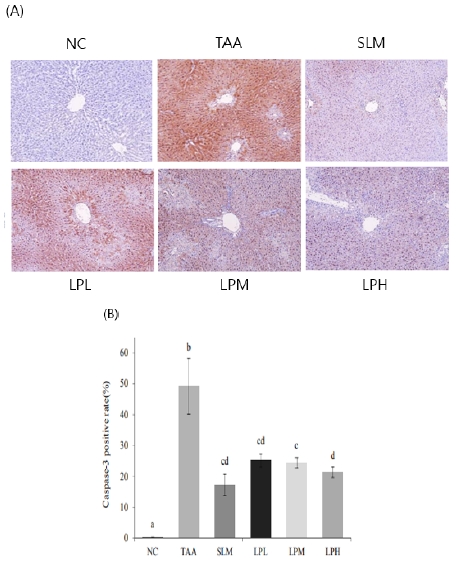
Effects of LPE on histochemical changes by Caspase-3 in hepatotoxicity induced SD rat (x100). (A) At the end of experiment, liver tissues were obtained, fixed in 10% nuetral buffer formalin (NBF) solution, paraffin embedded, sectioned at a thickness of 4 μm for cell observation and Caspase-3 for histochemical stain. Examination of the optical microscope for x100. Notes on group designation at the same as in Fig. 2. (B) Effects of LPE on histochemical changes by Caspase-3 and quantified using Image J in hepatotoxicity induced SD rat (x100). The liver tissue was stained with caspase-3 staining and quantified using program Image J. The positive rate was averaged by examining 5 liver tissue section. Differences between the six group were validated by Duncan’s multi range test after analysis with one way ANOVA. Group with different significance were classified by different letters. F: 15.423, p: 0.002, Duncan: a<d<cd<c<b significantly different between each group. Notes on group designation at the same as in Fig. 3. Data are shown as mean±SE (n=7).
고 찰
본 연구는 급성 간 독성 랫드에서 맥문동 에탄올 추출물의 간 보호 효과를 연구하고자 하였다. 연구에 사용된 맥문동 뿌리는 국내·외에서 약용식물로 사용되고 있으며, 한약재로서 맥문동은 간보호 및 항암효과 등의 약리작용을 가진다고 알려져 있다.15) 맥문동은 다량 섭취에도 독성이 없다는 특징이 있어 우수한 기능성 건강식품 소재로써 이용 가치가 높다.18)
간 독성을 유발하는 TAA는 조직병리학적으로 간세포에 강한 손상을 일으킨다.19) 특히, 소엽을 중심으로 간 손상이 나타나며, 이는 인간의 간 경변과 유사한 패턴을 가진다.19) 이에 본 연구에서는 TAA로 유발된 간 독성 동물모델에서 맥문동 추출물을 세 단계 농도로 투여하고 정량 분석을 통해 맥문동 추출물의 간 기능 보호 효과를 연구하고자 하였다.
TAA에 의한 간 독성 유발을 확인하기 위해 간의 중량을 측정한 결과 정상대조군 대비 모든 TAA 투여 군에서 유의한 증가가 나타났고, TAA 단독 투여군 대비 SLM군은 맥문동의 투여 농도 의존적인 중량 감소를 보였다. 이는 TAA에 의한 간 손상에 따라 간 기능의 저하 및 대사 효소들의 비정상 분비를 초래하고 간세포를 증식시켜 간 중량이 증가 된다는 Shin의 보고와 일치하는 결과이다.20)
이를 뒷받침 하듯, H&E 염색 표본에서 간세포 염증 양상을 평가하여 점수를 부여한 결과, TAA 단독 투여군 대비 맥문동 투여군의 핵의 대소부동, 세포질 공포화 정도, 핵의 농축과 세포 괴사, 수포성 병변이 유의하게 감소하는 결과를 나타냈다. Kang의 연구에 따르면 간 독성에 의한 세포 손상의 경우 산화적스트레스와 GSH의 고갈에 따라 세포내 지질, 단백질 및 DNA의 변화가 야기되며, 미토콘드리아 손상에 의한 염증 및 괴사가 유발된다고 보고하였다.21) 이에 본 실험에서 맥문동 추출물 투여군의 간 조직 내 지질과산화물의 감소와 혈청 내 항산화 효소 증가가 나타난 것은 맥문동 추출물이 산화적스트레스에 대한 간세포 보호 효과를 통해 간 조직의 염증반응이 완화된 것으로 해석된다.
또한, 간 세포의 Apoptosis를 확인하기 위해 세포자멸 효소를 측정한 결과 TAA를 투여한 간 조직의 세포 손상 부위에서 caspase-3의 발현량의 증가를 보였으며 TAA 단독 투여군 대비 맥문동 추출물 투여군에서 농도 의존적인 caspase-3 양성률 감소가 나타났다. Caspase-3는 가장 마지막에 활성화되는 caspase로서, 많은 주요 세포 단백질의 특이적인 절단을 촉매하여 사멸시키는 단백질로 알려져 있다.22) TAA 유도 간독성 모델에서 본 논문과 유사한 간 손상 병변 및 caspase 3의 활성화를 보인 Oh, Amit의 연구에 의하면, 인산화된 ERK, JNK, p38의 발현량이 TAA 단독 투여군에서 증가한 결과로 인해 나타난다고 밝혔다.22,23) 이는 TGF-β 에 의한 HSC의 활성화로 이어져 섬유아세포를 자극하며, MAPK 유도로 세포사멸을 증가한다고 보고하고 있다.23) 또한, 활성화된 MAPK 신호전달 기전으로 인해 BAX의 상향 조절 및 apoptosis 단백질 Bcl-2의 하향 조절이 일어난 결과, mitochondria 세포 내 이동으로 인한 cytochrome c의 방출 유도 및 전위유발을 일으켜 caspase3가 활성화된 것으로 보고되어지고 있다22,24). 이는 본 논문과 동일한 동물 종에서 200mg/kg의 같은 TAA 농도로 투여되었다는 점에서, 결과를 뒷받침할 수 있을 것으로 사료된다22-24). 반면 맥문동 추출물 투여 시 caspase3 활성이 감소하였는데, 이는 Lee 등의 연구와 같은 결과이며, 맥문동 투여가 세포의 생존력을 높이고 염증 세포 침윤을 억제함으로써 ERK 발현을 정상군의 방향으로 유도한 결과로서 보고 되고있다25). 이밖에도, 맥문동의 주성분 중 스피카토사이드 A가 세포자멸사에 관여하여 caspase-3의 활성화를 억제한 것으로 보이며26), 최종적으로 스피카토사이드 A는 미토콘드라이아의 기능 및 ROS를 조절함으로써 항 세포자멸제로서의 역할을 했다고 생각된다.27)
추가적으로 시행한 M-T 염색 및 현미경 검경에서 간섬유화를 평가한 결과, 정상대조군 및 SLM군을 제외한 TAA 투여군에서 M-T 양성률이 나타났으나, 이는 1% 보다 낮은 수준으로 간 섬유화가 유발되었다고 생각하기에 어려움이 있다. Lee의 연구에 따르면 단회 독성모델의 경우 간 섬유화가 유발되지 않으며, 이를 위해서는 콜라겐의 fiber 상태가 축적되어 섬유화가 될수 있도록 지속적인 물질의 투여가 이루어져야 한다고 보고된다.28) 그러나 본 단회 독성실험에서 미세한 아교섬유의 축적이 나타난 것을 보아 추후, TAA를 이용한 만성 간 섬유화 모델을 통해 맥문동 추출물의 효능평가가 진행된다면 의미가 있을 것으로 사료된다.
본 연구의 결과를 바탕으로 추가적인 항산화 효과 및 작용 기전과 관련하여 연구가 이루어진다면 천연물 소재의 간 기능 보호제로서 효과를 기대할 수 있을 것으로 생각된다. 보다 높은 활성효과를 위해 맥문동의 정제된 단일 성분에 대한 추가적인 연구도 의미가 있을 것이라고 사료된다.
결 론
본 연구는 급성 간 독성 랫드 모델에서 저, 중, 고농도의 맥문동 에탄올 추출물을 4주간 투여함에 따라 나타나는 간 보호 효과를 연구하고자 하였다. 이를 위해 장기 중량 측정, 혈액학적 검사, 조직병리학적 검사 등(H&E, Caspase-3)을 시행하였다. 그 결과, 간 기능 저하에 따른 대사 효소 분비 증가로 간세포 증식을 초래하였으며, 간에서 만들어지는 주요 조혈 인자인 혈소판 생성인자(thronbopoientin) 분비 감소로 혈소판 수의 감소를 초래하였다. 또한, 간세포 핵 내 대사부동, 세포질 공포, 수포성 병변을 비롯하여 세포자멸사(apoptosis)를 유발하는 결과를 나타내었다. Caspase-3는 산화적 스트레스와 GSH 고갈에 따라 세포 내 단백질, DNA 변화로 미토콘드리아 기능을 손상시킴으로써 세포자멸을 일으키는 주요 효소로 알려져있다. 반면, 맥문동 추출물을 투여했을 때, 이러한 증상이 완화되는 것은 맥문동의 주요 활성성분으로 알려진 스피카토사이드 A가 미토콘드리아 기능 및 산화스트레스에 대한 항산화 기능을 조절함에 따라 항세포자멸제로서의 역할을 한 것으로 보여진다. 향후에는 본 연구의 결과를 바탕으로 추가적인 항산화 효과 및 미토콘드리아 손상으로 인해 유발되는 항염 작용 기전과 관련하여 연구가 이루어진다면 천면물 소재의 간 기능 보호제로서 효과를 기대할 수 있을 것으로 생각된다.
Acknowledgments
This paper was supported by Daejeon university in 2022.
References
-
Abdelhafez OH, Fawzy MA, Fahim JR, Desoukey SY, Krischke M, Mueller MJ et al. Hepatoprotective potential of malvaviscus arboreus against carbon tetrachloride-induced liver injury in rats. Plos one. 2018 Aug; 13(8):e0202362.
[https://doi.org/10.1371/journal.pone.0202362]

-
Ali H, Kabir N, Muhammad A, Shah M. R, Musharraf S. G, Iqbal N et al. Hautriwaic acid as one of the hepatoprotective constituent of Dodonaea viscosa. Phytomedicine. 2014 Jan; 21(2):131-40.
[https://doi.org/10.1016/j.phymed.2013.08.019]
-
Kim HG. The effects of protecting liver and improving liver Function on cabbage extract. JCCT. 2019 May; 5(2):389-95.
[https://doi.org/10.17703/JCCT.2019.5.2.389]
- Statistics Korea, Social Census Bureau Population Trends Division, Statistical Results of Causes of Death in 2020. 2021[2024-10-01]; 1-56. Available from: https://kostat.go.kr/boardDownload.es?bid=218&list_no=403046&seq=3, .
- Statistics Korea, Social Census Bureau Population Trends Division, Trends in Mortality by Major Cause of Death. 2022[2024-10-01]. Available from: https://www.index.go.kr/unity/potal/main/EachDtlPageDetail.do?idx_cd=1012, .
-
Lee SH, Lee JA, Shin MR, Seo BI, Roh SS. Effect of paeoniae radix alba on a thiacetamide induced liver fibrosis mice model. Korean J. Food Sci Nutr. 2021 Oct; 53(5):544-52.
[https://doi.org/10.9721/KJFST.2021.53.5.544]
-
Ojha U, Kim SM, Rhee CY, You JH, Choi YH, Yoon SH et al. Endothelial RUNX3 controls LSEC dysfunction and angiocrine LRG1 signaling to prevent liver fibrosis. AASLD. 2024 Jul;1-16. 10.1097/HEP.0000000000001018
[https://doi.org/10.1097/HEP.0000000000001018]
-
Noh SH, Kim JE, Lee CS, Kim TH, Yoon KH, Jeong CW. Constructing of liver cirrhosis diagnosis system using web based machine learning. KSTDE. 2021 May;28(1):19-21.
[https://doi.org/10.3745/PKIPS.y2021m05a.19]
-
Lee JA, Shin MR, Lee JH, Park HJ, Roh SS. The effect of chaenomelis fructus on Thioacetamide-induced acute hepatic injury. Korean J. Food Sci Nutr. 2021;50(4):322-9.
[https://doi.org/10.3746/jkfn.2021.50.4.322]
-
Choi JW, Kim GW, Shin MR, Roh SS. Effect of Haegan-heon on Thioacetamide-induced liver fibrosis. J. Int. Korean Med. 2022;43(4):643-55.
[https://doi.org/10.22246/jikm.2022.43.4.643]
-
Lee SH, Oh MH, Shin MR, Lee JH, Roh SS. Effect of Sosiho-tang on a Thioacetamide-induced Liver Fibrosis Mouse Model. J. Int. Korean Med. 2021;42(6):1223-6.
[https://doi.org/10.22246/jikm.2021.42.6.1223]
-
Kim YM, Hwang DS, Kwak BM, Kim EH. Protective effect of herbal mixture including Lycii fructus on hepatotoxicity induced by thioacetamide in mice. Korean J Acupunct. 2019;36:221-9.
[https://doi.org/10.14406/acu.2019.025]
-
Cui F.J, Choi S.B, Cho J.A, Lee J.U, Kim S.K, Cho C.H et al. The development of an efficient rat hepatic cirrhosis model. Korean Journal of HBP Surgery. 2007;11(2)46-52.
[https://doi.org/10.1109/5.771073]
-
Lee ME, Kim DH, Kim MR. Physicochemical properties and antioxidant activities of morning bread added with liriope platyphylla. KJFCS. 2020 Jun;36(3):213-1. 10.9724/kfcs.2020.36.3.213
[https://doi.org/10.9724/kfcs.2020.36.3.213]
-
Kim KA, Nam YR, Bae EY, Ly SY. Suppression of TNF-α/IFN-γ-induced CCL22 production in keratinocytes and LPS-Induced NO production in macrophages by roasted liriope platyphylla roots ethanol extracts. KJHE. 2023 Dec;32(6):856-67.
[https://doi.org/10.5934/kjhe.2023.32.6.857]
- Lee CJ, Park HS, Lee EJ, Gong ES. Antibacterial effect of button mushroom downy mold pathogen (Cladobotryum mycophilum) using Macmundong extract. KSMS. 2019 Oct;23(2):54. https://db.koreascholar.com/Article/Detail/383561
- Park UK. In ovalbumin-Induced asthma mouse model a study on anti-inflammatory efficacy of macmundong extract[Doctor].[Daejeon]:Graduate School of Daejeon University;2021.103p
-
Lee KA, Park JS. Antioxidative activity of beverage with water and ethanol extracts of maegmundong (Liriope platyphylla). KJFCS. 2014 Dec;30(6):785-91.
[https://doi.org/10.9724/kfcs.2014.30.6.785]
-
Wallace MC, Hamesch K, Friedman SL. Standard operating procedures in experimental liver research: thioacetamide model in mice and rats. Laboratory Animals. 2015 Apr;49(1):21-9.
[https://doi.org/10.1177/0023677215573040]
- Shin HW, Jang JJ, Park SY, Lee KB, Shin E, Lee MJ et al. Inhibitory effect of turnip extract on thioacetamide induced rat hepatic fibrogenesis. Cancer Prev Res. 2006;11(4):265-72.
- Kang DY. Toxic and Weak Injury to the Liver - Pathologic Findings -. KASL. 2004;10(2s):19-29.
-
Oh MH, Park HJ, Shin MR, Roh SS. Effect of spatholobi caulis extract in acute liver injury. YAKHAK HOEJI. 2021;64(4):284-91.
[https://doi.org/10.17480/psk.2021.65.4.284]
-
Kundu A, Gali S, Sharma S, Kacew S, Yoon S, Jeong HG, Kwak JH, Kim HS. Dendropanoxide alleviates thioacetamide-induced hepatic fibrosis via inhibition of ROS production and inflammation in BALB/C Mice. Int J Biol Sci. 2023;19(9):2630-47.
[https://doi.org/10.7150/ijbs.80743]
-
Salama SM, Abdulla MA, AlRashdi AS, Hadi A, Hamid A. Mechanism of Hepatoprotective effect of Boesenbergia rotunda in thioacetamide-Induced liver damage in rats. eCAM. 2013;2013(1):1-13.
[https://doi.org/10.1155/2013/157456]
- Lee ES, Yang SY, Kim MH, Namgung U, Park YC. Effects of root of Liriope Spicata on LPS-induced lung injury. Korean J. Oriental Physiology & Pathology 2011;25(4):641-9.
-
Kim WK, Pyee Y, Chung HJ, Park HJ, Hong JY, Son KH et al. Antitumor activity of spicatoside a by modulation of autophagy and apoptosis in human colorectal cancer Cells. J Nat Prod. 2016 Apr;79(4):1097-1104.
[https://doi.org/10.1021/acs.jnatprod.6b00006]
-
Park HR, Lee H, Park H, Jeon JW, Cho WK, Ma JY et al. neuroprotective effects of liriope platyphylla extract against hydrogen peroxide-induced cytotoxicity in human neuroblastoma SH-SY5Y cells. BMC Complementary and Alternative Medicine. 2015 Jun;15(1):1-11.
[https://doi.org/10.1186/s12906-015-0679-3]
- Lee KS. Experimental animal models of hepatic fibrosis. Korean J Gastroenterol. 2001 Apr;37(4):227-32.