
양춘사 추출물이 HT-29 세포에서 염증성 장 질환(IBD)에 미치는 항염증 효과
Ⓒ The Society of Pathology in Korean Medicine, The Physiological Society of Korean Medicine
Abstract
Amomum villosum Lour extract (AVE) has been traditionally known for its therapeutic properties. This study investigated the anti-inflammatory effects of AVE on HT-29 colon epithelial cells to evaluate its potential application for inflammatory bowel diseases (IBD). The MTT assay demonstrated that AVE did not induce cytotoxicity across a wide range of concentrations, confirming its safety for cell viability. Enzyme-linked immunosorbent assay (ELISA) revealed that AVE significantly reduced the secretion of inflammatory cytokines IL-8 and TNF-α, while MCP-1 levels decreased even at low concentrations (100 μg/ml) and remained consistently low at higher concentrations. RT-PCR and Western blot analyses further confirmed the suppression of inflammatory markers (iNOS, COX-2, TNF-α) and the upregulation of mucosal barrier proteins (ZO-1, Occludin). These findings suggest that AVE modulates LPS-induced inflammatory signaling pathways and enhances mucosal barrier integrity, highlighting its potential as a therapeutic agent for IBD.
Keywords:
Amomum villosum, Inflammatory bowel diseases (IBD), Anti-inflammatory effects, Cytokine modulation, Mucosal barrier integrity서 론
염증성 장 질환(Inflammatory Bowel Disease, IBD)은 장관 내 만성적이고 비정상적인 염증반응이 호전과 재발을 반복하는 복합적인 질환으로, 대표적으로 궤양성 대장염(Ulcerative Colitis)과 크론병(Crohn's Disease)이 포함된다. 이러한 질환은 소화관 전반에 걸쳐 광범위한 염증을 유발하며, 심한 복통, 혈변을 동반한 설사, 체중 감소, 피로감 등의 증상을 나타내며, 환자의 삶의 질에 중대한 영향을 미친다1,2). 특히, 크론병은 소화관의 모든 층에 걸쳐 염증을 유발할 수 있어, 합병증 발생률이 높고 치료가 까다롭다. IBD의 발병 원인은 명확히 밝혀지지 않았으나, 유전적 소인, 환경적 요인, 면역계의 과도한 반응, 장내 미생물 균형의 붕괴 등이 복합적으로 작용하는 것으로 알려져 있다3,4). 최근 IBD의 유병률은 전 세계적으로 증가하고 있으며, 이는 개발도상국에서도 동일한 양상을 보인다. 국내에서도 IBD의 유병률이 지속적으로 증가하고 있으며, 젊은 연령층에서 발병률이 높아지는 경향을 보이고 있다. 이는 서구화된 식습관, 공해 및 환경적 요인, 도시화와 같은 생활 방식의 변화와 관련이 깊은 것으로 분석된다5). 예를 들어, 가공식품의 과다 섭취는 장내 미생물의 불균형을 유발하여 염증반응을 촉진할 수 있으며, 스트레스와 같은 심리적 요인도 IBD의 발병과 악화에 영향을 미치는 것으로 보고되었다6).
전통 한의학에서는 다양한 한약재를 활용하여 장 질환을 치료해 왔다. 금은화(Lonicera japonica)와 황련(Coptis chinensis) 같은 한약재는 항염증 작용과 면역 조절 효과가 뛰어나 염증성 장 질환 치료에 널리 활용되고 있다7). 이와 더불어, 천연물 유래 다당체의 면역계 활성화 작용은 장 점막의 염증반응 억제와 회복에 중요한 역할을 한다는 연구 결과가 보고되고 있다8). 이러한 천연물 기반 치료법은 현대 의학적 치료의 한계를 보완할 수 있는 중요한 대안으로 간주되고 있다.
양춘사(Amomum villosum Lour)는 생강과의 식물로, 전통적으로 위장관 건강 증진 및 소화불량 개선을 위해 사용되어 왔다. 양춘사 열매는 정유 성분(essential oil)과 플라보노이드, 다당체 등을 포함하여 항염증, 항산화, 진통 및 항균 효과를 나타내는 것으로 보고되었다9,10). 특히, 양춘사 추출물(Amomum villosum Lour extract, AVE)이 장내 염증을 완화하고, LPS로 유도된 염증반응에서 사이토카인 방출을 억제하며, 장 점막 장벽의 통합성을 회복시키는 데 효과적이라는 연구가 보고 되어 있다11,12). 본 연구는 HT-29 대장 상피세포주를 모델로 하여 양춘사 추출물의 항염증 효과와 점막 장벽 단백질(ZO-1, Occludin) 발현에 미치는 영향을 분석하였다. 이를 통해 양춘사 추출물이 장내 염증반응을 완화하고 장 점막의 구조적 안정성을 유지하는 데 기여할 수 있음을 규명하고자 한다. 이러한 연구를 통해 양춘사가 장 건강 증진 및 염증성 장 질환 예방 및 치료에 잠재적으로 활용될 가능성을 제시 할 수 있을 것이라 기대된다.
재료 및 방법
1. 양춘사 추출물의 제조
본 연구에 사용된 양춘사는 ㈜광명당제약(Ulsan, Korea)에서 구입하여 사용하였으며 원광대학교 한의과대학 본초학 교실에서 진품을 확인하였다. 양춘사 100 g을 3차 증류수 900 ㎖에 3시간 가열하여 환류 추출 후 여과하고 남은 용액을 감압시켜 농축, 건조하여 양춘사 추출물을 얻어 냉장 보관하였다.
2. 시약 및 재료
Antibiotic-Antimycotic(10,000 units/mL penicillin, 10,000 ㎍/mL streptomycin, 25 ㎍/mL amphotericin B), Fetal bovine serum (FBS), phosphate buffered saline (PBS), Trypsin/EDTA solution (0.025% trypsin, 0.01% EDTA)은 Gibco (CA, USA)에서 구입하였고, RPMI-1640 medium은 Cytiva (IL, USA)에서 구입하였다. EZ-cytox kit는 Dogenbio (Seoul, Korea)에서 구입하였다. human IL-8 ELISA kit, human MCP-1 ELISA kit는 Bioss (MA, USA)에서 구입하였고, human TNF-α ELISA kit는 Cusabio (Wuhan, China)에서 구입하였다. RIPA buffer와 BCA Protein Assay kit는 Thermo Fisher Scientific (CA, USA)에서 구입하였고, Phosphatase Inhibitor Cocktail, Protease inhibitor Cocktail, ECL kit는 Millipore (Darmstadt, Germany)에서 구입하였다. Phospho-ERK Antibody, ERK Antibody, p38 MAPK Antibody, Phospho-p38 MAPK (Thr180/Tyr182) Antibody는 Cell Signaling Technology (MA, USA)에서 구입하였고, TNF-α Antibody, Goat Anti-Mouse IgG H&L (HRP), Goat Anti-Rabbit IgG H&L (HRP), Goat Anti-Rat IgG H&L (HRP)는 Abcam(Cambridge, UK)에서 구입하였고, β-Actin Antibody, iNOS Antibody, COX-2 Antibody, ZO-1 Antibody, Occludin Antibody는 Santa Cruz Technology (CA, USA)로부터 구입하였다. skim milk는 BD Difco (NJ, USA)에서 구입하였고, PVDF blotting membrane은 GE Healthcare Life Sciences (Buckinghamshire, UK)에서 구입하였다. TRIzol™ Reagent는 Invitrogen (CA, USA)에서 구입하였고, SuperiorScript III Master Mix는 Enzynomics (Seoul, Korea)에서 구입하였고, Power SYBR Green PCR Master Mix는 Applied Biosystems (CA, USA)로부터 구입하였다. 그 외 Lipopolysaccharides from Escherichia coli O55:B5 (LPS), Bovine serum albumin (BSA), Isopropanol, Methanol 등 다른 시약들은 Sigma-Aldrich (MO, USA)에서 구입하였다.
3. 세포 배양 및 약물 처리
본 실험에 사용한 인간 유래 대장암 세포인 HT-29 세포주는 한국세포주은행(Seoul, Korea)으로부터 분양받아 사용하였다. 10% FBS, 2mM L-glutamine, 100 units/ml penicillin, 100 ㎍/ml streptomycin, 250 ng/ml amphotericin B가 포함된 RPMI-1640 배지로 배양하였고, PBS, Trypsin/EDTA solution을 사용하여 계대 배양하였다.
HT-29 세포주를 염증 관련 cytokines 농도 측정 및 Real time PCR 분석을 위해 5×10⁵ cells/well의 농도로 12 well plate에, Western blot analysis를 위해 3×10⁶ cells의 농도로 100mm dish에 분주하고 37℃, 5% CO₂ 조건에서 24시간 동안 배양한 후, 100, 200, 500 ㎍/ml 농도의 양춘사 추출물을 1시간 전처리 후 20 μg/ml의 LPS와 함께 처리하여 일정 시간 동안 배양하였다.
4. 세포 독성 시험
Water soluble tetrazolium salt (WST) assay 시약인 EZ-cytox를 사용하여 세포 독성을 확인하였다. HT29 세포주를 3×10⁴ cells/well의 농도로 96 well plate에 분주하고 37℃, 5% CO₂ 조건에서 24시간 동안 배양한 후 100, 200, 500 ㎍/ml 농도의 양춘사 추출물 단독으로 처리하여 24시간 동안 배양하였다. 각 well에 10μl의 EZ-cytox 시약을 첨가하고 37℃, 5% CO₂ 조건에서 30분 동안 반응시킨 후 microplate reader (Multiskan, Thermo Scientific, MA, USA)로 450 nm 파장에서 흡광도를 측정하였다.
5. 염증 관련 cytokines 농도 측정
약물 처리하여 3시간 또는 24시간 동안 배양한 후 얻은 세포 상층액의 cytokine 분비량을 확인하기 위하여 시판되는 ELISA kit를 사용하였다. 제조사의 방법에 따라 처리한 후 microplate reader로 450 nm 파장에서 흡광도를 측정하여 농도를 계산하였다.
6. Total RNA 분리 및 Real time reverse transcription-polymerase chain reaction (RT-PCR)
약물 처리하여 3시간 또는 24시간 동안 배양한 후 얻은 세포 내 RNA는 TRIzol reagent (Invitrogen, CA, USA)를 이용하여 분리하였고, 분광광도계(IMPLEN GmbH, Munich, Germany)에서 흡광도를 측정하여 정량하였다. RNA로부터의 cDNA 합성은 1㎍ total RNA와 SuperiorScript III Master Mix를 이용하여 진행하였다. Real Time PCR은 cDNA, primer sequences (Table 1), Power SYBR Green PCR master Mix를 이용하여 수행하였다. 발현된 각각 유전자의 mRNA양은 Real-time PCR systems (Applied Biosystems, CA, USA)를 이용하여 GAPDH에 대한 상대적인 양으로 계산하였다.

Sequences and Accession Numbers for Primer, Forward and Reverse, Used in Real-Time PCR.
7. Western blot analysis
타겟 단백질에 따라 약물 처리는 15분 또는 24시간 동안 진행하였으며, 이후 얻어진 세포 내 단백질은 protease inhibitor, phosphatase inhibitor를 포함한 RIPA lysis buffer를 사용하여 분리하였다. BCA protein assay를 이용하여 분리한 단백질을 정량하고 단백질 양이 동일하도록 검체를 제작하였다. 10 ㎍의 단백질을 sodium dodecyl sulfate-polyacrylamide (SDS-PAGE) gel에 분주하고 전기영동 시켜 분리하였다. Gel 내부에 크기별로 분리된 단백질은 PVDF membrane에 이동시켰다. 각각의 membrane은 5%의 skim milk 또는 5%의 BSA를 사용하여 2시간 동안 블로킹하였고, 1차 항체는 1㎍/ml를 1 : 2000으로 희석하여 4℃에서 밤새 반응시켰다. 2차 항체는 1 : 2000으로 희석하여 실온에서 1시간 동안 반응시키고 ECL kit와 image analyzer (EZ-Capture ST, Tokyo, Japan)를 사용하여 단백질 발현량을 확인하였다.
8. 통계 처리
모든 실험 결과는 평균 ± 표준편차로 표기하였다. 각 군 간의 통계적 유의성 검정에 따른 통계분석은 ANOVA (One-way analysis of variance test) Ducan 사후 검정 비교를 실시하여 p<0.05일 때 유의한 것으로 판정하였다(SPSS v12., SPSS Inc, IL, USA).
결 과
1. 양춘사 추출물의 세포 독성 효과
MTT assay를 통해 양춘사 추출물(Amomum villosum Lour extract, AVE)의 세포 독성을 평가하였다. HT-29 세포를 AVE 농도별(50, 100, 200, 500, 1000 μg/ml)로 24시간 처리한 후, 세포 생존율을 측정하였다. 대조군(Control)의 세포 생존율은 100%로 설정하였으며, AVE 처리군에서 세포 생존율은 농도에 따라 105~115%의 범위를 보였다. 이는 AVE가 세포 생존율에 긍정적인 영향을 미친 것으로 보이지만, 세포 독성을 평가하는 실험의 특성을 고려할 때 과학적으로 정확한 세포 생존율의 증가는 확신할 수 없다. 다만, AVE는 처리 농도와 관계없이 HT-29 세포에서 독성을 유발하지 않았음을 확인하였다.
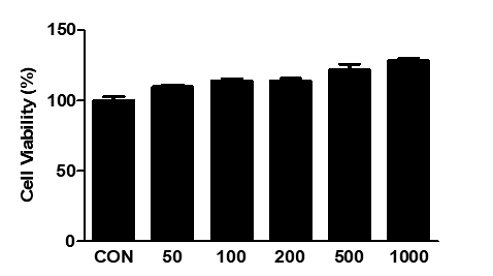
Cytotoxicity evaluation of Amomum villosum Lour extract (AVE) on HT-29 cells using the MTT assay. HT-29 cells were treated with AVE at concentrations of 50, 100, 200, 500, and 1000 μg/ml for 24 hours. Cell viability was measured relative to the untreated control group (set as 100%). AVE treatment showed no cytotoxicity across the tested concentrations. Data are presented as the mean ± standard deviation (n=3).
2. 양춘사의 염증성 사이토카인 억제 효과
Enzyme-linked immunosorbent assay (ELISA)를 이용하여 양춘사 추출물(Amomum villosum Lour extract, AVE)의 염증성 사이토카인 방출 억제 효과를 평가하였다. HT-29 세포를 AVE로 1시간 동안 전처리한 후, LPS로 자극하여 IL-8, TNF-α, MCP-1의 분비량을 측정하였다. 대조군(Control)에서 IL-8, TNF-α, MCP-1의 분비량은 각각 약 77.74±6.81, 3.43±0.12, 26.58±2.44 pg/ml로 나타났다. LPS 처리군에서는 IL-8과 TNF-α의 분비량이 각각 약 158.34±22.96, 6.08±0.50 pg/ml로 유의하게 증가하였고, MCP-1의 경우 42.79±5.69 pg/ml로 관찰되었다.
AVE 처리군에서는 IL-8과 TNF-α의 분비량이 농도 의존적으로 감소하는 양상을 보였다. AVE 100, 200, 500 μg/ml 처리 시 IL-8은 각각 126.69±10.67, 98.39±9.76, 67.26±7.06 pg/ml로, TNF-α는 각각 6.04±0.70, 2.86±1.73, 0.71±0.34 pg/ml로 나타났다. 반면 MCP-1의 경우, AVE 100 μg/ml 처리군에서는 약 16.83±8.44 pg/ml로 감소하였으며, 200 μg/ml와 500 μg/ml 처리군에서도 유사한 농도로 관찰되어 저농도에서 부터 안정적인 감소 효과를 나타냈다. 이러한 결과는 MCP-1이 AVE의 농도 의존적 패턴을 따르지 않으나, 낮은 농도에서도 효과적인 감소를 유도할 수 있음을 시사한다.
IL-8과 TNF-α는 AVE 전처리 후 LPS를 3시간 동안 자극한 후 측정하였으며, MCP-1은 24시간 동안 자극 후 평가하였다. 본 결과는 AVE가 LPS로 유도된 염증성 사이토카인 방출을 억제하고 염증반응을 완화하는 데 효과적임을 나타낸다.
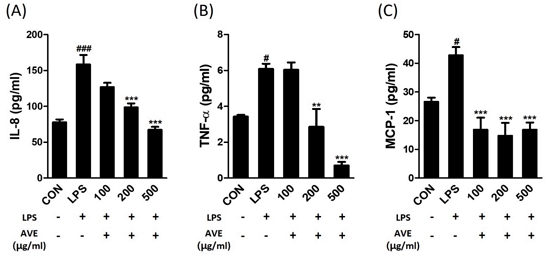
Inhibitory effects of Amomum villosum Lour extract (AVE) on cytokine release in HT-29 cells. HT-29 cells were pretreated with AVE at concentrations of 100, 200, and 500 μg/ml for 1 hour, followed by LPS stimulation. Cytokine levels were measured using ELISA. (A) IL-8 release was significantly reduced in a dose-dependent manner. (B) TNF-α secretion showed a similar dose-dependent decrease. (C) MCP-1 release was slightly reduced in AVE-treated groups compared to the control. Data are presented as the mean ± standard deviation (n=3). ###p<0.01, #p<0.005 vs. CON, **p<0.01, ***p<0.05, vs. LPS.
3. 양춘사의 염증반응 초기 조절 억제 효과
RT-PCR을 이용하여 양춘사 추출물(Amomum villosum Lour extract, AVE)이 COX-2, TLR-4, IL-8의 mRNA 발현에 미치는 영향을 분석하였다. HT-29 세포를 AVE로 1시간 동안 전처리한 후 LPS를 3시간 처리한 결과, 대조군(Control)의 COX-2, TLR-4, IL-8의 mRNA 발현 수준 대비, LPS 처리군에서는 COX-2, TLR-4, IL-8의 발현이 각각 1.4, 2.5, 1.93로 증가하였다. 그러나 AVE 처리군에서는 LPS 단독 처리군 대비, COX-2의 발현이 100, 200, 500 μg/ml 처리 시 각각 0.45, 0.31, 0.28로 감소하였으며, TLR-4의 발현은 각각 0.79, 0.52, 0.23으로 관찰되었다. IL-8의 경우 100, 200, 500 μg/ml 처리 시 각각 0.86, 0.77, 0.38로 감소하였다. 이러한 결과는 AVE가 염증반응 초기에 COX-2, TLR-4, IL-8의 발현을 억제하여 염증 완화 효과를 나타냄을 시사한다.
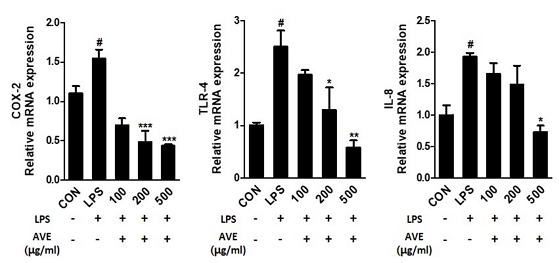
Inhibitory effects of Amomum villosum Lour extract (AVE) on COX-2, TLR-4, and IL-8 mRNA expression in HT-29 cells. Cells were pretreated with AVE at concentrations of 100, 200, and 500 μg/ml for 1 hour, followed by LPS stimulation for 3 hours. mRNA levels were analyzed using RT-PCR and normalized to the untreated control. Data are presented as the mean ± standard deviation (n=3). #p<0.05 vs. CON, *p<0.05, **p<0.01, ***p<0.05 vs. LPS.
4. 양춘사의 염증반응 후기 조절 및 점막 장벽 단백질의 변화
다음으로 염증반응 후기와 점막 장벽 단백질의 변화를 보기 위해 RT-PCR을 이용하여 양춘사 추출물(Amomum villosum Lour extract, AVE)이 iNOS, TNF-α, IL-6, ZO-1, Occludin의 mRNA 발현에 미치는 영향을 분석하였다. HT-29 세포를 AVE로 1시간 전처리한 후 LPS를 24시간 처리한 결과, 대조군(Control)의 iNOS, TNF-α, IL-6, ZO-1, Occludin의 mRNA 발현 수준 대비, LPS 처리군에서는 iNOS, TNF-α, IL-6의 발현이 각각 2.15, 4.29, 1.47로 증가한 반면, ZO-1과 Occludin은 각각 0.37, 0.68로 감소하였다. AVE 처리군에서는 LPS 단독 처리군 대비, iNOS의 발현이 100, 200, 500 μg/ml 처리 시 각각 0.74, 0.48, 0.41로 감소하였으며, TNF-α는 각각 0.88, 1.19, 0.33로, IL-6은 각각 0.83, 0.78, 0.54로 감소하였다. ZO-1의 발현은 각각 2.12, 1.52, 3.1로, Occludin의 발현은 각각 1.26, 1.29, 1.49으로 증가하였다. 이러한 결과는 AVE가 염증반응 진행 과정에서 염증성 사이토카인의 발현을 억제하고, 점막 장벽 관련 유전자의 발현을 증가시켜 장 점막의 보호 효과를 나타냄을 보여준다.
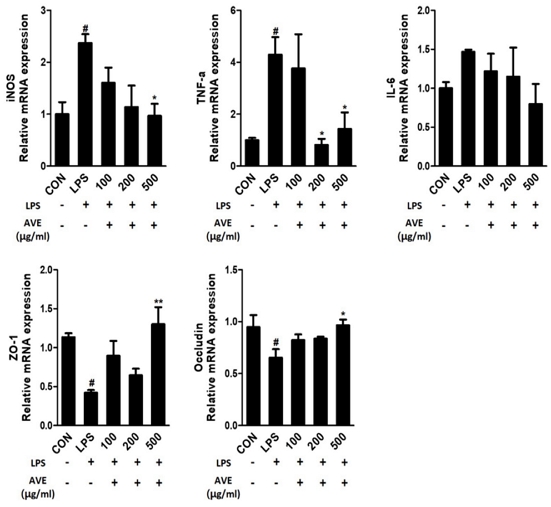
Effects of Amomum villosum Lour extract (AVE) on iNOS, TNF-α, IL-6, ZO-1, and Occludin mRNA expression in HT-29 cells. Cells were pretreated with AVE at concentrations of 200, 500, and 1000 μg/ml for 1 hour, followed by LPS stimulation for 24 hours. mRNA levels were analyzed using RT-PCR and normalized to the untreated control. Data are presented as the mean ± standard deviation (n=3). #p<0.05 vs. CON, *p<0.05, **p<0.01 vs. LPS.
5. 양춘사의 염증반응 후기 조절 및 점막 장벽 단백질의 변화
Western blot을 이용하여 양춘사 추출물(Amomum villosum Lour extract, AVE)이 염증성 단백질(iNOS, COX-2, TNF-α), 신호전달 관련 단백질(p-ERK, ERK, p-p38, p38), 점막 장벽 관련 단백질(Occludin, ZO-1)의 발현에 미치는 영향을 분석하였다.
첫 번째 결과는 iNOS, COX-2, TNF-α의 발현을 확인한 것으로, AVE 1시간 전처리 후 LPS를 3시간 처리한 결과이다. LPS 단독 처리군에서는 iNOS, COX-2, TNF-α 단백질의 발현이 대조군에 비해 유의하게 증가하였다. 그러나 AVE 처리군에서는 농도 의존적으로 iNOS, COX-2, TNF-α의 발현이 감소하였다. 특히, 500 μg/ml 농도에서 가장 낮은 발현을 보여 AVE가 염증성 단백질 발현을 효과적으로 억제할 수 있음을 시사하였다.(Fig. 5A)
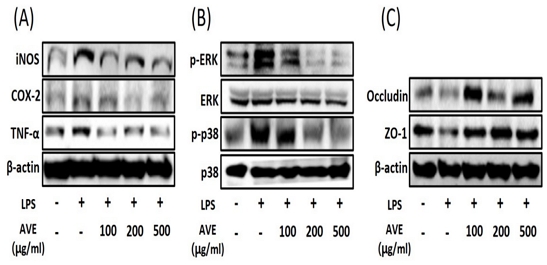
Effects of Amomum villosum Lour extract (AVE) on the expression of inflammatory proteins, signaling pathway proteins, and mucosal barrier proteins in HT-29 cells. (A) Protein levels of iNOS, COX-2, and TNF-α were analyzed by Western blot after pretreatment with AVE for 1 hour, followed by LPS stimulation for 3 hours. AVE treatment reduced the expression of all three proteins in a dose-dependent manner. (B) Phospho- and total forms of ERK and p38 were assessed after AVE pretreatment for 1 hour and LPS stimulation for 15 minutes. AVE inhibited phospho-ERK and phospho-p38 levels in a dose-dependent manner. (C) Protein levels of Occludin and ZO-1 were analyzed after AVE pretreatment for 1 hour and LPS stimulation for 24 hours. AVE increased the expression of Occludin and ZO-1 in a dose-dependent manner, restoring the levels reduced by LPS.
Fig. 5B는 신호전달 관련 단백질인 p-ERK, ERK, p-p38, p38의 발현을 관찰한 것으로, AVE 1시간 전처리 후 LPS를 15분 동안 처리한 결과이다. LPS 단독 처리군에서는 p-ERK 및 p-p38의 phospho-form 발현이 증가하였으나, AVE 처리군에서는 농도 의존적으로 감소하였다. 이는 AVE가 LPS로 유도된 염증 신호 전달 경로를 효과적으로 억제함을 보여준다.
Fig. 5C는 Occludin과 ZO-1 단백질의 발현을 분석한 것으로, AVE 1시간 전처리 후 LPS를 24시간 동안 처리한 결과이다. LPS 단독 처리군에서는 두 단백질 모두 발현이 감소하였으나, AVE 처리군에서는 농도 의존적으로 발현이 증가하였다. Occludin은 AVE 100 μg/ml 처리군에서 대조군보다 높은 발현을 보였으며, 500 μg/ml 처리군에서도 유의한 증가를 나타냈다. ZO-1의 경우, AVE 100, 200, 500 μg/ml 처리군이 대조군과 유사하거나 더 높은 발현을 보여, AVE가 점막 장벽 단백질의 발현을 촉진하는 데 효과적임을 시사하였다.
고 찰
염증성 장 질환(Inflammatory Bowel Disease, IBD)은 장관 내 만성 염증으로 인해 장 점막의 구조적 및 기능적 손상을 초래하며, 환자의 삶의 질을 심각하게 저하시킨다. 이러한 질환은 궤양성 대장염(Ulcerative Colitis)과 크론병(Crohn’s Disease)을 포함하며, 이들의 발병 기전에는 유전적, 환경적 요인과 장내 미생물군의 불균형, 면역계의 과도한 활성화가 복합적으로 작용한다13,14). 특히 장 점막은 장내 환경과 체내를 구분하는 주요 방어선으로, 염증반응이 지속되면 점막 장벽이 손상되고 장관 투과성이 증가하여 외부 병원체 및 독소의 침투가 용이해진다. 이는 염증성 사이토카인의 과도한 분비와 면역 반응의 불균형을 유발하여 질환의 악화를 초래한다. 따라서 염증반응의 조절 및 장 점막 장벽의 복원은 IBD 치료에서 중요한 목표로 간주된다15).
본 연구는 양춘사 추출물이 LPS로 유도된 염증반응에서 염증성 사이토카인의 분비를 억제하고 점막 장벽 단백질의 발현을 증가시키는 효과를 확인하였다. MTT assay를 통해 양춘사 추출물이 세포 생존율에 독성을 유발하지 않음을 입증하였으며, 이는 양춘사 추출물이 안전한 천연물 기반 치료제로서의 가능성을 보여준다. ELISA 결과는 양춘사 추출물이 IL-8과 TNF-α의 분비를 농도 의존적으로 억제하였음을 나타냈으며, 이는 장 점막 손상 및 염증성 면역 반응을 완화하는 중요한 메커니즘으로 평가된다. MCP-1의 경우, 저농도인 100 μg/ml 처리군에서 대조군(Control)보다 유의하게 감소하였으며, 고농도(200, 500 μg/ml) 처리군에서도 유사한 수준의 감소가 관찰되었다. 이는 MCP-1의 조절 메커니즘이 IL-8 및 TNF-α와는 다른 농도 의존성을 보이며, 양춘사 추출물이 만성 염증 상태에서의 MCP-1 분비를 더 즉각적으로 조절할 가능성이 있고, 이를 추가적으로 연구할 필요성을 제시한다16,17).
RT-PCR 결과는 양춘사 추출물이 COX-2, TLR-4, IL-8과 같은 염증성 마커의 발현을 억제함으로써 초기 염증반응을 조절하는 데 중요한 역할을 한다는 것을 보여준다. 특히 COX-2와 TLR-4는 염증반응 초기 신호 전달 경로의 핵심 단백질로, 이들의 발현 억제는 LPS로 유도된 염증반응의 증폭을 차단하는 데 효과적이다. IL-8 발현의 감소는 염증성 사이토카인 네트워크의 균형을 조절하여 장 점막 세포의 손상 및 염증성 면역 반응을 완화할 가능성을 나타낸다. ZO-1과 Occludin과 같은 점막 장벽 관련 단백질의 발현 증가는 양춘사 추출물이 손상된 점막 장벽의 복원과 장 점막의 기능적 안정성을 유지하는 데 기여할 수 있음을 시사한다18,19).
Western blot 분석을 통해 확인된 p-ERK와 p-p38의 발현 억제는 MAPK 신호 전달 경로가 양춘사 추출물에 의해 효과적으로 조절될 수 있음을 보여준다. MAPK 경로는 염증반응의 중심에 있는 신호전달 네트워크로, 이 경로의 활성화는 염증성 단백질(iNOS, COX-2, TNF-α)의 발현을 유도하고 염증반응을 증폭시킨다. 양춘사 추출물이 MAPK 경로의 억제를 통해 염증반응의 중심 기전을 차단하며, 이는 기존 항염증 약물과 유사한 효과를 보이면서도 자연 유래 소재로서의 안전성을 제공한다는 점에서 주목할 만하다20,21).
한편, 양춘사 추출물은 한약재로서 전통적으로 비위(脾胃)의 기능을 강화하고 습열(濕熱)을 제거하며 기체(氣滯)를 완화하는 데 사용되었다. 이는 장내 염증 및 점막 손상과 밀접하게 연관되며, 본 연구는 이러한 전통적 효능을 현대 과학적 방법으로 입증한 점에서 중요한 의의를 가진다. 특히, 양춘사 추출물의 정유 성분과 플라보노이드 화합물은 항염증 및 항산화 효과를 나타내며, 이는 염증반응과 산화적 스트레스가 상호 작용하여 장 점막 손상을 악화시키는 기전에 대항할 수 있는 중요한 작용 메커니즘으로 평가된다22,23).
본 연구는 양춘사 추출물이 염증성 장 질환에서 중요한 병리적 기전을 조절하고 장 점막의 복원과 안정성 유지에 기여할 수 있는 가능성을 제시하였다. 그러나 본 연구는 in vitro 모델에 국한되어 있으며, 양춘사 추출물의 주요 활성 성분과 작용 기전을 명확히 하기 위한 추가 연구가 요구된다. 또한, 양춘사 추출물의 효능을 실제 장내 환경에서 확인하기 위한 in vivo 연구와 임상 시험이 필수적이다. 이러한 추가 연구는 천연물 기반 치료제로서 양춘사 추출물의 잠재력을 극대화하고, 염증성 장 질환 관리에 새로운 접근 방식을 제공할 수 있을 것이다.
결 론
본 연구는 양춘사 추출물의 항염증 효과와 장 점막 장벽 복원 능력을 연구하여 아래와 같은 결론을 얻었다.
양춘사 추출물은 LPS로 유도된 초기 염증반응을 조절하여 염증성 사이토카인의 분비를 효과적으로 억제하였다.
후기 염증반응에서 양춘사 추출물은 염증 신호 전달 경로를 억제하고, 점막 장벽 단백질의 발현을 촉진하여 장 점막의 구조적 안정성을 유지하였다.
양춘사 추출물은 초기와 후기 염증반응을 동시에 조절함으로써, 염증성 장 질환의 주요 병리적 과정을 완화하는 데 기여하였다.
양춘사 추출물은 p-ERK와 p-p38을 포함한 MAPK 신호 전달 경로를 억제하여 염증반응의 핵심 기전을 차단하였다.
이상의 결과는 양춘사 추출물이 염증반응을 조절하고 장 점막을 복원하는 데 효과적임을 시사하며, 향후 염증성 장 질환의 예방 및 치료를 위한 건강 기능 식품 또는 천연물 기반 치료제로 활용될 가능성을 제시한다.
Acknowledgments
본 연구는 2022년도 중소벤처기업부의 기술개발사업 지원에 의한 연구임(RS-2022-00167168).
References
-
Xavier RJ, Podolsky DK. Unravelling the pathogenesis of inflammatory bowel disease. Nature. 2007;448(7152):427-34.
[https://doi.org/10.1038/nature06005]

-
Abraham C, Cho JH. Inflammatory bowel disease. New England Journal of Medicine. 2009;361(21):2066-78.
[https://doi.org/10.1056/NEJMra0804647]
-
Park SH, Kim YJ, Rhee KH, et al. A 30-year trend analysis in the epidemiology of inflammatory bowel disease in the Songpa-Kangdong district of Seoul, Korea in 1986-2015. J Crohns Colitis. 2019;13(11):1410-7.
[https://doi.org/10.1093/ecco-jcc/jjz081]
-
Lee SH, Kwon JE, Cho ML. Immunological pathogenesis of inflammatory bowel disease. Intest Res. 2018;16(1):26-42.
[https://doi.org/10.5217/ir.2018.16.1.26]
-
Ananthakrishnan AN. Environmental risk factors for inflammatory bowel diseases: a review. Dig Dis Sci. 2015;60(2):290-8.
[https://doi.org/10.1007/s10620-014-3350-9]
- Zhou SS, Sun Z, Wu Q, Zhou X, Zhang Y. Antiinflammatory effects of Amomum villosumLour. J Ethnopharmacol. 2010;130(1):54-62.
- Li HJ, Zhang ZW, Wang XL, Liu P, Yu ZX. Phytochemical analysis and biological activities of Amomum villosumLour. Phytochem Rev. 2018;17(6):1359-75.
- Wu T, Yang N, Zhang D, Zhang Q, Li L. Amomum villosumextract improves intestinal barrier function and reduces inflammation in LPS-treated intestinal models. J Med Food. 2021;24(3):242-50.
-
Loftus EV Jr. Clinical epidemiology of inflammatory bowel disease: Incidence, prevalence, and environmental influences. Gastroenterology. 2004;126(6):1504-17.
[https://doi.org/10.1053/j.gastro.2004.01.063]
-
Sartor RB. Mechanisms of disease: Pathogenesis of Crohn's disease and ulcerative colitis. Nat Clin Pract Gastroenterol Hepatol. 2006;3(7):390-407.
[https://doi.org/10.1038/ncpgasthep0528]
-
Luo D, Wu J, Chen Y, Zhang Q, Huang X. Dietary supplement of Amomum villosumLour. polysaccharide attenuates ulcerative colitis in BALB/c mice. Foods. 2022;11(22):3737.
[https://doi.org/10.3390/foods11223737]
-
Wu Z, Li S, Wang X, Zhao F, Zhang H. Therapeutic effect of Amomum villosumon inflammatory bowel disease in rats. Front Pharmacol. 2018;9:639.
[https://doi.org/10.3389/fphar.2018.00639]
-
Ng SC, Shi HY, Hamidi N, Underwood FE, Tang W. Worldwide incidence and prevalence of inflammatory bowel disease in the 21st century: A systematic review of population-based studies. The Lancet. 2018;390(10114):2769-78.
[https://doi.org/10.1016/S0140-6736(17)32448-0]
- Liu Z, Wu Z, Li Z, Zhao T, Yu W. Protective effects of natural products on intestinal barrier function in inflammatory bowel disease. World J Gastroenterol. 2015;21(42):11317-29.
- He X, Wang X, Fang J, Zhao T, Huang L. Traditional uses, phytochemistry, and pharmacology of Amomum villosumLour.: A review. J Ethnopharmacol. 2013;147(2):245-56.
- Wang Y, Li L, Yang X, Zhang H, Chen Y. Role of flavonoids in the modulation of inflammatory signaling pathways. Int J Mol Sci. 2019;20(23):5678.
-
Sartor RB. Mechanisms of disease: Pathogenesis of Crohn's disease and ulcerative colitis. Nat Clin Pract Gastroenterol Hepatol. 2006;3(7):390-407.
[https://doi.org/10.1038/ncpgasthep0528]
-
Loftus EV Jr. Clinical epidemiology of inflammatory bowel disease: Incidence, prevalence, and environmental influences. Gastroenterology. 2004;126(6):1504-17.
[https://doi.org/10.1053/j.gastro.2004.01.063]
- Zhou SS, Sun Z, Wu Q, Zhou X, Zhang Y. Antiinflammatory effects of Amomum villosumLour. J Ethnopharmacol. 2010;130(1):54-62.
- Wu T, Yang N, Zhang D, Zhang Q, Li L. Amomum villosumextract improves intestinal barrier function and reduces inflammation in LPS-treated intestinal models. J Med Food. 2021;24(3):242-50.
- Li HJ, Zhang ZW, Wang XL, Liu P, Yu ZX. Phytochemical analysis and biological activities of Amomum villosumLour. Phytochem Rev. 2018;17(6):1359-75.
- He X, Wang X, Fang J, Zhao T, Huang L. Traditional uses, phytochemistry, and pharmacology of Amomum villosumLour.: A review. J Ethnopharmacol. 2013;147(2):245-56.
- Wang Y, Li L, Yang X, Zhang H, Chen Y. Role of flavonoids in the modulation of inflammatory signaling pathways. Int J Mol Sci. 2019;20(23):5678.