
한의학 교육에서 시뮬레이션 기반 임상실습 전 교육과정에 대한 평가
Ⓒ The Society of Pathology in Korean Medicine, The Physiological Society of Korean Medicine
Abstract
Competency-Based Medical Education (CBME) emphasizes developing practical clinical skills beyond theoretical knowledge, yet students in clerkships often face limited opportunities to directly engage with patients due to concerns about safety, privacy, and ethics. These constraints can leave graduates insufficiently prepared for clinical practice. Although Korean medicine education has adopted performance assessments such as CPX and OSCE, simulation-based training remains underdeveloped. This study evaluated the educational experience and satisfaction of students participating in a digital clinical simulation curriculum at Pusan National University School of Korean Medicine. The program comprised three modules: structured history-taking for dizziness patients, physical examination with simulators, and patient education through peer role-play. Fifteen students in clinical preparatory stages participated, and post-training online surveys assessed satisfaction with the program, perceived usefulness for clinical clerkship preparation, and feedback on each training component. Thirteen students responded (86.7% response rate). Overall satisfaction was high, with 84.6% reporting improved readiness for clerkship. Simulators were valued for providing comprehensive vital signs and pathological findings, while role-play enhanced communication skills. Students highlighted structured content and practical learning opportunities but noted the short duration and limited practice with traditional procedures as drawbacks. In conclusion, Digital clinical simulation combining simulators and role-play was perceived by students as a useful approach to enhance their clinical competence and confidence prior to real patient encounters, particularly in contexts where patient access is limited. Future development should expand skills training, extend program duration, and establish standardized examinations, with multi-center studies recommended to confirm and generalize these findings.
Keywords:
Competency-Based Medical Education, Clinical Simulation, Clinical Performance Examination, Korean Medicine Education서 론
현대 의학교육은 단순한 지식 전달을 넘어, 실제 임상 현장에서 요구되는 실무 역량을 갖춘 의료인을 양성하는 방향으로 변화하고 있다. 이러한 패러다임 전환 속에서 역량중심교육(Competency-Based Medical Education, CBME)은 ‘무엇을 알고 있는가’에서 ‘무엇을 할 수 있는가’에 중점을 두는 교육 철학으로 주목받고 있다. 의학교육에서도 단순한 지식 전달을 넘어, 실제 임상 현장에서 요구되는 실무 역량을 갖춘 의료인 양성의 중요성이 강조되고 있다1). 특히 임상실습(Clinical Clerkship)은 Miller의 역량 피라미드에서 ‘show how’와 ‘do’에 해당하는 고차원적 임상 능력을 학습자가 직접 경험하고 평가받는 핵심 단계이다2). 그러나 실제 임상 환경에서는 환자 안전, 사생활 보호, 법적·윤리적 제약 등으로 인해 학생들이 환자를 직접 면담하거나 술기를 수행할 기회가 제한적인 것이 현실이다3).
이에 실제 환자 진료를 직접 경험하기 어려운 상황을 보완하기 위해 다양한 교육 방법이 모색되고 있으며, 그중에서도 시뮬레이터를 활용한 시뮬레이션 기반 의학교육(Simulation-Based Medical Education, SBME)이 주목받고 있다. 이러한 교육은 단순 술기 연습뿐만 아니라 표준화 환자(Standardized Patient, SP)와 연계한 모의 진료, 생체 징후 및 병적 소견을 재현하는 시뮬레이터 실습 등을 포함하여 임상 술기와 환자 의사소통 능력 모두를 향상시키는 데 효과적인 것으로 보고되었다4). 또한 임상실습 이전 단계에 있는 학생들에게 실제 임상 환경과 유사하게 설계한 시뮬레이션 실습 기회를 제공함으로써 임상실습 준비도를 높인 사례가 보고되었으며, 실습 참여 전 준비도(perceived preparedness)를 높이고, 임상 술기 및 의사소통 능력의 통합적 향상을 기대할 수 있다. 교육 후 실시된 만족도 및 자기평가 조사에서도 학습자들의 긍정적인 반응이 확인되었다5). 이와 같이 시뮬레이션은 실제 환자를 대상으로 임상술기를 시행하기 어려운 임상실습 교육환경의 한계를 보완하는 유용한 교육 방법으로 활용되고 있다.
한의학 교육 분야에서도 진료역량 강화의 필요성이 대두되며, 임상실습 과정에 임상수행평가(Clinical Performance Examination, CPX)와 객관적 구조화 임상시험(Objective Structured Clinical Examination, OSCE) 등 평가 도구를 활용한 교육적 접근이 활발히 연구되고 있다6,7). 최근 국내 문헌 고찰에 따르면 2012년부터 2022년까지 발표된 25편의 연구에서 OSCE와 CPX가 다양한 임상과목에 적용되었고, 학생 만족도, 교육 효과 면에서 긍정적 평가가 보고되었다8). 또한 한의사 국가시험에 실기시험(Clinical Skills Examination, CSE) 도입의 타당성을 델파이 기법으로 검토하는 등 기본한의학교육의 핵심 역량의 평가 체계 개선에 대한 관심도 커지고 있다9). 이와 함께 최근에는 거대 언어 모델(Large Language Models, LLM)을 활용한 병력청취 훈련 도구가 개발되어, 학생들이 가상의 환자와 대화하며 임상 문진 과정을 반복 학습할 수 있는 기반이 마련되었다10,11).
그러나 현재까지 한의과대학의 술기교육은 주로 단일 술기의 OSCE 위주로 시행되고 있으며, 실제 임상 상황과 같이 임상추론 및 문제해결을 요구하는 진료역량의 평가에 대한 연구는 부족한 상태이다8). 특히 다양한 임상상황에서 정보수집, 임상추론과 함께 진단술기와 치료 술기를 종합적으로 수행하는 능력을 효과적으로 교육하기 위한 지속적인 연구가 필요하다.
한의학 교육에서도 학생들이 환자를 직접 대면하기 전, 임상 현장에서 요구되는 기본 진료 절차와 의사소통 기술을 체계적으로 학습할 수 있는 임상실습 전(pre-clerkship) 단계 교육의 중요성이 커지고 있다12,13). 임상실습 전 교육의 목표는 실제 환자를 다루기 전에 병력청취, 신체진찰, 기본 술기, 임상추론, 환자 교육 등의 핵심 임상 역량을 안전한 환경에서 익히도록 하는 것이다. 이러한 관점에서 시뮬레이션 기반 교육은 실제 환자 진료를 대체하며, 학습자가 반복적으로 진료 과정을 수행하고 피드백을 받을 수 있는 효과적인 방법이다. 본 연구에서 설계한 [디지털 기반 한의임상 시뮬레이션 교육과정]은 이러한 임상실습 전 단계의 교육 목표에 부합하도록 병력청취 훈련, 시뮬레이터를 활용한 신체진찰 실습, 환자교육 역할극, 그리고 종합실기평가(CPX·OSCE)를 단계적으로 구성하였다. 이를 통해 학생들이 실제 환자 진료에 앞서 임상적 사고력과 술기 수행 능력을 통합적으로 훈련할 수 있도록 하였다. 따라서 본 연구는 임상실습 전 단계에서 시행된 시뮬레이션 기반 한의학 실습교육의 적합성과 교육 효과를 학습자 만족도를 중심으로 평가하고자 한다. 이에 본 연구는 시뮬레이터와 표준화 환자를 활용하여 병적징후를 활용하여 임상추론 및 문제해결 능력을 배양하기 위한 임상 시뮬레이션 교육과정을 설계·운영하고, 그 교육 효과를 분석하고자 한다.
연구방법
1. 교육 방법
전국 한의과대학 재학생 중 희망자 15인을 대상으로 임상실습 전 단계의 시뮬레이션 교육 기회를 제공하기 위하여 총 5개의 한의과대학(원) 소속 교수 9인이 [디지털 기반 한의임상 시뮬레이션 교육과정]을 2025년 2월 3일부터 2월 4일까지 운영하였다. 본 연구는 해당 교육과정의 일부인 시뮬레이터를 활용한 수업과 동료 간 역할극에 참여한 학생들의 교육 경험과 만족도를 조사하고 이를 분석하였다. 이 연구는 기관윤리심의위원회의 승인을 받았다(IRB No. GIRB-25-102).
본 교육은 기초 및 임상 강의를 모두 이수 완료하고 임상실습 진입 전 단계에 있는 학생을 대상으로 설계되어 한의과대학 본과 3학년과 한의학전문대학원 2학년을 대상으로 교육참여자를 모집하였다. 교육 참여자는 한의학 교육기관에 발송된 공문과 온라인 게시판을 통해 교육 내용 및 일정을 안내받았으며, 참가를 희망하는 학생을 대상으로 선착순 15명을 모집하였다. 이 과정에서, 본과 1학년과 본과 2학년 각 1명씩 희망자가 있어, 본 교육 내용 및 선행학습 필요성을 충분히 설명한 후, 최종적으로 교육 참여를 희망하여 교육에 참여하였다. 이러한 설계와 대상자 선정은 다음 사항을 고려하여 공동 교수진의 회의를 통해 결정되었다: 본 교육이 계절학기나 비교과프로그램이 아닌 자율교육과정인 점, 본 교육이 ‘공동 교과목’ 사업의 일환으로 설계되었으며 이는 학교 내외의 경계를 허물어 다양한 교수와 학생이 참여하도록 한다는 점, 또한 교육 수준을 안내하였음에도 참여를 원하는 학생의 경우, 학문적 호기심과 자기주도적 학습 촉진 효과 측면에서 긍정적 효과가 있다는 점을 고려하였다.
[디지털 기반 한의임상 시뮬레이션 교육과정]은 일개 대학교의 ‘공동 교과목’ 개발사업의 일환으로 개발되었다. 다양한 세부 분야의 교수들이 협력하여 교육프로그램을 기획하고, 특히 기존 교육과정에서 다루어지지 않는 첨단 기술을 융합한 교육과정을 제공하도록 하였다. 과제책임자는 미래 교육과정에서 보강이 필요한 부분을 선정하여 해당 세부 분야의 전문가를 공동 강사진으로 위촉하였으며, 3개월간 참여 교수진의 정기적 회의를 통해 교육프로그램이 설계되었다. 이에 첨단 기술로 인공지능(Artificial Intelligence, AI), 가상현실(Virtual Reality, VR), 의료 시뮬레이터 등을 활용하고, 사업의 지침과 학습 내용을 고려하여 총 16시간 분량으로 구성되었다.
‘병력청취 훈련’에서는, LLM 기반 병력청취 훈련’에서는 진료수행평가(CPX) 상황을 모사한 챗봇과의 대화를 통해 학생들이 가상의 환자를 대상으로 병력청취를 반복 연습하였다. 이어서 ‘어지럼증’을 주소로 내원한 환자의 병력청취에 관한 임상교수의 강의가 제공되었으며, 학생들은 증상에 기반한 구조화된 문진 기술을 학습하였다.
‘시뮬레이터 활용 신체진찰 실습’ 모듈에서는 ‘어지럼증’을 주제로 시뮬레이터(인체모형)를 활용한 신체진찰 실습이 이루어졌으며, 서맥, 저혈당, 뇌졸중 등 다양한 이상 활력징후(abnormal vital signs), 심음·폐음·장음의 청진, 동공반사, 맥진, 복진 확인 등 실제 임상에서 요구되는 핵심 술기를 반복적으로 연습할 수 있도록 구성하였다. 해당 실습에 활용된 시뮬레이터는 SUSIE® S2000(Gaumard Scientific, USA) 모델이다. 또한, ‘초음파유도하약침 실습’에서는 VR 기반 가상 시뮬레이션을 활용하여 학생들이 안전한 환경에서 침술 및 약침 시술을 연습할 수 있도록 구성하였다. VR 시뮬레이션에는 360° VR 프로그램인 HaniE-VR1(주식회사 글로브포인트 공동 개발)과 독립형 HMD (Head-Mounted Display) 기기인 Meta Quest 3을 활용하였다14). 학생들은 HMD를 착용하고 손에 컨트롤러를 쥐며 머리를 상하좌우로 움직이며 1인칭 시점에서 VR 화면을 관찰하면서 단계별 시나리오에 따라 술기와 관련된 퀴즈를 수행하였다. 프로그램의 시나리오는 어깨 통증을 호소하는 환자를 대상으로 초음파를 이용한 진단과 초음파 유도하 약침 치료 과정을 360° VR 화면으로 재현하여, 학생들이 가상 환경에서 진단과 시술 절차를 체험하고 학습할 수 있도록 설계되었다.
‘환자교육 동료 역할극’ 모듈에서는, 모의진료 전체 과정을 수행하고, 환자에게 수집한 정보를 바탕으로 추정 진단을 설명하고, 향후 관리 계획을 환자와 함께 수립하는 공유된 의사결정(shared decision making) 기반의 의사소통 기술을 훈련하였다. 이 과정에서 ‘시뮬레이터 활용 신체진찰 실습’과 ‘환자 교육 동료 역할극’ 교육은 두 개 조(A조, B조)의 분반 형태로 두가지 교육이 병행하여 실시되었다. A조는 시뮬레이터 실습 후 역할극 실습을, B조는 역할극 실습 후 시뮬레이터 실습을 수행하였다. 이러한 분반 운영은 참여형 수업을 위해 소규모 그룹으로 실습을 진행하기 위함이었다. 시뮬레이터 1대를 사용하였기 때문에 교수의 시연을 효과적으로 관찰할 수 있는 적정 인원과 강의실 규모를 고려하였으며, 동료 역할극 또한 환자와 의사 역할을 1명씩 수행해야 하므로 주어진 시간 내에 모든 학생이 각각의 역할을 경험하고 개별 피드백을 받을 수 있도록 소그룹 형태로 운영하였다.
위의 교육 모듈을 모두 이수한 후에는 종합실기시험으로서 CPX (Clinical Performance Examination)와 OSCE (Objective Structured Clinical Examination)가 시행되었으며, 실제 임상 상황을 반영한 시나리오 기반으로 구성되었다. CPX 및 OSCE 수행 이후 실시한 자기평가와 만족도 조사의 결과는 본 연구의 주요 분석 자료로 활용되었다. 상기 교육과정에 대한 세부 내용은 Supplementary File 1, Supplementary File 2에 제시하였다.

Course Schedule
Instructors’ Educational Backgrounds and Teaching Methods
2. 분석 방법
교육 만족도 조사는 교육 종료 직후 온라인 설문지를 통해 익명으로 실시되었으며, 모든 참여자는 자율적으로 설문에 응답하였다. 설문지는 총 13문항으로 구성되었으며, 객관식과 주관식 문항이 혼합되어 있어 정량적 평가와 함께 참여자의 자유로운 의견을 수렴할 수 있도록 설계되었다. 만족도 문항은 학습자 참여와 몰입, 기대, 만족의 상호 연관성을 제시한 Bowden 등(2019)의 연구15)와, 교육 성과 평가를 위한 Kirkpatrick 4단계 모형 중 학습자의 반응(reaction)을 engagement, relevance, satisfaction으로 제시한 Smidt 등(2009)의 연구16)를 참고하여 개발하였다.
객관식 문항으로 수집된 범주형 자료는 각 항목별로 도수와 백분율을 산출하여 제시하였다. 통계 분석은 Microsoft Excel (Microsoft 365, 버전 16.0.19231.20138, 64비트)을 사용하여 수행하였다. 주관식 문항에 해당하는 질적 자료는 응답자의 실제 진술을 기반으로 한 in vivo 코딩을 실시하였고, 이후 반복적으로 나타나는 핵심 의미를 중심으로 lean coding을 적용하여 유의미한 진술을 도출하였다. 분석된 결과는 주요 주제별로 정리하였으며, 필요한 경우 대표 진술을 함께 제시하였다.
주관식 문항에 해당하는 질적 자료는 응답자의 실제 진술을 기반으로 한 in vivo 코딩을 실시하였고, 이후 반복적으로 나타나는 핵심 의미를 중심으로 lean coding을 적용하여 유의미한 진술을 도출하였다. 분석된 결과는 주요 주제별로 정리하였으며, 필요한 경우 대표 진술을 함께 제시하였다.
질적 분석의 타당도를 높이기 위해 삼각분석(triangulation)을 실시하였다. 첫째, 연구자 삼각검증(investigator triangulation)으로 2명 이상의 연구자가 독립적으로 자료를 분석한 뒤 결과를 대조하여 주관적 편향을 최소화하였다. 둘째, 방법론 삼각검증(methodological triangulation)으로 정성적 분석과 정량적 분석을 병행함으로써 주관적 해석에 의한 오류를 줄이고 결과의 신뢰성을 강화하였다.
결 과
본 연구에서는 총 15명의 교육 참가자 중 13명이 설문에 응답하였으며, 응답률은 86.7%였다. 설문은 인구학적 정보, 교육 만족도, 시뮬레이터 활용 및 역할극에 대한 인식, 교육 전반에 대한 평가 등으로 구성되었다.
1. 인구학적 정보
응답자 13명 중 남학생은 4명(30.8%), 여학생은 9명(69.2%)이었다. ‘어지럼증 환자 진료에 대한 실습 교육 경험 여부’에 대해서는 7명(53.8%)이 ‘예’라고 응답하였고, 6명(46.2%)은 경험이 없다고 응답하였다. 또한, CPX 또는 모의진료 경험이 있다고 응답한 학생은 4명(30.8%)이었고, 9명(69.2%)은 관련 경험이 없다고 답하였다(Table 1).
Demographic Characteristics and Prior Practical Training Experience of Respondents(n=13)
2. 교육과정에 대한 만족도
‘본 교육이 본과 4학년 실습 이전에 도움이 되었는가’라는 문항에서 응답자의 84.6%(11명)는 매우 그렇다(5점), 15.4%(2명)는 그렇다(4점)라고 응답하였다. 시뮬레이터의 효과성에 대해서도 동일한 비율로 응답이 분포하였다(5점: 84.6%, 4점: 15.4%).
동료 간 역할극에 대한 평가에서는, 전체 응답자의 84.6%(11명)가 전반적으로 도움이 되었다고 답하였으며, 한의사 역할이 학습에 도움이 되었는가에 대한 항목에서도 동일한 비율(84.6%)이 긍정적으로 응답하였다. 반면, 환자 역할과 관찰자 피드백 역할에 대해서는 각각 53.8%와 53.8%가 매우 도움이 되었다고 응답했으며, 다소 도움되었다는 응답도 각각 38.5%와 30.8%로 뒤를 이었다.
CPX 연습의 임상실습 및 향후 진료에 대한 기여도 평가에서는 84.6%가 매우 도움이 되었다고 응답하였고, CPX 교육 만족도(76.9%)와 OSCE 교육 만족도(76.9%) 모두 높게 나타났다(Fig. 1, Table 2).
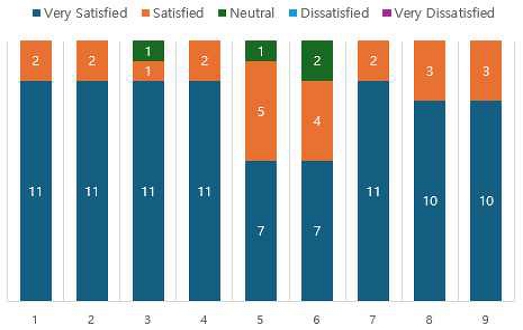
Distribution of Responses on Curriculum Satisfaction. 1= To what extent do you consider this training helpful prior to 4th-year clinical practice? 2= To what extent do you consider the use of simulators beneficial during practical training? 3= To what extent do you consider peer role-playing beneficial during practical training? 4= How beneficial is the “Korean medicine doctor” role in peer role-playing for learning? 5= How beneficial is the “patient” role in peer role-playing for learning? 6= How beneficial is the “observer feedback” role in peer role-playing for learning? 7= To what extent does CPX clinical performance practice assist in clinical practice and future treatment? 8= How satisfied are you with the CPX training in this Korean medicine clinical simulation education? 9= How satisfied are you with the OSCE (skill) training in this Korean medicine clinical simulation education?
Satisfaction with the Korean Medicine Clinical Simulation Curriculum(n=13)
3. 시뮬레이터 활용 요소별 유용성 평가
성인 시뮬레이터 활용에서 가장 도움이 된 요소로는 ‘종합적 생체정보 제공(심전도, 뇌압, 혈당 등)’이 40.7%(11명)로 가장 높았으며, ‘병적 징후의 관찰(비정상 동공반사, 심음 등)’이 33.3%(9명), ‘다양한 혈압 및 맥박 사례 관찰’이 25.9%(7명)로 뒤를 이었다(Table 3).
Educational Elements Found Most Beneficial When Using an Adult Simulator(total responses = 27)
4. 교육에 대한 긍정적 경험과 요구사항
개방형 문항을 통해 교육에 대한 긍정적 경험과 아쉬운 점이 함께 도출되었다. 긍정적인 응답은 ‘실습 기회 및 실제감 있는 구성(38.5%)’, ‘다양한 실습 도구 경험(30.8%)’, ‘교육 내용의 체계성과 실용성(23.1%)’, ‘AI 및 새로운 접근법의 경험(15.4%)’, ‘학습 방향성 확보(7.7%)’ 등이 있었다. 학생들은 “실제 시험치듯이 CPX를 연습할 수 있어 좋았다”, “인체 더미를 활용해 맥박과 동공반사를 확인한 것이 인상 깊었다”, “CPG와 flowchart를 통해 다빈도 질환을 도식화한 것이 도움이 되었다”는 의견을 주었다.
반면 아쉬운 점으로는 ‘교육 기간 및 준비 시간 부족(15.4%)’, ‘수업 간 연계 부족(7.7%)’, ‘자료 및 평가 기준 부족(15.4%)’, ‘한방 술기 체험 기회 부족(15.4%)’ 등이 지적되었다. 특히 “짧은 시간에 내용을 숙지하고 시험을 치는 것이 어려웠다”, “CPX/OSCE 준비 시간이 부족했다”, “약침 시술을 실제로 해볼 기회가 없었던 점이 아쉽다”는 의견이 확인되었다(Table 4).
Positive Experiences and Areas for Improvement in the Korean Medicine Clinical Simulation Curriculum(n=13)
고 찰
본 연구는 [디지털 기반의 한의임상 시뮬레이션 교육과정]에 참여한 학생들의 교육 경험과 만족도를 분석함으로써, 실제 교육 현장에서 시뮬레이터와 역할극을 활용한 임상 교육이 학습자에게 어떤 영향을 미쳤는지를 탐색하였다. 특히 본과 3~4학년 학생을 대상으로 진행된 이번 교육은 임상실습을 본격적으로 시작하는 시기의 학습자에게 시의적절한 실습 경험을 제공하고자 설계되었다. 교육과정을 구체적으로 살펴보면 LLM 기반 진료수행평가 병력청취 훈련을 시작으로, 구조화된 병력청취 교육, 시뮬레이터 실습, 환자 교육 역할극을 결합한 후 표준화 환자를 대상으로 한 CPX 및 OSCE 평가로 마무리되었다. 이러한 단계적 구성이 학습자에게 실제 진료 수행과 유사한 경험을 제공하였으며, 이는 학생들의 몰입도와 만족도를 높이는 데 기여했을 것으로 생각된다.
우선, 학생들은 교육 전반에 대해 높은 만족도를 보였으며, 특히 ‘본과 4학년 실습 전에 도움이 되었다’, ‘시뮬레이터가 도움이 되었다’, ‘동료간 역할극이 도움이 되었다’는 문항에서 각각 84.6%의 응답자가 ‘매우 그렇다’고 답해, 교육 내용과 방식이 학습자에게 실질적인 도움이 되었음을 보여주었다. 본 연구의 설문 문항 중 ‘본과 4학년 실습 이전에 도움이 되었는가’라는 항목은, 실제로 임상실습을 아직 경험하지 않았으므로, 본과 3학년까지 학습에서 본인들이 부족하다고 느낀 분야에 대한 학습 경험을 평가한 것으로 해석할 수 있다. 따라서 이는 실습 경험 이후의 실제 효과 평가보다는, 시뮬레이션 교육을 통해 임상실습에 대한 준비도(perceived preparedness)가 향상되었다는 인식을 나타낸다. 학생들은 병력청취 절차의 구조화, 신체진찰 단계별 접근, 환자와의 의사소통 과정 등에서 실질적인 이해와 자신감이 높아졌다고 응답하였으며, 이는 임상실습 진입 전에 필요한 기초 임상 역량(병력청취, 관찰, 환자응대)에 대한 사전 훈련의 효과를 시사한다. 본 교육 프로그램은 임상실습 중 수행되는 실제 진료를 모사하되, 환자 안전과 시간 제약이 없는 환경에서 학생들이 반복 학습과 피드백을 받을 수 있도록 설계되었다는 점에서 임상실습 전 교육과정으로서의 의의가 있다. CPX 및 OSCE 형식으로 구성된 임상 시나리오 실습은 학생들에게 실제 시험 상황을 간접적으로 체험할 기회를 제공하였고, 이는 실습 준비의 자신감 향상으로 이어졌다고 해석할 수 있다. 특히, 동료 간 역할극을 포함한 실습은 의사소통 능력 및 환자 응대 역량을 강화하는 데 효과적이었으며, 선행 연구(Yamauchi et al.(2021)17), Gelis et al.(2020)18), Nestel and Tierney(2007)19)에서도 유사한 교육 방식이 임상추론 및 커뮤니케이션 능력 향상에 유의미한 영향을 미쳤다는 점이 보고된 바 있다.
학생들은 시뮬레이터를 통해 병적 징후, 다양한 혈압과 맥박 사례, 심전도·뇌압·혈당 등 종합적인 생체 정보를 시각적·청각적으로 확인할 수 있어 만족도가 높았다. 구체적으로, Table 3에 따르면 전체 응답자의 40.7%가 심전도, 뇌압, 혈당 및 활력징후 등 종합적인 생체정보 제공을 가장 유익하다고 응답했으며, 병적 징후 관찰과 다양한 혈압·맥박 사례 관찰도 각각 33.3%, 25.9%로 뒤를 이었다. 이러한 결과는 실제 환자와의 접촉 기회가 제한된 한의과대학 교육 환경에서, 인체 모형을 통한 반복 실습이 임상 술기 습득을 위한 효과적인 대안임을 시사한다. 실제로, 시뮬레이터 활용은 반복 학습 및 즉각적 피드백, 다양한 생체 반응 재현이 가능하다는 점에서 교육적 가치가 크다20). 이러한 시뮬레이션 기반 학습은 학습자가 실수 상황에서도 안전한 환경에서 반복할 수 있으며, 전문적인 임상 판단력을 단계적으로 향상시킬 수 있다21,22). 또한, 시뮬레이션 교육은 의학 교육에서 핵심 절차 기술 습득 및 의사결정 능력 강화에 효과적인 교수법으로 입증되었으며, 학습자들이 기술 숙련도와 자신감 향상을 경험할 수 있었다는 연구도 있다23-26).
질적 분석 결과에서도 학생들은 다양한 실습 도구를 직접 활용한 경험과 이를 통해 학습 방향을 구체화할 수 있었다는 점을 긍정적으로 평가하였다. 특히 CPG (clinical practice guideline)와 flowchart를 활용한 교육이 질환별 진단 및 처치 과정을 구조화하는 데 도움이 되었다는 응답은, 학습자가 임상 상황을 보다 체계적으로 이해하는 데 실질적인 도움을 받았음을 시사한다. 이는 현재 한의약임상정보센터에서 개발 중인 진료수행평가 교육도구27)와 같은 실용적 교육자료가 학습자의 임상추론 역량을 강화하는 데 중요한 역할을 할 수 있음을 보여준다28,29).
한편, 교육과정에 대한 아쉬운 점으로는 교육 기간이 짧아 충분한 준비 시간을 확보하기 어려웠다는 점, 한의학 고유의 술기(예: 약침 등)에 대한 실습 기회가 제한적이었다는 점, 평가 기준 및 교육자료 제공이 부족했다는 점, 그리고 수업 간 연계성 부족 등이 지적되었다. 특히 오전·오후 수업 간 연결이 부족하다는 의견은 과목 간 조화나 용어 사용의 일관성 부족 등 horizontal integration 측면의 개선 필요성을 시사한다30,31). 이러한 피드백은 향후 교육과정 설계 시 사전 학습자료의 충분한 제공, 과목 간 내용의 유기적 연계 강화, 한방 임상 술기 체험 기회 확대 등의 개선 방향을 마련하는 데 유용한 시사점을 제공한다. 특히 CPX 및 OSCE와 같은 평가 중심의 실습에서는 실제 평가기준과 모범 사례를 사전에 공유함으로써 학생들의 학습 효과를 높일 수 있을 것으로 기대된다32).
이와 더불어, 본 연구는 시범적으로 소규모 학생 집단을 대상으로 진행되었기 때문에 연구 결과를 일반화하는 데에는 한계가 있다. 특히 참여자 수가 제한적이어서 설문 문항의 신뢰도를 산출하기 어려웠다. 따라서 설문 결과를 해석할 때 일반화에는 주의가 필요하며, 추후 연구에서는 보다 충분한 표본을 확보하여 문항 신뢰도를 검증하고 연구 결과의 신뢰성을 강화할 필요가 있다. 또한 자료 수집이 만족도 중심의 설문조사에 국한되어 있어, 학습자의 실제 임상 수행 능력 향상 여부를 직접적으로 확인할 수 없었다. 더불어 교육 효과에 대한 장기적 지속성을 추적하지 못하였다는 점 역시 제한점으로 지적될 수 있다.
본 교육과정은 임상실습 이전 단계에 있는 한의과대학 학생들에게 시뮬레이션 기반 실습의 유용성을 제시하였으며, 학습자의 주관적 만족도 외에도 구체적인 교육 방법에 대한 평가 자료를 제공하였다는 점에서 의의가 있다. 향후에는 동일한 교육과정을 사전-사후 비교 설계로 운영하여 학습 효과를 검증하고, 다양한 학교 및 학년을 대상으로 확장 적용함으로써 일반화 가능성을 높일 필요가 있다. 또한 교육 프로그램은 LLM 기반 병력청취 챗봇, 시뮬레이터 실습, 동료 역할극, 표준화 환자 평가 등의 모듈을 체계적으로 결합하여 운영하고, 정규 교과목과 연계하여 학기 중 일부 실습 세션을 통합하는 방식이 효과적일 것으로 보인다. 평가 기준과 모범 사례를 사전에 공유하고, 교수자 피드백과 객관적 수행 지표를 함께 활용하면 학생들의 임상 능력 향상과 학습 몰입도를 동시에 높일 수 있을 것이다.
결 론
시뮬레이션을 활용한 교육은 다양한 임상 사례에 대한 실습 기회를 제공하고, 임상 술기 이해도 및 의사소통 능력 훈련에 긍정적 반응을 이끌어냈다. 학생들의 전반적인 교육 만족도는 높게 나타났으며, 특히 실제 임상 상황과 유사한 환경이 학생들에게 도움이 된 것으로 사료된다.
향후 교육 설계에서는 한의학 임상 술기를 보다 다양한 방식으로 경험할 수 있도록 기회를 확대하고, 교육 기간 및 준비 시간을 충분히 확보하는 방안이 고려될 수 있다. 또한, 교육자료의 사전 제공과 함께 평가 모범 사례를 포함한 명확한 기준을 마련함으로써, 사전 학습, 실습, 평가가 유기적으로 연계되는 교육 체계를 구축하는 것이 바람직할 것으로 생각된다. 각 단계별 학습량, 난이도, 내용의 조화를 이루는 방향으로 교육 내용을 조정할 필요도 있을 것이다. 향후 연구에는 더 많은 연구 대상자를 포함한 다기관 연구를 통해 본 교육 모델의 일반화 가능성을 검증하는 추가 연구가 필요할 것으로 사료된다.
Acknowledgments
본 과제(결과물)는 2025년도 교육부 및 부산광역시의 재원으로 부산 RISE센터의 지원을 받아 수행된 글로컬대학30 프로젝트의 결과입니다. (2025-glocal-02-004-511-004)
References
-
Frank JR, Snell LS, Cate OT, Holmboe ES, Carraccio C, Swing SR, et al. Competency-based medical education: theory to practice. Medical teacher. 2010;32(8):638-45.
[https://doi.org/10.3109/0142159X.2010.501190]

-
Miller GE. The assessment of clinical skills/competence/performance. Academic medicine. 1990;65(9):S63-7.
[https://doi.org/10.1097/00001888-199009000-00045]
-
Vaughn JL, Rickborn LR, Davis JA. Patients' attitudes toward medical student participation across specialties: a systematic review. Teaching and learning in medicine. 2015;27(3):245-53.
[https://doi.org/10.1080/10401334.2015.1044750]
-
McGaghie WC, Issenberg SB, Petrusa ER, Scalese RJ. A critical review of simulation‐based medical education research: 2003–2009. Medical education. 2010;44(1):50-63.
[https://doi.org/10.1111/j.1365-2923.2009.03547.x]
-
Kweon JH, Sim SB, Kim EJ, Hong JW, Shin SW. Evaluation of the implementation of clinical performance examination in Korean medicine education. Journal of Physiology & Pathology in Korean Medicine. 2018;32(1):51-61.
[https://doi.org/10.15188/kjopp.2018.02.32.1.51]
- Jo H-J, Jo N-y, Park J-S. Consistency of Student Self-Assessment of Role Play Using the Syndrome Differentiation-Based Clinical Performance Examination Scenario and Improvement Measures. Journal of Society of Preventive Korean Medicine. 2022;26(2):37-53.
-
Han SY, Lee S-H, Chae H. Developing a best practice framework for clinical competency education in the traditional East-Asian medicine curriculum. BMC Medical Education. 2022;22(1):352.
[https://doi.org/10.1186/s12909-022-03398-4]
- Shin J, Go Y, Song C, Cho E, Leem J. Presentation on research trends and suggestion for further research and education on Objective Structured Clinical Examination and Clinical Performance Examination in Korean Medicine education: Scoping review. Journal of Society of Preventive Korean Medicine. 2022;26(2):87-112.
-
Kwon C-Y, Lee S, Hwangbo M, Cho C, Shin S, Kim D-H, et al. Implementation strategy for introducing a clinical skills examination to the Korean Oriental Medicine Licensing Examination: a mixed-method modified Delphi study. Journal of educational evaluation for health professions. 2023;20.
[https://doi.org/10.3352/jeehp.2023.20.23]
-
Kim J, Lee H-Y, Kim J-H, Kim C-E. Development of an LLM-based CPX Practicing Chatbot for Korean Medicine Education: Implementation of Automated Scoring and Feedback Generation Framework. Journal of Korean Medicine. 2024;45(4):215-30.
[https://doi.org/10.13048/jkm.24067]
-
Kim J, Lee H-Y, Kim J-H, Kim C-E. Pilot development of a'clinical performance examination (CPX) practicing chatbot'utilizing prompt engineering. Journal of Korean Medicine. 2024;45(1):200-12.
[https://doi.org/10.13048/jkm.24013]
-
Poncelet A, O’Brien B. Preparing medical students for clerkships: a descriptive analysis of transition courses. Academic Medicine. 2008;83(5):444-51.
[https://doi.org/10.1097/ACM.0b013e31816be675]
-
O'Brien BC, Poncelet AN. Transition to clerkship courses: preparing students to enter the workplace. Academic Medicine. 2010;85(12):1862-9.
[https://doi.org/10.1097/ACM.0b013e3181fa2353]
- Sung H-K. Development of the ‘HaniE-VR1’ Program for Clinical Practice Education of Korean Medicine [Doctoral dissertation]. Dongguk University Graduate School: Dongguk University; 2025.
-
Bowden JL-H, Tickle L, Naumann K. The four pillars of tertiary student engagement and success: a holistic measurement approach. Studies in Higher Education. 2021;46(6):1207-24.
[https://doi.org/10.1080/03075079.2019.1672647]
-
Smidt A, Balandin S, Sigafoos J, Reed VA. The Kirkpatrick model: A useful tool for evaluating training outcomes. Journal of Intellectual and Developmental Disability. 2009;34(3):266-74.
[https://doi.org/10.1080/13668250903093125]
-
Yamauchi K, Hagiwara Y, Iwakura N, Kubo S, Sato A, Ohtsuru T, et al. Using peer role-playing to improve students’ clinical skills for musculoskeletal physical examinations. BMC medical education. 2021;21(1):322.
[https://doi.org/10.1186/s12909-021-02742-4]
-
Gelis A, Cervello S, Rey R, Llorca G, Lambert P, Franck N, et al. Peer role-play for training communication skills in medical students: a systematic review. Simulation in Healthcare. 2020;15(2):106-11.
[https://doi.org/10.1097/SIH.0000000000000412]
-
Nestel D, Tierney T. Role-play for medical students learning about communication: guidelines for maximising benefits. BMC medical education. 2007;7(1):3.
[https://doi.org/10.1186/1472-6920-7-3]
-
Elendu C, Amaechi DC, Okatta AU, Amaechi EC, Elendu TC, Ezeh CP, et al. The impact of simulation-based training in medical education: A review. Medicine. 2024;103(27):e38813.
[https://doi.org/10.1097/MD.0000000000038813]
-
Wu Q, Wang Y, Lu L, Chen Y, Long H, Wang J. Virtual simulation in undergraduate medical education: a scoping review of recent practice. Frontiers in medicine. 2022;9:855403.
[https://doi.org/10.3389/fmed.2022.855403]
-
Chernikova O, Heitzmann N, Stadler M, Holzberger D, Seidel T, Fischer F. Simulation-based learning in higher education: A meta-analysis. Review of educational research. 2020;90(4):499-541.
[https://doi.org/10.3102/0034654320933544]
-
Shanks D, Wong RY, Roberts JM, Nair P, Ma IW. Use of simulator-based medical procedural curriculum: the learner's perspectives. BMC medical education. 2010;10(1):77.
[https://doi.org/10.1186/1472-6920-10-77]
- McInerney N, Nally D, Khan M, Heneghan H, Cahill R. Performance effects of simulation training for medical students–a systematic review. GMS journal for medical education. 2022;39(5):Doc51.
-
Sattler LA, Schuety C, Nau M, Foster DV, Hunninghake J, Sjulin T, et al. Simulation-based medical education improves procedural confidence in core invasive procedures for military internal medicine residents. Cureus. 2020;12(12).
[https://doi.org/10.7759/cureus.11998]
-
Alrashidi N, Pasay an E, Alrashedi MS, Alqarni AS, Gonzales F, Bassuni EM, et al. Effects of simulation in improving the self-confidence of student nurses in clinical practice: a systematic review. BMC Medical Education. 2023;23(1):815.
[https://doi.org/10.1186/s12909-023-04793-1]
- National Institute for Korean Medicine Development. Clinical Performance Examination 2025 [Available from: https://nikom.or.kr/nckm/html.do?menu_idx=225, .
-
Schmidt HG, Mamede S. How to improve the teaching of clinical reasoning: a narrative review and a proposal. Medical education. 2015;49(10):961-73.
[https://doi.org/10.1111/medu.12775]
-
Norman G. Research in clinical reasoning: past history and current trends. Medical education. 2005;39(4):418-27.
[https://doi.org/10.1111/j.1365-2929.2005.02127.x]
-
Wijnen-Meijer M, Van den Broek S, Koens F, Ten Cate O. Vertical integration in medical education: the broader perspective. BMC medical education. 2020;20(1):509.
[https://doi.org/10.1186/s12909-020-02433-6]
-
Vidic B, Weitlauf HM. Horizontal and vertical integration of academic disciplines in the medical school curriculum. Clinical Anatomy: The Official Journal of the American Association of Clinical Anatomists and the British Association of Clinical Anatomists. 2002;15(3):233-5.
[https://doi.org/10.1002/ca.10019]
-
Newlyn D. Providing exemplars in the learning environment: the case for and against. Universal Journal of Educational Research. 2013;1(1):26-32.
[https://doi.org/10.13189/ujer.2013.010104]