
활혈거어제의 혈소판 활성화 조절을 통한 대장암 세포 이동 및 침윤 억제
Ⓒ The Society of Pathology in Korean Medicine, The Physiological Society of Korean Medicine
Abstract
Platelets play a pivotal role in cancer metastasis through diverse mechanisms, including the promotion of angiogenesis, induction of epithelial–mesenchymal transition, remodeling of the extracellular matrix, and the establishment of an immunosuppressive tumor microenvironment. In this study, we investigated the effects of blood-activating and stasis-dispelling herbal medicine (BASDH) extracts, traditionally used to enhance blood circulation, on platelet activation-mediated migration and invasion of colorectal cancer (CRC) cells. Extracts from 18 BASDHs were first screened for cytotoxicity in MC38 CRC cells and for platelet toxicity, and non-toxic concentrations were used for subsequent functional assays. All extracts significantly suppressed MC38 cell-induced platelet activation, as evidenced by reduced ATP release. Furthermore, co-culture with platelets markedly enhanced the migration and invasion of MC38 cells, indicating that CRC cell-induced platelet activation augments their metastatic potential. Among the 18 BASDH extracts, 15 inhibited platelet activation-driven migration, and 12 reduced invasion. Notably, Spatholobus suberectus extract exhibited the most potent inhibitory effects on both migration and invasion. Collectively, these findings suggest that BASDH extracts effectively attenuate the metastatic ability of CRC cells by inhibiting platelet activation, supporting their potential as promising adjunctive agents for preventing CRC metastasis.
Keywords:
Blood-activating and stasis-dispelling herbal medicine, Platelet, Colorectal cancer cell, Migration, Invasion서 론
대장암은 2022년 기준 전 세계적으로 약 200만 명이 새롭게 진단되어 발생률 3위를 차지하였고, 약 90만 명이 사망하여 암 사망 원인 2위에 해당한다1). 이러한 수치는 2040년까지 크게 증가할 것으로 전망된다2). 우리나라의 경우 대장암은 발생률 2위 암종으로, 특히 40대 이하 젊은 연령층에서의 발병률이 세계 1위로 보고되었으며, 사망률 또한 폐암과 간암에 이어 3위를 차지한다3,4). 대장암의 조기 발견 증가로 전체 5년 생존율은 약 70% 수준까지 향상되었으나, 전이와 항암제 내성으로 인한 재발은 여전히 극복해야 할 중요한 난제이다5,6). 현재 전이성 대장암의 표준치료로는 5-FU, 류코보린(leucovorin), 옥살리플라틴(oxaliplatin)을 병용하는 FOLFOX 요법과 5-FU, 류코보린, 이리노테칸(irinotecan)을 병용하는 FOLFIRI 요법이 주로 사용되며, 여기에 혈관내피성장인자(Vascular endothelial growth factor, VEGF) 억제제인 베바시주맙(bevacizumab)이나 상피성장인자수용체(epidermal growth factor receptor, EGFR) 억제제인 세툭시맙(cetuximab)과 같은 표적 치료제가 병용되고 있다6). 그러나 이들 치료의 반응률은 여전히 50% 미만에 머물고 있으며, 대부분의 환자에서 6개월에서 1년 이내에 내성이 발생한다6). 따라서 대장암의 재발과 전이를 억제할 수 있는 새로운 치료 전략의 개발이 절실하다.
최신 의학 연구에 따르면 혈소판은 암의 전이를 조절하는 데 있어 중요한 역할을 하며 유망한 치료 타겟으로 주목받고 있다7,8). 암 환자는 정상인보다 혈전 발생 위험이 4~8배 높으며, 혈전증은 암 환자의 사망률을 증가시키고 전이를 촉진하는 것으로 알려져 있다9). 암세포는 혈소판을 과활성화시켜 암을 악화시키는데, 이 과정에서 혈소판-암세포 간 상호작용뿐만 아니라 혈관내피세포, 면역세포 등 종양 미세환경을 구성하는 다양한 기질세포와의 복잡한 상호작용이 필수적이다7,8). 암세포는 트롬빈(thrombin), ADP(adenosine diphosphate), 조직 인자(tissue factor) 등을 분비하여 혈소판을 활성화시키고 응집을 유도한다. 활성화된 혈소판은 다양한 기전을 통해 암 전이를 촉진하는데, 대표적인 기전은 다음과 같다7,8). 첫째, 활성화된 혈소판은 α-과립으로부터 형질전환성장인자베타(Transforming growth factor-beta, TGF-β)를 방출하여 암세포의 상피간엽이행(epithelial–mesenchymal transition, EMT)을 유도한다10). 둘째, 혈소판은 혈관 내에서 순환 종양세포(circulating tumor cells, CTCs)에 부착하여 면역세포의 공격이나 전단응력(shear stress)에 의한 물리적 손상으로부터 암세포를 보호한다11). 셋째, 기질금속단백분해효소(matrix metalloproteinase, MMP)를 분비하여 세포외기질(extracellular matrix, ECM) 분해를 촉진함으로써 암세포의 침윤을 유도한다12). 넷째, 활성화된 혈소판 표면의 P-selectin은 면역세포와의 결합을 매개하여 종양 부위로의 유입을 촉진하고, 이들로부터 분비되는 면역억제성 사이토카인을 통해 전이성 틈새(metastatic niche)를 형성한다13). 다섯째, 혈소판은 VEGF 등 다양한 혈관신생인자를 방출하여 혈관내피세포의 증식과 이동을 촉진하고 혈관 투과성을 증가시켜 암세포의 혈관외유출(extravasation)을 강화함으로써 원격 장기로의 전이를 돕는다14). 이와 같은 혈소판의 전이 촉진 기전은 항혈전제를 통한 치료 가능성으로 이어지고 있다. 전임상 및 임상 연구에 따르면 항응고제인 헤파린, 항혈소판제인 아스피린, P-selectin 길항제 등은 암 전이를 억제하는 효과를 나타내었다15). 흥미롭게도 아스피린은 소화기계 암에서 두드러진 항암 효과를 보이며, 대장암 예방뿐 아니라 생존율 향상과 전이 발생 위험 감소에도 기여하는 것으로 보고되었다16). 따라서 대장암 전이를 억제하기 위해 혈소판 활성을 효과적으로 조절하는 전략을 연구할 필요가 있다.
어혈(瘀血)은 스트레스, 음식, 외상 등 다양한 원인에 의해 혈액순환이 장애를 받아 형성되는 병리 산물로 정의된다17). 어혈은 기본적으로 체내에 혈액이 정체된 덩어리를 의미하며, 가시적인 어혈이 나타나기 전 혈액 성분의 변화나 혈류 이상으로 인해 어혈이 형성되기 쉬운 환경이 조성되는 경우 혈어증(血瘀證)의 범주로 다루어진다17). 일본의 어혈 진단 기준에서도 혈소판 응집성 증가, 혈소판 분비인자(β-thromboglobulin, β-TG) 상승 등이 주요 지표로 제시되고 있어, 어혈과 혈소판 활성화 간의 밀접한 연관성을 뒷받침한다17). 중의학 임상 연구에서도 대장암 환자의 가장 흔한 변증 유형이 혈어증으로 보고되며, 이는 stage I에서 III에 이르기까지 광범위한 분포를 보인다18). 혈어증에 속하는 대장암 환자는 전이와 양의 상관관계를 보였고, 활혈거어법(活血祛瘀法)을 적용한 경우 재발률이 감소하였다19). 이러한 근거는 혈류순환을 촉진하고 어혈을 제거하는 활혈거어제가 혈소판 활성화로 인한 대장암의 진행을 조절하는 유효한 후보 물질임을 시사한다. 그러나 기존 연구에서 활혈거어제의 항암 효과는 주로 암세포의 사멸 유도나 세포주기 억제 등 암세포 자체의 조절에 초점이 맞추어져 있었으며, 혈소판 조절을 통한 항암 효과에 대해서는 아직까지 보고된 바 없다. 이에 본 연구에서는 본초학적으로 활혈거어제로 분류되는 대표적 한약재 18종을 대상으로 혈소판 활성화 조절을 통한 암세포 이동 및 침윤 억제 효과를 조사하였으며, 유의한 결과를 얻었기에 보고하는 바이다.
재료 및 방법
본 연구에서 사용한 18종의 활혈거어제는 모두 ㈜본초마루(Seoul, Korea)에서 구입하였으며, 각 약재의 학명, 약용 부위 및 원산지는 Table 1에 제시하였다. 각 약재 20 g을 작은 조각으로 자른 뒤, 80% 에탄올 200 mL를 가하여 초음파세척기에서 20분간 3회 sonication하였다. 이후 40 ℃, 120 rpm 조건에서 48시간 동안 1차 추출을 수행하였다. 1차 추출액을 회수한 후, 동일한 시료에 80% 에탄올 100 mL를 가하고 같은 조건으로 24시간 동안 2차 추출을 진행하였다. 1차 및 2차 추출액을 합하여 원심분리 후 여과지를 통과시켜 불용성 잔여물을 제거하였다. 여과된 추출액은 감압 농축 후 72시간 동안 동결건조하여 최종 추출 분말을 얻었으며, 각 약재의 수율은 Table 1에 나타내었다. 확보된 추출 분말은 dimethyl sulfoxide (DMSO; Amresco, Solon, OH, USA)에 100 mg/mL 농도로 용해하여 실험에 사용하였다.

Botanical name, medicinal part, and origin of each herbal medicine.
2. 세포 배양
MC38 마우스 대장암 세포주는 부산대학교 한의학전문대학원 하기태 교수님으로부터 분양받았으며, Dulbecco's Modified Eagle's Medium (DMEM; WELGENE, Seoul, Korea)에 10% fatal bovine serum (FBS; WELGENE), 100,000 U/ℓ penicillin (WELGENE), 100 ㎎/ℓ streptomycin (WELGENE)을 첨가하여 37℃, 5% CO2 조건에서 배양하였다.
3. 마우스 혈소판 분리
마우스 실험은 동의대학교 동물실험윤리위원회의 승인(승인번호: R2025-011)을 받아 기관 동물실험 지침에 따라 수행하였다. 8주령 C57BL/6 수컷 마우스는 ㈜샘타코 BIO KOREA(Gyeonggi-do, Korea)에서 구입하였다. 마우스를 에틸에테르(ethyl ether) 흡입으로 마취한 뒤 복부 절개를 통해 흉부를 노출시켰다. 이후 ACD buffer (3.2% sodium citrate, 0.4 mM GPRP, pH 6.5) 100 ㎕를 미리 주입한 23G 주사기를 이용하여 심장천자(cardiac puncture)로 채혈하였다. 채취한 혈액은 즉시 15 mL 원심분리 튜브에 옮겨 platelet isolation buffer (12% iohexol, 0.85% sodium chloride, 5 mM Tricine, pH 7.4) 3 mL과 혼합하였다. 혼합액은 상온에서 400×g로 20분간 원심분리하여 상층액인 혈소판 풍부 혈장(platelet-rich plasma, PRP)을 회수하였다. 이후 washing buffer(1 µM PGE1, 0.02 U/mL apyrase, PBS, pH 7.4) 1 mL을 첨가하여 800×g로 10분간 원심분리하였다. 원심분리 후 상층액을 완전히 제거한 뒤 혈소판 침전물을 washing buffer에 재현탁하였으며, hemocytometer를 이용해 혈소판 수를 계수하였다. 모든 과정은 실온에서 수행되었다.
4. MTT assay
MC38 세포를 96 well plate에 1 × 10³개 분주하고, 다음 날 세포에 18종의 활혈거어제 추출물을 다양한 농도(0.4-100 μg/mL)로 24시간 동안 처리하였다. 이후 각 well에 MTT 용액(Duchefa, Haarlem, The Netherlands)을 0.5 mg/mL 농도로 첨가하고 37°C에서 2시간 반응시켰다. 반응 후 상층액을 제거하고, DMSO 100 ㎕를 가하여 formazan 결정을 용해시켰다. 흡광도는 microplate reader (Molecular Devices, Sunnyvale, CA, USA)를 사용하여 540 nm에서 측정하였다. 세포 생존율은 약물 처리를 하지 않은 대조군의 흡광도를 기준으로 하여 각 실험군의 흡광도를 백분율로 환산하여 계산하였다.
5. LDH assay
마우스 혈소판을 96 well plate에 5 × 10³개 분주한 후, 18종의 활혈거어제 추출물을 다양한 농도(0.4-100 μg/mL)로 처리하여 37°C에서 1시간 동안 반응시켰다. 반응 종료 후 상층액을 회수하여 800×g에서 10분간 원심분리하였고, 얻어진 상층액을 LDH 분석에 사용하였다. 상층액 내 LDH 방출은 D-Plus™ LDH cell cytotoxicity assay kit (Dongin Biotech, Seoul, Korea)를 이용하여 제조사 지침에 따라 측정하였다.
6. ATP assay
마우스 혈소판을 PBS에 2 × 10⁸개/mL 농도로 현탁한 후, 18종의 활혈거어제 추출물을 MC38 세포와 혈소판에 독성을 나타내지 않는 최고 농도로 선처리하여 37℃에서 30분간 반응시켰다. 이후 MC38 세포(1 × 10⁶개/mL)를 첨가하여 37℃에서 15분간 추가 반응시켰다. 대조군으로는 한약재를 선처리하지 않은 혈소판을 동일한 조건에서 배양하였다. 그 후 800×g에서 3분간 원심분리하여 상층액을 회수하였다. 상층액 내 ATP 농도는 ATP assay kit (Thermo Fisher Scientific, Waltham, MA, USA)를 사용하여 제조사 지침에 따라 측정하였다.
7. Tranwell assay
Transwell migration assay는 Transwell plate (8.0 ㎛ pore size; Corning, NY, USA)의 insert 바깥 면을 0.1% gelatin (Sciencell, Carlsbad, CA, USA)으로 코팅하여 사용하였다. MC38 세포(1 × 10⁴개)를 단독으로 혹은 혈소판(1 × 10⁷개)과 함께 serum이 포함되지 않은 DMEM 배지 200 ㎕에 현탁하여 insert에 분주하였다. 이때 18종의 활혈거어제 추출물을 MC38 세포와 혈소판에 독성을 나타내지 않는 최고 농도로 함께 처리하였다. Lower chamber에는 chemoattractant로서 10% FBS가 포함된 DMEM 배지 500 ㎕를 분주하였다. 24시간 후 insert 내 배지를 제거하고, 세포를 메탄올로 5분간 고정한 뒤 hematoxylin (Sigma‐Aldrich, St. Louis, MO, USA)으로 30분간 염색하였다. 이후 증류수로 수차례 세척 하고, membrane을 절제하여 슬라이드 글라스에 mounting 한 후 염색된 세포를 현미경으로 촬영(×100) 및 계수하였다. Transwell invasion assay는 insert 바깥 면을 0.1% gelatin으로 코팅하고, 안쪽 면을 300 μg/mL Matrigel (BD Bioscience, San Jose, CA, USA)로 코팅하여 수행하였다. 이후의 과정은 transwell migration assay와 동일하게 진행하였다.
8. 통계 분석
모든 실험 결과는 평균(mean)±표준편차(standard deviation, SD)로 표시하였다. 통계 분석은 일원분산분석(one-way ANOVA) 후 Tukey의 사후 검정(Tukey’s post hoc test)을 통해 P < 0.05인 경우 통계적으로 유의한 것으로 간주하였다. 모든 통계 분석은 GraphPad Prism 10.4.2(GraphPad Software, San Diego, CA, USA)를 이용하여 수행하였다.
결 과
1. 18종 활혈거어제 추출물의 MC38 대장암 세포주에 대한 독성 조사
먼저 18종 활혈거어제 추출물이 MC38 마우스 대장암 세포주에 독성을 나타내지 않는 농도를 확인하기 위해 MC38 세포에 각 추출물을 24시간 처리한 후 MTT assay를 통해 세포 생존율을 측정하였다. 암세포의 이동 및 침윤에 대한 약물의 영향을 정확히 평가하기 위해서는, 세포 독성으로 인한 이동·침윤 감소 가능성을 배제하는 것이 필수적이다. 이에 대조군 대비 세포 생존율이 90% 이상인 경우를 비독성 범위로 판정하였다. 실험 결과, 천궁, 우슬, 울금, 계혈등, 도인, 적작약, 홍화, 삼릉, 단삼, 당귀 추출물은 10-100 μg/mL 농도 범위에서 모두 세포 생존율이 90% 이상으로 나타나 독성을 나타내지 않는 것으로 나타났다(Fig. 1A, B, C, D, F). 유향, 오령지, 아출 추출물은 50 μg/mL까지 비독성 범위를 유지하였으며(Fig. 1A, D, F), 왕불류행, 현호색, 몰약, 소목 추출물은 10 μg/mL 이하에서만 90% 이상의 세포 생존율을 보였다(Fig. 1D, E). 반면 건칠 추출물은 높은 세포독성을 나타내어 1 μg/mL 처리군에서만 90% 이상의 세포 생존율을 보였다(Fig. 1F). 따라서 후속 실험에서는 천궁, 우슬, 울금, 계혈등, 도인, 적작약, 홍화, 삼릉, 단삼, 당귀 등 10종 추출물은 100 μg/mL, 유향, 오령지, 아출 3종 추출물은 50 μg/mL, 왕불류행, 현호색, 몰약, 소목 4종 추출물은 10 μg/mL, 건칠 추출물은 1 μg/mL를 각각 최고 농도로 설정하여 진행하였다.
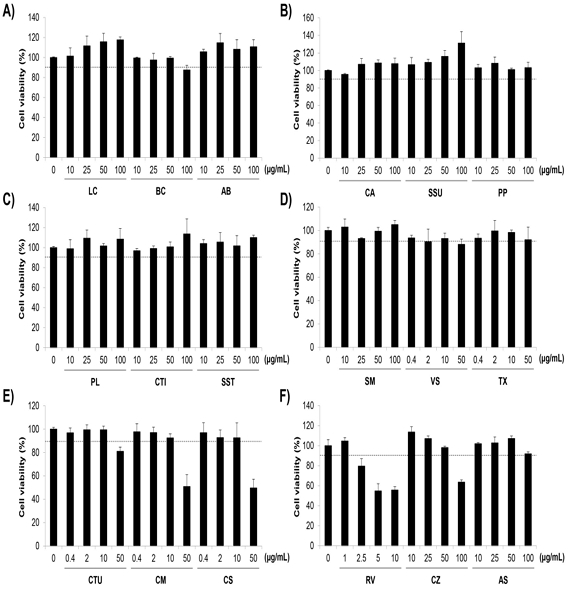
Effects of BASDH extracts on the viability of MC38 colorectal cancer cells. (A-F) MC38 mouse colorectal cancer (CRC) cells were treated with various concentrations (0.4–100 μg/mL) of 18 blood-activating and stasis-dispelling herbal medicine (BASDH) extracts for 24 h. Cell viability was determined by the MTT assay. The dotted line indicates 90% cell viability. Data are presented as the mean ± SD of three independent experiments. AB, Achyranthes bidentata; AS, Angelica sinensis; BC, Boswellia carterii; CA, Curcuma aromatica; CS, Caesalpinia sappan; CM, Commiphora myrrha; CTI, Carthamus tinctorius; CTU, Corydalis turtschaninovii; CZ, Curcuma zedoaria; LC, Ligusticum chuanxiong; PL, Paeonia lactiflora; PP, Prunus persica; RV, Rhus verniciflua; SM, Salvia miltiorrhiza; SSU, Spatholobus suberectus; SST, Sparganium stoloniferum; TX, Trogopterus xanthopes; VS, Vaccaria segetalis.
2. 18종 활혈거어제 추출물의 혈소판에 대한 독성 평가
혈소판에 대한 18종 활혈거어제의 잠재적 독성을 확인하기 위하여, 마우스에서 혈소판을 분리한 뒤 각 활혈거어제 추출물을 처리하고 LDH 유출 정도를 측정하여 독성을 평가하였다. 혈소판은 MC38 세포와 달리 부유 상태로 존재하며 미토콘드리아 대사가 활발하지 않기 때문에, 미토콘드리아 활성에 기반하여 세포 생존율을 평가하는 MTT assay보다는 세포막 손상에 따른 LDH 방출을 측정하는 LDH assay가 혈소판 독성 평가에 더 보편적으로 활용되고 있다20,21). 각 추출물의 처리 농도는 MC38 세포에서의 MTT assay 결과를 바탕으로 설정된 최고 농도를 기준으로 하였다. 한약재를 처리하지 않은 대조군 대비 LDH 방출이 10% 이상 증가한 경우 혈소판에 독성이 나타난 것으로 판정하였다. 실험 결과, 계혈등, 당귀, 홍화, 천궁, 삼릉, 적작약, 울금, 도인, 단삼 추출물은 최고 농도인 100 μg/mL 처리 시에도 대조군 대비 LDH 방출이 증가하지 않거나 미미하게 증가하여 혈소판 독성이 나타나지 않는 것으로 판단하였다(Fig. 2A, B). 왕불류행, 현호색, 소목 추출물 역시 최고 농도인 10 μg/mL까지 LDH 방출이 미미하였으며, 칠피 추출물 또한 최고 농도인 1 μg/mL에서 독성이 관찰되지 않았다(Fig. 2C, D). 반면 우슬 추출물은 MC38 세포에서 독성을 보이지 않았던 100 μg/mL 처리군에서 대조군 대비 267.87 ± 2.65%의 LDH 방출을 보여 혈소판 독성이 확인되었다(Fig. 2B). 오령지, 아출, 유향 추출물 역시 MC38 세포에 독성을 나타내지 않았던 50 μg/mL 처리군에서 각각 190.01 ± 0.61%, 232.9 ± 1.26%, 140.01 ± 1.70%의 LDH 방출을 보였으며(Fig. 2C, D), 몰약 추출물은 10 μg/mL 처리군에서 139.01 ± 2.89%의 LDH 방출을 보여 혈소판 독성이 나타났다(Fig. 2C). 이상의 결과를 종합하여, MC38 세포와 혈소판 모두에서 독성이 나타나지 않는 최고 농도는 계혈등, 당귀, 홍화, 천궁, 삼릉, 적작약, 울금, 도인, 단삼 등 9종 추출물은 100 μg/mL, 우슬 추출물은 20 μg/mL, 왕불류행, 현호색, 소목, 오령지, 아출, 유향 등 6종 추출물은 10 μg/mL, 몰약 추출물은 2 μg/mL, 칠피 추출물은 1 μg/mL로 설정하여 다음 실험을 진행하였다.
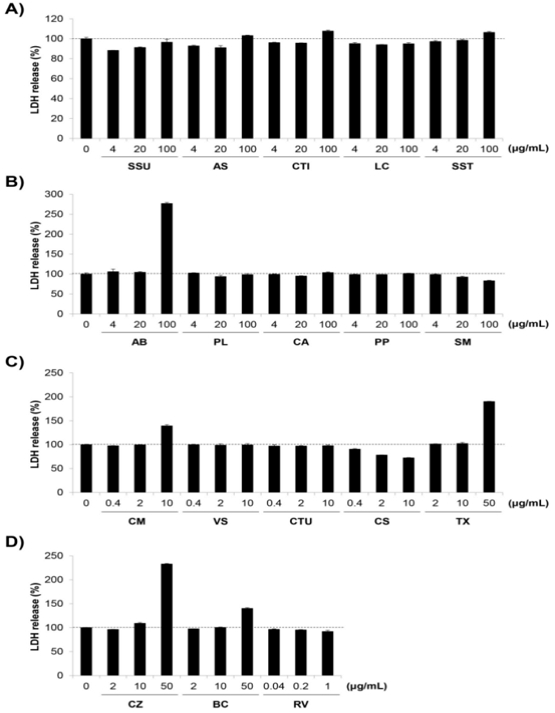
Effects of BASDH extracts on platelet toxicity. (A-D) Mouse platelets were treated with 18 blood-activating and stasis-dispelling herbal medicine (BASDH) extracts. The supernatant was collected, and LDH release was measured to assess platelet toxicity. LDH release was expressed as a percentage relative to the OD value of untreated control cells. Data are shown as the mean ± SD of three independent experiments. AB, Achyranthes bidentata; AS, Angelica sinensis; BC, Boswellia carterii; CA, Curcuma aromatica; CS, Caesalpinia sappan; CM, Commiphora myrrha; CTI, Carthamus tinctorius; CTU, Corydalis turtschaninovii; CZ, Curcuma zedoaria; LC, Ligusticum chuanxiong; PL, Paeonia lactiflora; PP, Prunus persica; RV, Rhus verniciflua; SM, Salvia miltiorrhiza; SSU, Spatholobus suberectus; SST, Sparganium stoloniferum; TX, Trogopterus xanthopes; VS, Vaccaria segetalis.
3. 18종 활혈거어제 추출물의 암세포 유도 혈소판 활성화에 대한 억제 효과 조사
암세포가 혈소판을 활성화하여 혈소판 응집을 유도하는 현상은 종양세포 유도 혈소판 응집(Tumor cell-induced platelet aggregation, TCIPA)으로 알려져 있다7,8). 본 연구에서는 TCIPA에 미치는 18종 활혈거어제 추출물의 영향을 평가하기 위하여, 마우스 혈소판을 분리하여 각 추출물을 30분 전처리한 후 MC38 세포와 15분간 공배양하였다. 혈소판이 활성화되면 dense granule에서 ATP가 방출7)되므로, 공배양 상층액(conditioned medium, CM)의 ATP 농도를 측정하여 혈소판 활성 정도를 평가하였다. 실험 결과, Fig. 3A에서 MC38 단독배양군과 혈소판 단독배양군의 ATP 방출은 각각 8.90 ± 9.78 nM, 59.83 ± 7.56 nM으로 낮았으나, 공배양 시 2707.03 ± 141.98 nM으로 급격히 증가하였다. 그러나 당귀, 계혈등, 천궁, 아출 추출물 전처리에 의해 ATP 방출은 각각 346.49 ± 51.86 nM, 473.50 ± 81.87 nM, 715.12 ± 48.19 nM, 606.19 ± 47.81 nM로 유의하게 감소하였다(Fig. 3A). Fig. 3B에서도 MC38 단독배양군과 혈소판 단독배양군의 ATP 방출은 각각 0.92 ± 4.34 nM, 3.05 ± 10.99 nM로 낮았으나 공배양 시 866.87 ± 147.09 nM으로 증가하였고, 오령지 추출물 전처리군에서는 11.03 ± 9.22 nM으로 현저히 감소하였다(Fig. 3B). Fig. 3C에서 MC38 단독배양군과 혈소판 단독배양군의 ATP 방출은 각각 9.28 ± 20.31 nM, 16.11 ± 4.59 nM이었으나 공배양 시 503.34 ± 47.99 nM으로 상승하였고, 왕불류행, 현호색, 소목 추출물 전처리에 의해 각각 60.92 ± 11.83 nM, 164.74 ± 46.22 nM, 128.94 ± 43.88 nM으로 감소하였다(Fig. 3C). Fig. 3D에서도 단독 배양군(40.45 ± 4.42 nM, 53.66 ± 1.15 nM)에 비해 공배양 시 ATP 방출이 1566.23 ± 10.34 nM으로 상승하였으나, 홍화와 울금 추출물 전처리에 의해 각각 404.98 ± 10.44 nM, 419.78 ± 18.05 nM으로 억제되었다(Fig. 3D). Fig. 3E에서는 단독 배양군(134.14 ± 3.31 nM, 169.08 ± 3.18 nM)에 비해 공배양에 의해 1487.39 ± 11.86 nM까지 ATP 방출이 증가하였으나, 우슬, 삼릉, 칠피 추출물 전처리에 의해 각각 597.34 ± 19.17 nM, 536.22 ± 3.14 nM, 459.03 ± 27.01 nM로 감소하였다(Fig. 3E). Fig. 3F에서 MC38 또는 혈소판 단독배양군의 ATP 방출은 각각 183.03 ± 0.78 nM, 190.51 ± 1.25 nM 수준이었으나, 공배양 시 2576.93 ± 23.36 nM으로 급격히 증가하였고, 몰약과 유향 추출물 전처리에 의해 각각 724.68 ± 70.56 nM, 823.91 ± 56.18 nM으로 현저히 감소하였다(Fig. 3F). 마지막으로 Fig. 3G에서 단독배양군의 ATP 방출(7.04 ± 0.39 nM, 7.81 ± 0.47 nM)에 비해 공배양군의 ATP 방출(404.24 ± 16.41 nM)이 현저히 증가하였으며, 도인, 단삼, 적작약 추출물 전처리 시 각각 70.17 ± 1.9 nM, 72.34 ± 2.97 nM, 64.08 ± 1.58 nM으로 유의하게 감소하였다(Fig. 3G). 이상의 수치는 모두 최고 농도 처리군을 기준으로 작성하였다. 상기 결과를 종합하면, 18종 활혈거어제 추출물은 공히 MC38 대장암 세포로 유도된 혈소판 활성화를 현저히 억제하는 효과를 보였다.
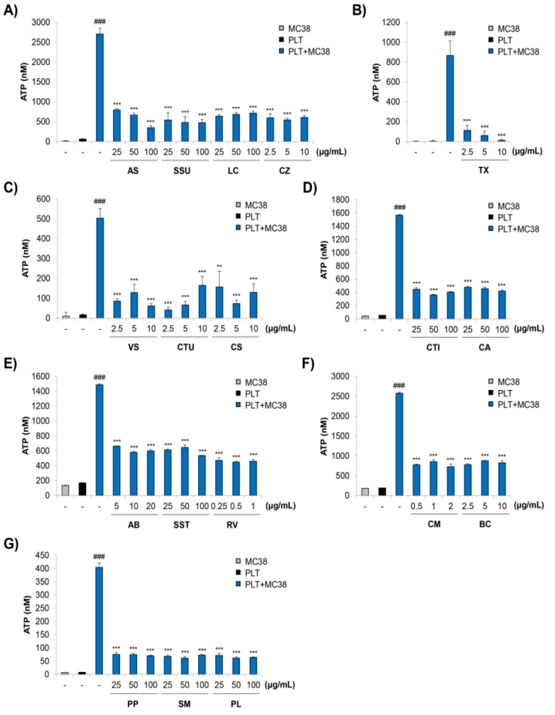
Effects of BASDH extracts on MC38 cells-induced ATP release from platelets. (A-G) Mouse platelets were pretreated for 30 min with 18 blood-activating and stasis-dispelling herbal medicine (BASDH) extracts, followed by co-incubation with MC38 mouse colorectal cancer cells for 15 min. The supernatant was collected, and ATP release was measured. Supernatants collected from mono-cultured MC38 cells or platelets were served as controls. Data are shown as the mean ± SD of three independent experiments. Statistical analysis was performed using one-way ANOVA followed by Tukey’s post hoc test (### P < 0.001 vs. untreated platelets; *** P < 0.001 vs. platelets co-cultured with MC38 cells). PLT, platelet; AB, Achyranthes bidentata; AS, Angelica sinensis; BC, Boswellia carterii; CA, Curcuma aromatica; CS, Caesalpinia sappan; CM, Commiphora myrrha; CTI, Carthamus tinctorius; CTU, Corydalis turtschaninovii; CZ, Curcuma zedoaria; LC, Ligusticum chuanxiong; PL, Paeonia lactiflora; PP, Prunus persica; RV, Rhus verniciflua; SM, Salvia miltiorrhiza; SSU, Spatholobus suberectus; SST, Sparganium stoloniferum; TX, Trogopterus xanthopes; VS, Vaccaria segetalis.
4. 18종 활혈거어제 추출물이 혈소판 활성화로 유도한 암세포 이동에 미치는 영향 조사
활성화된 혈소판은 다양한 성장인자와 사이토카인을 분비하여 암세포의 부착, 이동, 침윤 및 혈관신생을 유도하여 전이를 촉진하는 것으로 알려져 있다7,8). 앞서 18종 활혈거어제 추출물이 혈소판의 활성화를 효과적으로 억제하는 것을 확인하였으므로(Fig. 3), 이들이 혈소판 활성 억제를 통해 암세포의 이동능을 조절할 수 있는지를 Transwell migration assay로 평가하였다. MC38 세포와 혈소판에 독성을 나타내지 않는 최고 농도로 실험을 진행한 결과, MC38 단독배양군에 비해 혈소판과 공배양 시 MC38 세포의 이동능이 현저히 증가하였으며, 이러한 이동능 증가에 대한 억제 효과는 추출물에 따라 차이를 보였다. Fig. 4A에서 혈소판 공배양에 의해 MC38 세포의 이동은 1578.69 ± 132.93%까지 증가하였으며, 당귀 추출물 전처리에 의해 1457.38 ± 78.03%로 감소하였으나, 통계적으로 유의한 억제 효과는 나타나지 않았다(Fig. 4A, G). Fig. 4B에서는 혈소판 공배양 시 325.30 ± 11.60%로 증가한 이동능이 삼릉, 울금, 홍화 추출물에 의해 각각 273.67 ± 16.58%, 211.04 ± 32.94%, 259.84 ± 15.19%로 유의하게 억제되었다(Fig. 4B, H). 계혈등과 단삼 추출물은 혈소판 공배양으로 333.33 ± 18.81%까지 증가한 MC38 세포 이동을 각각 11.06 ± 1.84% 및 153.13 ± 9.11%로 현저히 억제하였다(Fig. 4C, I). 아출과 오령지 추출물 역시 혈소판 공배양군의 이동능(518.13 ± 42.04%)을 각각 388.82 ± 21.10% 및 322.65 ± 23.92%로 유의하게 감소시켰다(Fig. 4D, J). Fig. 4E에서 혈소판 공배양에 의해 MC38 세포의 이동능은 208.64 ± 9.14%로 증가하였으며, 왕불류행, 소목, 건칠, 유향 추출물 처리군에서는 각각 175 ± 13.57%, 152.31 ± 18.1%, 136.11 ± 3.21%, 122.68 ± 7.15%로 유의하게 감소하였다. 반면 현호색(262.96 ± 43.22%)과 몰약(197.22 ± 17.79%) 추출물은 억제 효과를 나타내지 않았다(Fig. 4E, K). Fig. 4F에서는 혈소판 공배양군에서 184.89 ± 7.07%로 증가한 이동능이 우슬, 적작약, 천궁, 도인 추출물 처리에 의해 각각 61.63 ± 2.47%, 95.23 ± 13.41%, 110.34 ± 9.28%, 163.98 ± 12.78%로 유의하게 감소하였다(Fig. 4F, L). 이상의 결과를 종합하면, 18종 활혈거어제 추출물 중 15종(삼릉, 울금, 홍화, 계혈등, 단삼, 아출, 오령지, 왕불류행, 소목, 건칠, 유향, 우슬, 적작약, 천궁, 도인)은 혈소판 활성화로 유도된 대장암 세포의 이동능 증가를 유의하게 억제하였으며, 3종(당귀, 현호색, 몰약)은 유의한 억제 효과가 나타나지 않았다. 특히 계혈등, 우슬, 적작약 추출물은 대조군 수준 이하(100% 이하)로 암세포 이동능을 현저히 억제하였다.
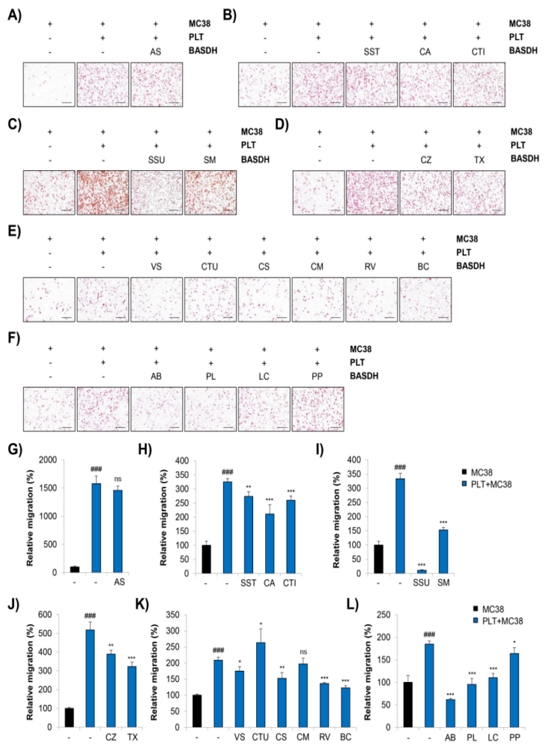
Effects of BASDH extracts on the migration of MC38 cells induced by activated platelets. (A–L) MC38 mouse colorectal cancer cells were seeded alone or co-seeded with mouse platelets in the inserts of Transwell plates and treated with 18 blood-activating and stasis-dispelling herbal medicine (BASDH) extracts. After 24 h of incubation, migrated cells were stained and imaged at ×100 magnification (scale bar = 200 μm). Representative images from three independent experiments are shown (A–F). Relative migration was quantified by counting the stained cells (G–L). Data are presented as the mean ± SD of three independent experiments. Statistical significance was determined by one-way ANOVA followed by Tukey’s post hoc test (### P < 0.001 vs. MC38 cells seeded alone; ns, not significant, * P < 0.05, ** P < 0.01, *** P < 0.001 vs. untreated MC38 cells co-seeded with platelets). PLT, platelet; AB, Achyranthes bidentata; AS, Angelica sinensis; BC, Boswellia carterii; CA, Curcuma aromatica; CS, Caesalpinia sappan; CM, Commiphora myrrha; CTI, Carthamus tinctorius; CTU, Corydalis turtschaninovii; CZ, Curcuma zedoaria; LC, Ligusticum chuanxiong; PL, Paeonia lactiflora; PP, Prunus persica; RV, Rhus verniciflua; SM, Salvia miltiorrhiza; SSU, Spatholobus suberectus; SST, Sparganium stoloniferum; TX, Trogopterus xanthopes; VS, Vaccaria segetalis.
5. 18종 활혈거어제 추출물이 혈소판 활성화로 유도한 암세포 침윤에 미치는 영향 조사
다음으로 18종 활혈거어제 추출물이 혈소판 활성화에 의해 유도된 암세포 침윤을 조절할 수 있는지를 확인하기 위하여 Transwell invasion assay를 실시하였다. 실험 결과, Fig. 4의 결과와 유사하게 MC38 세포는 혈소판과 공배양 시 침윤능이 현저히 증가하였으며, 일부 활혈거어제 추출물은 이러한 증가를 억제하였다. Fig. 5A에서 혈소판 공배양군의 세포 침윤능은 대조군에 비해 183.81 ± 11.65%로 증가하였으며, 당귀, 오령지, 계혈등, 우슬 추출물 처리에 의해 각각 136.69 ± 22.81%, 95.32 ± 15.38%, 0.72 ± 0.83%, 103.59 ± 18.71%로 유의하게 억제되었다. 반면 아출 추출물은 189.57 ± 33.28%로 억제 효과가 나타나지 않았다(Fig. 5A, C). 또한 Fig. 5B에서 혈소판 공배양 시 MC38 세포 침윤능은 182.90 ± 24.19%로 증가하였으나, 천궁, 홍화, 적작약, 현호색, 도인, 유향, 건칠, 소목 추출물에 의해 각각 90.16 ± 9.94%, 49.74 ± 10.97%, 115.54 ± 16.78%, 122.28 ± 28.47%, 125.39 ± 12.72%, 125.91 ± 13.89%, 111.92 ± 13.11%, 109.85 ± 17.42%로 유의하게 감소하였다. 반면 삼릉, 울금, 왕불류행, 단삼, 몰약은 각각 182.38 ± 8.63%, 169.43 ± 22.35%, 163.21 ± 12.93%, 201.04 ± 17.59%, 179.28 ± 10.77%로 통계적으로 유의한 억제 효과를 보이지 않았다(Fig. 5B, D). 이상의 결과를 종합하면, 18종 활혈거어제 추출물 중 12종(당귀, 계혈등, 오령지, 우슬, 천궁, 홍화, 적작약, 현호색, 도인, 유향, 건칠, 소목)은 혈소판 활성화로 유도된 MC38 세포의 침윤을 유의하게 억제한 반면, 6종(아출, 삼릉, 울금, 왕불류행, 단삼, 몰약)은 억제 효과가 나타나지 않았다. 특히 오령지, 계혈등, 천궁, 홍화 추출물은 대조군 수준 이하(100% 이하)로 암세포 침윤능을 감소시켜 가장 현저한 억제 효과를 보였다.
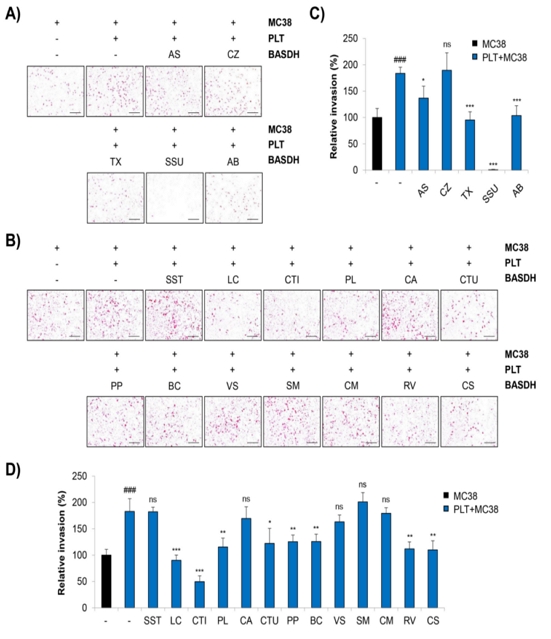
Effects of BASDH extracts on the invasion of MC38 cells induced by activated platelets. (A–D) MC38 mouse colorectal cancer cells were seeded alone or co-seeded with mouse platelets in the inserts of Transwell plates and treated with 18 blood-activating and stasis-dispelling herbal medicine (BASDH) extracts. After 24 h of incubation, invaded cells were stained and imaged at ×100 magnification (scale bar = 200 μm). Representative images from three independent experiments are shown (A, B). Relative migration was quantified by counting the stained cells (C, D). Data are presented as the mean ± SD of three independent experiments. Statistical significance was determined by one-way ANOVA followed by Tukey’s post hoc test (### P < 0.001 vs. MC38 cells seeded alone; ns, not significant, * P < 0.05, ** P < 0.01, *** P < 0.001 vs. untreated MC38 cells co-seeded with platelets). PLT, platelet; AB, Achyranthes bidentata; AS, Angelica sinensis; BC, Boswellia carterii; CA, Curcuma aromatica; CS, Caesalpinia sappan; CM, Commiphora myrrha; CTI, Carthamus tinctorius; CTU, Corydalis turtschaninovii; CZ, Curcuma zedoaria; LC, Ligusticum chuanxiong; PL, Paeonia lactiflora; PP, Prunus persica; RV, Rhus verniciflua; SM, Salvia miltiorrhiza; SSU, Spatholobus suberectus; SST, Sparganium stoloniferum; TX, Trogopterus xanthopes; VS, Vaccaria segetalis.
고 찰
본 연구는 암의 진행 과정에 혈소판의 중요성이 점차 부각되는 시점에서, 활혈거어제를 활용하여 과활성화된 혈소판을 억제하고 혈류 순환을 촉진함으로써 대장암 전이를 억제할 수 있는 가능성을 탐색하고자 수행되었다. 대장암 치료 시 혈소판 조절 전략이 유망한 것은 다음과 같은 근거에 기반한다. 첫째, 임상적 연관성이 뚜렷하다. 대장암 환자의 높은 혈소판/림프구 비율은 전체 생존율(overall survival) 및 질병 무재발 생존율(recurrence-free survival)과 밀접한 관련이 있으며, 불량한 종양 분화도 및 침윤 정도와 연관되어 있다고 메타 분석으로 보고되었다22,23). 또한 대장암 환자에서는 혈소판 활성화 마커인 soluble CD40 ligand (sCD40L)와 P-selectin이 유의하게 증가하며, 이들 인자는 대장암 진행과 직접적으로 연관되어 있음이 밝혀졌다24). 대장암 세포는 조직인자 발현을 통해 트롬빈 생성을 유도하고 혈소판을 활성화하여 혈전증 발생 위험을 높이며25), 실제로 대장암 환자의 정맥혈전색전증(venous thromboembolism, VTE) 발생률은 정상인 대비 3.5배 높다고 보고되어 있다26). 둘째, 대장암의 병리학적 특성은 만성 염증과 밀접하게 연관된다. 반복적 염증으로 인한 장 조직 손상과 리모델링 과정은 대장암의 발생과 진행을 촉진하며27), 염증 반응에서 생성되는 활성산소종(reactive oxygen species, ROS)은 대장 상피세포의 돌연변이를 유발한다28). 아울러 다양한 성장인자와 염증성 사이토카인은 암세포의 증식, 전이, 혈관신생을 촉진한다29). 혈소판 활성화는 혈관내피세포 활성화 및 면역세포 유입을 매개하며, 이러한 과정은 염증 반응의 핵심 병리와 직결되어 대장암 진행에 기여한다25). 따라서 만성 염증과 밀접히 연관된 대장암에서 혈소판 활성 조절은 암 발생과 악화에 중요한 영향을 미칠 수 있다. 셋째, 현재 사용되는 대장암 치료제 역시 혈소판 과활성화와 혈관내피세포 활성화를 통해 혈전 형성을 촉진하는 것으로 알려져 있다. 예를 들어 옥살리플라틴, 베바시주맙, 세툭시맙 등은 혈전 형성을 유발하며30-32), 이 과정에서 활성화된 혈소판은 암세포의 EMT를 촉진하고, 성장인자 분비를 통해 항암제 내성을 유도할 수 있다7,8,25). 넷째, 항혈전제의 대장암 억제 효과도 보고되고 있다. 항혈소판제인 아스피린은 소화기계 암에서 두드러진 항암 효과를 보이며, 대장암 예방, 생존율 향상, 전이 위험 감소 효과가 확인되었다16). 이러한 효과의 주요 기전으로 혈소판 과활성 억제가 제시되고 있으며, 아스피린은 5-FU 및 베바시주맙과 병용 시 항암 효과를 증대시키고, 5-FU 내성을 극복하는 데 기여할 수 있음이 밝혀졌다33,34). 이상의 근거들은 혈소판 활성 조절이 대장암 치료에서 매우 유망한 전략임을 강력히 시사한다.
본 연구의 독창성과 의의는 다음과 같다. 다양한 전임상 및 임상 근거들이 암으로 인한 혈소판 과활성화가 암 전이를 촉진할 수 있음을 시사하고 있음에도 불구하고, 활혈거어제의 항암 효과는 주로 세포사멸 유도, 세포주기 조절, 혈관신생 억제에 국한되어 연구되어 왔다. 이들 연구는 활혈거어제가 Bcl-2 억제, Bax 활성화, caspase 경로 활성화 등을 통해 암세포의 세포사멸을 유도하며, G0/G1 또는 G2/M기 세포주기 정지를 통해 종양 증식을 억제하고, VEGF/VEGFR2 경로 등을 억제하여 종양 신생혈관 형성을 차단함을 폭넓게 보고하였다35,36). 본 연구는 활혈거어제의 항암 효과를 혈소판 활성 조절에 초점을 맞추어 탐색했다는 점에서 독창성이 있으며, 18종의 활혈거어제 추출물을 스크리닝하여 우수한 효과를 보이는 후보군을 선별했다는 점에서 학문적 의의가 있다. 혈소판과 공배양 시 대장암 세포의 이동과 침윤이 증가하는 현상은 기존에도 보고된 바 있으며10,37), 본 연구에서도 동일한 결과를 확인할 수 있었다. 특히 18종의 모든 추출물이 ATP assay에서 혈소판 활성화를 현저히 억제했으며, 이는 ‘활혈거어제’라는 명칭에 부합하는 효과라 할 수 있다. 이들 중 혈소판-대장암 세포 공배양으로 유도된 대장암 세포의 이동 및 침윤을 억제한 추출물은 각각 15종과 12종이었으며, 두 과정을 공통적으로 억제한 것은 계혈등, 건칠, 도인, 소목, 오령지, 우슬, 유향, 적작약, 천궁, 홍화 등 10종이었다. 그중 가장 뛰어난 억제 효과를 보인 것은 계혈등으로, 이는 계혈등이 암세포–혈소판 상호작용을 차단하여 유방암 및 대장암 전이를 억제한다는 기존 보고와 일치한다38,39). 상기한 결과들은 활혈거어제 추출물이 혈소판 활성화에 의해 촉진되는 대장암 세포의 이동과 침윤을 억제함으로써 대장암 전이 억제에 기여할 가능성을 시사하며, 한의학적으로 혈어증으로 진단되거나 혈전 경향이 보이는 대장암 환자에게 전이 억제 목적으로 활혈거어제를 활용할 수 있음을 시사한다.
상기한 의의에도 불구하고 추후 다음과 같은 보완연구가 요구된다. 첫째, 본 연구의 목적은 18종의 활혈거어제 추출물 중 가장 효과가 탁월한 추출물을 선별하는 데 있었으므로 향후 구체적인 작용 기전 및 분자적 타겟 규명이 필요하다. 특히, 활혈거어제가 활성화된 혈소판에서 분비되는 인자를 조절하여 항암 효과를 나타내는지, 혹은 혈소판과 암세포 간 직접 접촉에 의한 분자 신호 전달을 억제함으로써 효과를 발휘하는지, 나아가 이러한 과정에 관여하는 구체적 타겟이 무엇인지를 체계적으로 규명할 필요가 있다. 둘째, 본 연구는 ATP 방출을 혈소판 활성화 지표로 사용하였는데, 이는 dense granule 분비를 반영하지만 응집 자체를 직접 평가하는 지표는 아니다. 따라서 향후 광투과 응집도(aggregometry), CD62P 유세포분석 등 추가 실험을 통해 혈소판 응집 및 부착 단계를 직접적으로 검증해야 한다. 셋째, 혈소판 매개 대장암 전이 마우스 모델을 활용하여 선별된 추출물의 항전이 효과를 in vivo에서 입증하는 연구가 필요하다. 마지막으로, 선별된 추출물의 어떤 성분이 혈소판 매개 암 전이 억제를 유도하는지 정성·정량 분석과 효과 검증을 통해 면밀히 규명해야 한다.
결 론
본 연구에서는 활혈거어제 추출물 18종이 혈소판 활성화에 의해 유도된 MC38 대장암 세포주의 이동과 침윤에 미치는 영향을 평가하였다. 그 결과, 다음과 같은 결론을 얻을 수 있었다. 첫째, 18종의 활혈거어제 추출물 모두가 MC38 세포에 의해 유도된 혈소판 활성화를 유의하게 억제하였다. 둘째, 삼릉 추출물을 포함한 15종은 활성화된 혈소판으로 유도된 MC38 세포의 이동 증가를 유의하게 억제하였으며, 이 중 계혈등, 우슬, 적작약 추출물이 특히 우수한 억제 효과를 나타냈다. 셋째, 당귀 추출물을 포함한 12종은 활성화된 혈소판으로 유도된 MC38 세포의 침윤 증가를 유의하게 억제하였으며, 계혈등, 오령지, 천궁, 홍화 추출물이 두드러진 억제 효과를 보였다. 넷째, 암세포 이동 및 침윤을 공통으로 억제하는 것은 총 10종(계혈등, 건칠, 도인, 소목, 오령지, 우슬, 유향, 적작약, 천궁, 홍화)이었으며, 이 중 가장 탁월한 억제 효과를 보인 것은 계혈등 추출물이었다. 이러한 결과를 종합하면, 활혈거어제 추출물은 혈소판 활성화에 의해 촉진되는 대장암 세포의 이동과 침윤을 억제함으로써 대장암 전이 억제에 기여할 가능성이 있다. 향후 이들의 구체적인 작용 기전 및 분자 표적이 규명된다면 혈어증으로 변증된 대장암 환자의 전이를 억제하기 위해 활혈거어제를 투여하는 과학적 근거로 활용됨과 동시에 활혈거어제를 기반으로 한 신약 개발에 일조할 수 있을 것이다.
Acknowledgments
본 연구는 보건복지부의 재원으로 한국보건산업진흥원의 보건의료기술연구개발사업 지원에 의하여 이루어진 것임(과제고유번호 RS-2025-02215233).
References
-
Bray F, Laversanne M, Sung H, Ferlay J, Siegel RL, Soerjomataram I, Jemal A. Global cancer statistics 2022: GLOBOCAN estimates of incidence and mortality worldwide for 36 cancers in 185 countries. CA Cancer J. Clin. 2024;74(3):229-63.
[https://doi.org/10.3322/caac.21834]

-
Morgan E, Arnold M, Gini A, Lorenzoni V, Cabasag CJ, Laversanne M, Vignat J, Ferlay J, Murphy N, Bray F. Global burden of colorectal cancer in 2020 and 2040: incidence and mortality estimates from GLOBOCAN. Gut. 2023;72(2):338-44.
[https://doi.org/10.1136/gutjnl-2022-327736]
- National Cancer Information Center. https://www.cancer.go.kr/
-
The Lancet Gastroenterology Hepatology. The rise in early-onset colorectal cancer: now a global issue. Lancet Gastroenterol. Hepatol. 2025;10(2):95.
[https://doi.org/10.1016/S2468-1253(24)00441-2]
-
Siegel RL, Miller KD, Wagle NS, Jemal A. Cancer statistics, 2023. CA Cancer J. Clin. 2023;73(1):17-48.
[https://doi.org/10.3322/caac.21763]
-
Fabregas JC, Ramnaraign B, George TJ. Clinical Updates for Colon Cancer Care in 2022. Clin. Colorectal Cancer. 2022;21(3):198-203.
[https://doi.org/10.1016/j.clcc.2022.05.006]
-
Haemmerle M, Stone RL, Menter DG, Afshar-Kharghan V, Sood AK. The Platelet Lifeline to Cancer: Challenges and Opportunities. Cancer Cell. 2018;33(6):965-83.
[https://doi.org/10.1016/j.ccell.2018.03.002]
-
Braun A, Anders HJ, Gudermann T, Mammadova-Bach E. Platelet-Cancer Interplay: Molecular Mechanisms and New Therapeutic Avenues. Front. Oncol. 2021;11:665534.
[https://doi.org/10.3389/fonc.2021.665534]
-
Abdol Razak NB, Jones G, Bhandari M, Berndt MC, Metharom P. Cancer-Associated Thrombosis: An Overview of Mechanisms, Risk Factors, and Treatment. Cancers (Basel). 2018;10(10):380.
[https://doi.org/10.3390/cancers10100380]
-
Labelle M, Begum S, Hynes RO. Direct signaling between platelets and cancer cells induces an epithelial-mesenchymal-like transition and promotes metastasis. Cancer Cell. 2011;20(5):576-90.
[https://doi.org/10.1016/j.ccr.2011.09.009]
-
Lou XL, Sun J, Gong SQ, Yu XF, Gong R, Deng H. Interaction between circulating cancer cells and platelets: clinical implication. Chin. J. Cancer Res. 2015;27(5):450-60.
[https://doi.org/10.3978/j.issn.1000-9604.2015.04.10]
-
Gresele P, Falcinelli E, Momi S, Petito E, Sebastiano M. Platelets and Matrix Metalloproteinases: A Bidirectional Interaction with Multiple Pathophysiologic Implications. Hamostaseologie. 2021;41(2):136-45.
[https://doi.org/10.1055/a-1393-8339]
-
Gil-Bernabé AM, Ferjancic S, Tlalka M, Zhao L, Allen PD, Im JH, Watson K, Hill SA, Amirkhosravi A, Francis JL, Pollard JW, Ruf W, Muschel RJ. Recruitment of monocytes/macrophages by tissue factor-mediated coagulation is essential for metastatic cell survival and premetastatic niche establishment in mice. Blood. 2012;119(13):3164-75.
[https://doi.org/10.1182/blood-2011-08-376426]
-
Battinelli EM, Markens BA, Italiano JE Jr. Release of angiogenesis regulatory proteins from platelet alpha granules: modulation of physiologic and pathologic angiogenesis. Blood. 2011;118(5):1359-69.
[https://doi.org/10.1182/blood-2011-02-334524]
-
Wojtukiewicz MZ, Hempel D, Sierko E, Tucker SC, Honn KV. Antiplatelet agents for cancer treatment: a real perspective or just an echo from the past? Cancer Metastasis Rev. 2017;36(2):305-29.
[https://doi.org/10.1007/s10555-017-9683-z]
-
Tao DL, Tassi Yunga S, Williams CD, McCarty OJT. Aspirin and antiplatelet treatments in cancer. Blood. 2021;137(23):3201-11.
[https://doi.org/10.1182/blood.2019003977]
- Editorial Committee of Korean Medicine Pathology Textbook. Pathology of Korean Medicine. Seoul: Hani Munhwasa; 2019.
- Zhang T. The TCM constitution analysis of colorectal cancer and the distribution of cancer toxin [Master’s thesis]. Nanjing University of Chinese Medicine; 2020.
- Zhang ZL. A study on the correlation between preoperative types of TCM syndromes and clinicopathological factors in stage I–III colorectal cancer [Master’s thesis]. Nanjing University of Chinese Medicine; 2020.
-
Fotakis G, Timbrell JA. In vitro cytotoxicity assays: comparison of LDH, neutral red, MTT and protein assay in hepatoma cell lines following exposure to cadmium chloride. Toxicol. Lett. 2006;160(2):171-7.
[https://doi.org/10.1016/j.toxlet.2005.07.001]
-
Kim EJ, Lim KM, Kim KY, Bae ON, Noh JY, Chung SM, Shin S, Yun YP, Chung JH. Doxorubicin-induced platelet cytotoxicity: a new contributory factor for doxorubicin-mediated thrombocytopenia. J. Thromb. Haemost. 2009;7(7):1172-83.
[https://doi.org/10.1111/j.1538-7836.2009.03477.x]
-
Tan D, Fu Y, Su Q, Wang H. Prognostic role of platelet-lymphocyte ratio in colorectal cancer: A systematic review and meta-analysis. Medicine (Baltimore). 2016;95(24):e3837.
[https://doi.org/10.1097/MD.0000000000003837]
-
You J, Zhang H, Shen Y, Chen C, Liu W, Zheng M, Van Poucke S, Guo G, Huang Z. Impact of platelet to lymphocyte ratio and metabolic syndrome on the prognosis of colorectal cancer patients. Onco Targets Ther. 2017;10:2199-208.
[https://doi.org/10.2147/OTT.S132621]
-
Gronostaj K, Richter P, Nowak W, Undas A. Determinants of hypofibrinolysis in patients with digestive tract cancer. Prz. Gastroenterol. 2016;11(2):104-10.
[https://doi.org/10.5114/pg.2016.57619]
-
Bonfitto PHL, Rodrigues BAG, Siqueira NSN, Genaro LM, Rodrigues BL, Oliveira PSP, Martinez CAR, Ayrizono MLS, Leal RF. Involvement of platelet signaling pathways in colorectal cancer and new therapeutic targets. Am. J. Cancer Res. 2024;14(11):5133-53.
[https://doi.org/10.62347/PJNU8987]
-
Mitrugno A, Tassi Yunga S, Sylman JL, Zilberman-Rudenko J, Shirai T, Hebert JF, Kayton R, Zhang Y, Nan X, Shatzel JJ, Esener S, Duvernay MT, Hamm HE, Gruber A, Williams CD, Takata Y, Armstrong R, Morgan TK, McCarty OJT. The role of coagulation and platelets in colon cancer-associated thrombosis. Am. J. Physiol. Cell Physiol. 2019;316(2):C264-C273.
[https://doi.org/10.1152/ajpcell.00367.2018]
-
Zhang F, Qiao S. Research Progress on the Relationship Between Inflammation and Colorectal Cancer. Ann. Gastroenterol. Surg. 2021;6(2):204-11.
[https://doi.org/10.1002/ags3.12517]
-
Catalano T, Selvaggi F, Cotellese R, Aceto GM. The Role of Reactive Oxygen Species in Colorectal Cancer Initiation and Progression: Perspectives on Theranostic Approaches. Cancers (Basel). 2025;17(5):752.
[https://doi.org/10.3390/cancers17050752]
-
Zhao H, Wu L, Yan G, Chen Y, Zhou M, Wu Y, Li Y. Inflammation and tumor progression: signaling pathways and targeted intervention. Signal Transduct. Target Ther. 2021;6(1):263.
[https://doi.org/10.1038/s41392-021-00658-5]
-
Tajima H, Ohta T, Miyashita T, Nakanuma S, Matoba M, Miyata T, Sakai S, Okamoto K, Makino I, Kinoshita J, Hayashi H, Nakamura K, Oyama K, Inokuchi M, Nakagawara H, Takamura H, Kitagawa H, Fushida S, Ikeda H. Oxaliplatin-based chemotherapy induces extravasated platelet aggregation in the liver. Mol. Clin. Oncol. 2015;3(3):555-8.
[https://doi.org/10.3892/mco.2015.512]
-
Kumar J, Bhargava M, Aggarwal S. Bevacizumab-induced reversible thrombocytopenia in a patient with adenocarcinoma of colon: rare adverse effect of bevacizumab. Case Rep. Oncol. Med. 2012;2012:695430.
[https://doi.org/10.1155/2012/695430]
-
Liu F, Xu Y, Yang G, Guo Y, Nian J. Portal vein thrombosis after cetuximab and 5-fluorouracil therapy in a patient with advanced colon cancer and decompensated cirrhosis: a case report and review of the literature. World J. Surg. Oncol. 2023;21(1):302.
[https://doi.org/10.1186/s12957-023-03175-7]
-
Susan M, Macasoi I, Pinzaru I, Dehelean C, Ilia I, Susan R, Ionita I. In Vitro Assessment of the Synergistic Effect of Aspirin and 5-Fluorouracil in Colorectal Adenocarcinoma Cells. Curr. Oncol. 2023;30(7):6197-219.
[https://doi.org/10.3390/curroncol30070460]
-
Fu J, Xu Y, Yang Y, Liu Y, Ma L, Zhang Y. Aspirin suppresses chemoresistance and enhances antitumor activity of 5-Fu in 5-Fu-resistant colorectal cancer by abolishing 5-Fu-induced NF-κB activation. Sci. Rep. 2019;9(1):16937.
[https://doi.org/10.1038/s41598-019-53276-1]
-
Wu S, Sun Z, Guo Z, Li P, Mao Q, Tang Y, Chen H, Peng H, Wang S, Cao Y. The effectiveness of blood-activating and stasis-transforming traditional Chinese medicines (BAST) in lung cancer progression-a comprehensive review. J Ethnopharmacol. 2023;314:116565.
[https://doi.org/10.1016/j.jep.2023.116565]
-
Lu X, Li B. Exploration of the effect and mechanism of activating blood circulation and stasis-removing therapy on tumor metastasis. Chin J Integr Med. 2009;15(5):395-400.
[https://doi.org/10.1007/s11655-009-0395-2]
-
Wu LS, Wang XW, He W, Ma XT, Wang HY, Han M, Li BH. TRAIL inhibits platelet-induced colorectal cancer cell invasion. J. Int. Med. Res. 2019;47(2):962-72.
[https://doi.org/10.1177/0300060518820785]
-
Sun L, Li Q, Guo Y, Yang Q, Yin J, Ran Q, Liu L, Zhao Z, Wang Y, Li Y, Chen Y, Weng X, Cai W, Zhu X. Extract of Caulis Spatholobi, a novel platelet inhibitor, efficiently suppresses metastasis of colorectal cancer by targeting tumor cell-induced platelet aggregation. Biomed. Pharmacother. 2020;123:109718.
[https://doi.org/10.1016/j.biopha.2019.109718]
-
Chen X, Li Q, Kan XX, Wang YJ, Li YJ, Yang Q, Xiao HB, Chen Y, Weng XG, Cai WY, Zhu XX. Extract of Caulis Spatholobi, a novel blocker targeting tumor cell-induced platelet aggregation, inhibits breast cancer metastasis. Oncol. Rep. 2016;36(6):3215-24.
[https://doi.org/10.3892/or.2016.5184]