
The Ethanol Extract of Juk-Yeo, Bambusae Caulis in Taeniam, Decreases the Intracellular Levels of Lamins, Structural Nuclear Proteins of Lamina
Ⓒ The Society of Pathology in Korean Medicine, The Physiological Society of Korean Medicine
Abstract
Juk-Yeo (JY: 竹茹), an extract of the inner bark of Phyllostachys nigra var. henosis (Milford) Rendle (Poaceae), has been prescribed to clear heat and resolve phlegm in traditional Korean medicine, suggesting that JY has anti-inflammatory activity. While studying how JY regulates inflammation, we encountered unexpected findings regarding JY. Here, we provide evidence that JY decreased the intracellular levels of lamin B1, lamin B2, and A-type lamins. When treated with JY, A549 cells showed a reduced level of lamin B1 without altering the expression of YY1 and histone H3, well-documented nuclear proteins. Confocal analysis revealed that JY decreased lamin B1 in the nucleoplasm. Western blot analyses showed that JY could lower lamin B1 in many other cell types. As evidenced by RT-PCR analyses of lamin B1 mRNA and by unresponsiveness to protease inhibitors, such as E64d/PepA or MG132, JY neither blocks mRNA synthesis nor enhances protein degradation of lamin B1. Lamin B1 was under-detectable in exosomes, an extracellular vesicle that harbors various RNAs and proteins to be excreted. However, an anti-lamin B1 antibody precipitated lamin B1 in the media, in which JY-treated cells were cultured. Collectively, our findings suggest that JY excretes lamin B1 from cells, resulting in the decreased level of lamin B1. Lamins are part of the structural protein, providing the integrity of the nuclear membrane. Since abnormalities in lamins are found among the aged and in patients with rare diseases including Hutchinson-Gilford Progeria Syndrome (HGPS) and Emery-Dreifuss Muscular Dystrophy (EDMD), our results suggest that JY can be explored as therapeutics to ease symptoms associated with aging or lamin disorders.
Keywords:
Juk-Yeo (竹茹), Phyllostachys nigra var. henosis (Milford) Rendle (Poaceae), Lamins, Aging, Lamin-associated genetic diseasesIntroduction
Bambusae Caulis in Taeniam, called as Juk-Yeo (竹茹) in traditional Korean medicine, is an extract of the inner bark of Phyllostachys nigra var. henosis (Milford) Rendle (Poaceae)1). In traditional Korean medicine, Juk-Yeo (JY) has been used to clear heat, ease irritability, and resolve phlegm2,3). These indications suggest that JY regulates inflammation, contributing to easing inflammatory symptoms4). Indeed, a recent study showed that JY relieves pulmonary inflammation associated with chronic obstructive pulmonary disease (COPD) in a cigarette smoke-induced COPD mouse model5). Several mechanistic studies have hinted at the underlying mechanisms for JY to suppress inflammation. For instance, JY activates an anti-inflammatory factor such as nuclear erythroid-2 related factor 2 (Nrf-2). Along with p38 MAPK activation, JY activates Nrf26), resulting in heme oxygenase-1 (HO-1) expression7). As HO-1 is involved in clearing oxidative molecules, JY likely reduces inflammation via the expression of HO-18). JY is also reported to suppress the transcriptional activities of nuclear factor kappa B (NF-κB) and activator protein 1 (AP-1)7). Since, when activated, NF-κB increases inflammation by inducing pro-inflammatory cytokines, NF-κB activity suppressed by JY could also result in suppressed inflammation9). One of the gene families regulated by NF-κB includes metalloproteinases (MMPs), and JY concordantly suppresses the expression of MMP-910). This result implicates JY as a possible cancer therapeutics given that MMPs are involved in cancer metastasis. Since NF-κB and Nrf2 are key transcription factors that regulate inflammation11), JY is likely applicable to treating other inflammatory diseases. However, studies addressing this possibility remain scarce.
While studying the effects of JY on other inflammatory diseases including acute lung injury, we encountered an unexpected effect of JY on nuclear lamins: JY decreased the levels of lamins. Lamins are part of the structural proteins comprised of the nuclear lamina, a mesh-like structure located beneath the inner nuclear membrane that provides the integrity of the nuclear membrane12). Lamins are categorized as A-type, which includes lamin A and lamin C, and B-type, such as lamin B1 and B213). Here, we present evidence showing that JY decreases the levels of lamin B1 and another B-type lamin, lamin B2, along with A-type lamins. Our results suggest that JY neither suppresses the expression of mRNA of lamin B1 nor increases the intracellular degradation of lamin B1. Rather, JY appears to excrete lamin B1 from the JY-treated cells. Abnormalities in lamins are found among aged people and cause rare diseases including Hutchinson-Gilford Progeria Syndrome (HGPS) and Emery-Dreifuss Muscular Dystrophy (EDMD)14). Thus, our results indicate that JY can be used to ease the symptoms associated with aging or help patients suffering from those rare diseases.
Materials and Methods
1. Cells
The following cells were purchased from the American Type Culture Collection (ATCC, Manassa, VA, USA): A549 (Human lung adenocarcinoma), MRC-5 (human lung fibroblast), DBT (mouse astrocytoma), HEK 293 (human embryonic kidney cell), and RAW 264.7 (mouse macrophage). SNU2292 (human lung carcinoma) was obtained from the Korean Cell Line Bank (Seoul, Korea). These cells were cultured in cell culture media recommended by ATCC and maintained in a 5% CO2 cell culture incubator.
2. Reagents
Juk-Yeo (Bambusae Caulis in Taeniam) extracted with 95% ethanol GR grade; CA03-055) was purchased from the Natural Product Central Bank, Korea Research Institute of Bioscience and Biotechnology, Ochang, Korea. MG132 and doxorubicin were from Sigma-Aldrich (St. Louis, MO, USA). E-64-D and pepstatin A were from Enzo Life Sciences (Farmingdale, NY, USA). Human TNF-α (Thermo Fisher Scientific, Waltham, MA, USA) was used in the study.
3. Assessment of Cytotoxicity
The cytotoxicity of Juk-Yeo (JY) was determined by using the Vybrant® MTT assay kit and the manufacturer’s protocol (Thermo Scientific). Cells were treated with 50 /ml of JY for 24 h in the presence or absence of variable amounts of doxorubicin. Then metabolically active cells were measured by a plate reader (BioTeK, VT, USA). The percentage of live cells in JY or JY/doxorubicin-treated cells was calculated against untreated cells. The assay was conducted in triplicate and repeated three times.
4. Immunoprecipitation and Western Blot Analysis
Total cell lysate and nuclear lysate were prepared by Pierce™ IP lysis buffer and NE-PER™ nuclear extraction kit, respectively, per the manufacturer’s protocols (Thermo Scientific). The protein quantity was determined by Bradford (Bio-Rad, Hercules, CA, USA). An equal amount of proteins were loaded and fractionated on NuPAGE gel (Thermo Scientific). Proteins were blotted to PVDF membrane (Bio-Rad), which was blocked with 5 % non-fat dry milk for 1 h and incubated with primary antibodies at 4 ℃ overnight and then with HRP-conjugated secondary antibodies for 1 h at room temperature. Proteins of interest were revealed by using SuperSignal®West Femto (Thermo Scientific). Most antibodies used for western blotting were purchased from Santa Cruz Biotechnology (Santa Cruz, CA, USA), except an anti-CD63 antibody (Abcam, Cambridge, UK).
5. Confocal Microscopy
Cells were permeabilized with Triton X-100 and incubated with an anti-lamin B1 antibody (Santa Cruz Biotech; SC-374015) and an anti-human IgG antibody conjugated with Alexa Fluor 488 (Invitrogen; A11001). After being washed out excessive antibodies, cells were mounted with VECTASHIELD® Antifade Mounting Medium with DAPI (H-1200-10; Vector Laboratories, Newark, CA, USA)
6. Real-time Quantitative PCR and semi-quantitative RT-PCR
Total RNA was isolated from cells by QIAGEN RNeasy®mini kit and the manufacturer’s protocol (Qiagen, Germany). After being quantitated, 1 ㎍ of the RNA was reverse-transcribed to cDNA by M-MLV reverse transcriptase (Promega, WI, USA). For semi-quantitative RT-PCR, cDNA underwent two serial 1:1 dilution, prior to PCR amplification. PCR was performed as follows: initial denaturation at 95 ℃ for 5 min followed by 25~35 cycle of denaturation for 30 sec at 95 ℃, annealing for 30 sec at 58 ℃, and extension for 40 sec at 72 ℃ with a final extension for 7 min at 72 ℃. Relative expression of a gene was calculated over GAPDH, a house-keeping gene. The cDNA was mixed with the SYBR Green PCR Master Mix (Enzynomics, Daejeon, Korea) and gene-specific primers. The primers for human lamin B1 were 5'-GAAGACCTGGAGAAGCTGGA-3' and 5'-TCTGCTTGTTGCTTCCACCT-3' Those for mouse lamin B1 were 5’-CCGGCCTCAAGGCTCTCTA-3’ and 5’-GTGCCGCCTCATACTCTCG-3’. Those for GAPDH were 5’-GGAGCCAAAAGGGTCATCAT-3’ and 5’-GTGATGGCATGGAC TGTGGT-3’. PCR reaction ran at 95 ℃ for 10 min, followed by 40 cycles of 95 ℃ for 10s, 57 ℃ for 15s, and 72 ℃ for the 20s in a Rotor-Gene Q real-time PCR system (Qiagen). The threshold cycles (Ct) were used to quantify the mRNA expression of the target genes.
7. Exosome preparation
Cells (>1x10⁷ cells) were cultured in 100 mm dish with a standard culture media (Thermo Scientific), which was replaced with a serum-free media. After 16 h, the culture media was collected and centrifugated at 2000 g for 30 min to clear cell debris. Exosomes in the supernatant were enriched by total exosome isolation reagent (Thermo Scientific Cat# 4478359), and the final exosomes were prepared after ultracentrifugation at 35000 rpm (Thermo Scientific). The quantity and quality of exosomes purified were analyzed by NTA (Malvern Nanosight NS300, Malvern Panalytical Ltd, Malvern, UK).
8. Statistical Analysis
Paired or unpaired T-tests and one-way analysis of variance (ANOVA) tests were used (InStat, Graphpad Software, Inc., San Diego, CA). Data are shown in the mean ± SEM (Std. Error) of at least three measurements. P (≥0.05) was considered statistically significant.
Results
1. JY decreases the level of lamin B1 proteins in various cells
While studying the effect of JY on inflammation, we consistently found that JY decreased the level of lamin B1 in RAW 264.7 cells in various experimental settings. To consolidate this finding in RAW 264.7 cells, we tested if JY decreases the level of lamin B1 in other types of cells. HEK 293 cells, a human cell line, were treated with two different amounts of JY (10 ㎍/ml and 50 ㎍/ml) for 16 h and then treated with TNF-α for 15 min to induce NK-κB activity. The variably treated cells were split half, and total proteins and nuclear proteins were prepared for western blot analysis. First, the nuclear proteins were analyzed for the nuclear p65, a subunit of NK-κB that is translocated to the nucleus upon TNF-α treatment. As shown in Fig. 1A, TNF-α treatment induced the nuclear localization of the p65 subunit of NK-κB (the top panel), which was decreased by JY pretreatment, suggesting an anti-inflammatory function of JY. Next, we similarly analyzed lamin B1 in the nuclear fraction and found that JY treatment decreased lamin B1 (the 2nd panel from the top). Unlike lamin B1, JY did not decrease other nuclear proteins including YY115), a transcription factor found mostly in the nucleus (the 3rd panel), and histone H3 proteins16), a component of histones that wrap genomic DNA (the 4th panel). These results suggest a possible selective decrease of lamin B1 by JY. Consistent with this notion, JY did not alter the level of actin, a housekeeping protein, from the total protein (the 5th panel).
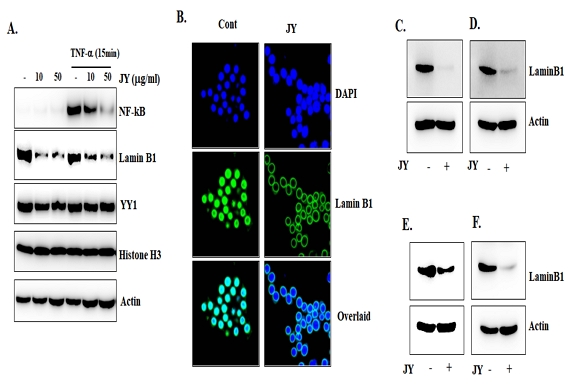
Juk-Yeo decreases the level of lamin B1 in various cells. (A) HEK 293 cells were treated with two different amounts of Juk-Yeo (JY), 10 ㎍/ml or 50 ㎍/ml, for 16 h, and then with TNF-α (10 ng/ml) for 15 min to activate NF-κB. The cytoplasmic and nuclear fractions were isolated to measure the translocation of the cytosolic p65 subunit of NF-κB to the nucleus and nuclear housekeeping proteins, respectively. The membrane for lamin B1 was stripped and reblotted with an anti-YY1 antibody to ensure equal loading of proteins (the 3rd panel from the top). To further confirm the equal loading of nuclear proteins, we repeated Western analyses for Histone H3 (the 4th panel) and actin (the 5th panel). (B) Lamin B1 in HEK 293 cells was analyzed by confocal microscopy. Cells were treated with PBS (control) or JY (50 ㎍/ml) for 16 h. After permeabilization, an anti-lamin B1 antibody was added and lamin B1 was revealed by an anti-human IgG antibody conjugated with Alexa 488 (the middle panel). DNA was labeled with DAPI (the top panel). The lamin B1 residing in the nucleus was shown in sky blue. The effects of JY on the expression of lamin B1 in A549, a human adenocarcinoma cell (C), MRC-5, a human lung fibroblast (D), SNU2292, human lung carcinoma (E), and DBT, mouse astrocytoma (F) were similarly examined by western blotting with the total cell lysate of each cell type.
To confirm the decrease of lamin B1 by JY, we used confocal microscopy to analyze lamin B1 in the nucleus. HEK 293 cells treated with or without JY (50 ㎍/ml) for 16 h were permeabilized and stained with an anti-lamin B1 antibody. The nuclear lamin B1 was revealed with an anti-human IgG Alexa fluor 488 antibody. As shown in Fig. 1B, unlike the PBS-treated control, the nucleus of JY-treated cells appeared hollow because of the lack of lamin B1 in the nucleus. We extended the similar experiment with cancerous and non-cancerous cell types including A549, a human adenocarcinoma cell (Fig. 1C), MRC-5, a human lung fibroblast (Fig. 1D), SNU2292, human lung carcinoma (Fig. 1E), and DBT, mouse astrocytoma (Fig. 1F), showing that JY consistently decreased the level of lamin B1 in these cell types. Together, our results suggest that JY reduces the level of lamin B1 regardless of cell type.
2. The reduction of lamin B1 is not due to the cytotoxicity inflicted by JY
To understand how JY reduces lamin B1 in various cell types, we first determined if the cytotoxicity caused by JY is responsible for the decreased lamin B1. A549 cells were treated with 50 ㎍/ml of JY with or without increasing amounts of doxorubicin for 24 h, an anti-cancer drug that causes cytotoxicity and inhibits cellular replication17). Our rationale for adding doxorubicin in conjunction with JY was that it might increase susceptibility to the cytotoxic effects of JY, if any. When A549 cells were treated with JY, no cytotoxicity was observed, and adding doxorubicin did not increase or decrease the cytotoxic effect of JY (Fig. 2A). A similar effect was observed in MRC-5. As shown in Fig. 2B, JY did not cause any cytotoxicity to MRC-5. Rather, it appears that JY protected cells from the cytotoxicity caused by co-treated doxorubicin. Similarly, JY did not cause any cytotoxicity to DBT cells (Fig. 2C). However, JY showed slight cytotoxicity to SNU2292 cells, which was further increased by doxorubicin (Fig. 2D). Nonetheless, JY did not inflict significant cytotoxicity to these cells, suggesting that the cytotoxicity caused by JY is not contributable cause to the reduced lamin B1.
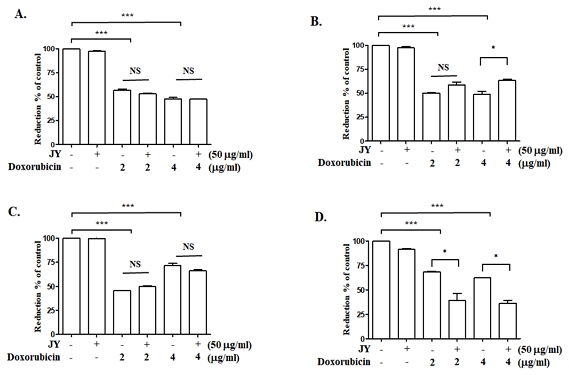
Measuring the cytotoxicity of Juk-Yeo in various cell types. (A) A549 cells were treated without or with 50 ㎍/ml of JY for 16 h. The cytotoxic effect of JY was measured by MTT assay (the 1st and 2nd columns). Two different amounts of doxorubicin were added to the cells treated with or without JY. The cytotoxicity caused by JY and doxorubicin was similarly measured by MTT (the 3rd to the 6th columns). Similar experiments were performed with MRC-5 (B), DBT (C), and SNU2292 cells (D). Statistic significances were determined by comparing vehicle-treated control with JY-treated cells, regardless of doxorubicin treated. NS was no statistical significance and *P was >0.5 when compared to JY-untreated cells in doxorubicin treatment experiments. ***P was >0.05 when doxorubicin treated experimental groups were compared to JY-untreated cells. All the experiments were performed in triplicate and three times independently. The results shown are representative of three repetitive experiments.
3. The reduction of lamin B1 is not due to the suppressed expression of lamin B1 mRNA
Next, we tested whether JY inhibits lamin B1 mRNA synthesis to block lamin B1 protein production. A549 cells were treated with two different amounts of JY, 10 ㎍/ml and 50 ㎍/ml, for 16 h. Then total RNA was extracted from the differentially treated cells and analyzed for lamin B1 mRNA with semi-quantitative RT-PCR. At the onset of this experiment, we took 1 ㎍ of cDNA to determine a change in the level of lamin B1 mRNA and found no differences among the differentially treated cells (Fig. 3A, the top panel). To determine a minute reduction of lamin B1 mRNA, we further diluted cDNA two-fold and did RT-PCR analysis of it to determine the effect of JY on the lamin B1 mRNA expression, finding no differences either (2nd and 3rd panels). To further confirm this observation, we performed a similar experiment with RAW 264.7 cells (Fig. 3B). From the total RNA extracted from RAW 264.7 cells, cDNA was synthesized and analyzed by a real-time RT-PCR. Similar to A549, no significant differences were found between JY-treated and untreated groups (Fig. 3B), suggesting that JY does not decrease lamin B1 protein by suppressing the mRNA synthesis of lamin B1.
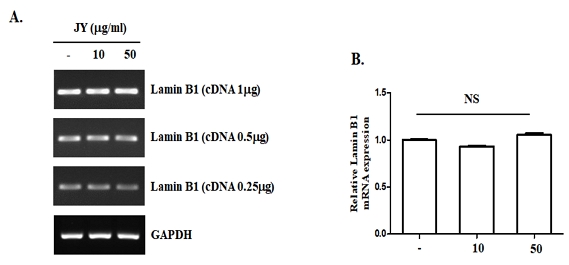
Juk-Yeo does not suppress the expression of lamin B1 mRNA. (A) A549 cells were treated without or with 10 ㎍/ml or 50 ㎍/ml of JY for 16 h. Total RNA was extracted from the differentially treated cells, and RT-PCR was performed. At the outset, one microgram of cDNA was used (the top panel). After two-fold dilution, RT-PCR was performed with decremental amounts of cDNA to determine the lamin B1 mRNA expression. (B) RAW 264.7 cells were similarly treated with JY. Total RNA was extracted from the differentially treated cells, and analyzed by quantitative RT-PCR. This experiment was performed three times independently and no statistical significances were found among experimental groups.
4. The reduction of lamin B1 is not due to increased protein degradation of lamin B1
Given that JY did not appear to inhibit the expression of lamin B1 mRNA for the purpose of decreasing lamin B1 protein, we tested whether JY is involved in degrading lamin B1 protein. Most protein degradation follows two paths, autophagosome-lysosome and 26S proteasome degradation pathways. Thus, we first examined whether JY induces the degradation of lamin B1 via the autophagosome-lysosome pathway. RAW 264.7 cells were treated with JY as described above in the absence or presence of E64D and pepstatin A, inhibitors of proteases located in lysosomes18). We reasoned that if JY induces the lamin B1 degradation via autophagosome-lysosome pathways, E64D and pepstatin A would block lamin B1 degradation triggered by JY, sustaining the level of lamin B1 comparable to that of the cells untreated with JY. However, as shown in Fig. 4A, E64D and pepstatin A failed to block the reduction of lamin B1 triggered by JY (lanes 5, 6). This result suggests that JY decreasing lamin B1 is not mainly due to the protein degradation mediated by autophagosome-lysosome. Next, we tested if JY decreases lamin B1 via 26S proteasome degradation. One could expect that if JY induces the lamin B1 degradation via 26S proteasome pathway, then MG132, an inhibitor of 26S proteasome19), would block lamin B1 reduction by JY. RAW 264.7 cells were treated with or without MG132, along with JY. Lamin B1 was analyzed by western blot. As shown in Fig. 4B, while JY decreased lamin B1 (lanes 1, 2, 3), MG132 failed to block the JY-induced reduction of lamin B1 (lane 5, 6). Together, these results suggest that JY does not decrease lamin B1 by mediating lysosome or 26S proteasome.
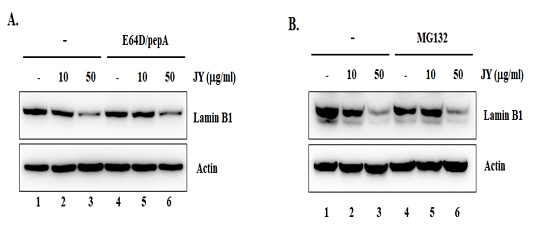
Juk-Yeo does not increase the degradation of lamin B1 protein. (A) RAW 264.7 cells were treated without or with 10 ㎍/ml or 50 ㎍/ml of JY for 16 h. Three hours before being harvested, cells were treated with 10 ㎍/ml of E64D and pepstatin A (pepA) mixture to block protein degradation via the autophagy-lysosome pathway. Total proteins were extracted from the treated cells and analyzed by western blotting for lamin B1 proteins and actin. (B) Similarly, RAW 264.7 cells were treated with JY as in (A), with or without 10 ㎍/ml of MG132 to block protein degradation via the 26S proteasome pathway. Total proteins were analyzed by western blotting for lamin B1 and actin.
5. JY induces the excretion of lamin B1 out of cells
Since JY did not block mRNA expression, or increase protein degradation of, lamin B1, we tested the possibility that lamin B1 is excreted from the cell when treated with JY. One of the possible ways of excreting lamin B1 is via exosomes20). It is conceivable that the amount of lamin B1 is lowered if lamin B1 is one of the proteins incorporated into exosomes, the production of which is increased by JY. To test this possibility, we treated RAW 264.7 cells with JY for 16 h and took the supernatant of cultured cells, from which exosomes were harvested and purified with ultracentrifugation. Purified exosomes were analyzed by western blotting for CD63, one of the hallmark proteins found in exosomes. In untreated control cells, CD63 was found abundantly in the exosome than in the total cell lysate, suggesting that CD63 is constantly excreted out of the cells as one of the exosome proteins (Fig. 5). In the exosome produced by the untreated cells, however, lamin B1 was not detectable, suggesting that lamin B1 may not be excreted as one of the exosome proteins. Interestingly, it appears that JY suppressed exosome production, as evidenced by that JY decreased CD63 in the exosome fraction. Accordingly, lamin B1 was under-detectable in the exosomes collected from the JY-treated cells. Together, these results suggest that the decrease of lamin B1 is not associated with exosome that may take lamin B1 out of the cell.
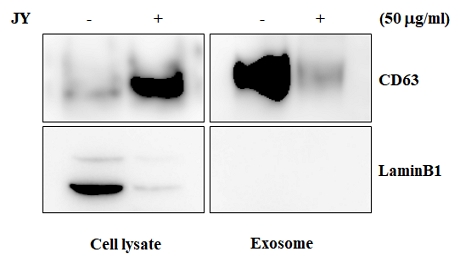
Juk-Yeo does not excrete lamin B1 protein via exosome. RAW 264.7 cells were treated without or with 50 ㎍/ml of JY. At 16 h after JY treatment, cell culture supernatant was collected, from which exosomes were isolated by ultracentrifugation. Exosomes were revealed by western blotting for CD63, the membrane of which was stripped and reprobed for the presence of lamin B1 in the exosome. Total cell lysate was similarly analyzed for CD63 and lamin B1.
Another possible way to reduce intracellular lamin B1 is excreting the protein out of cells. To test this possibility, we treated RAW 264.7 cells with JY, as described above, and collected the cell culture supernatant. If JY expels lamin B1 out of the cell, presumably we could precipitate the protein from the cell culture supernatant. An anti-lamin B1 antibody was added to the cell culture supernatant, where the immune complex generated by the added antibody was captured by protein-A agarose bead and the precipitated lamin B1 was revealed by western blotting for lamin B1. As shown in Fig. 6, unlike in the untreated control cells, lamin B1 was detectable in the supernatant of JY-treated cells. Together, these results suggest that JY decreases the level of intracellular lamin B1 by excreting the protein out of the cells.
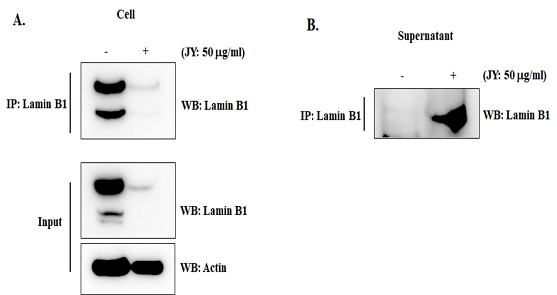
Juk-Yeo excretes lamin B1 protein. RAW 264.7 cells were treated without or with 50 ㎍/ml of JY. At 16 h after JY treatment, total cell lysate was prepared and lamin B1 protein was precipitated by the anti-lamin B1 antibody. The immune complex was analyzed by western blotting for lamin B1. As input, the total cell lysate was analyzed by western blotting for lamin B1 and actin (A). From the supernatant of RAW 264.7 cells treated with or without JY as described in (A), lamin B1 was precipitated by adding the anti-lamin B1 antibody to the supernatant and the immune complex was similarly analyzed by western blotting for lamin B1 (B).
6. JY decreases the levels of other lamin proteins
Finally, we examined whether JY could decrease other lamin proteins including lamin B2 and lamin A/C, along with lamin B1. RAW 264.7 cells were treated with JY, as described above, and the total cell lysate was analyzed by western blotting for lamin B2 and lamin A/C. As shown in Fig. 7A, JY decreased not only lamin B2 but lamin A/C. To test whether JY similarly decreases these lamins in other cell types, we treated MRC-5 cells with JY and performed western blotting for the lamin proteins. As shown in Fig.7B, JY decreased lamin B2 and lamin A/C in MRC-5 cells as well. Together, these results suggest that JY is capable of decreasing the levels of type-A and type-B lamin proteins in many animal cells.
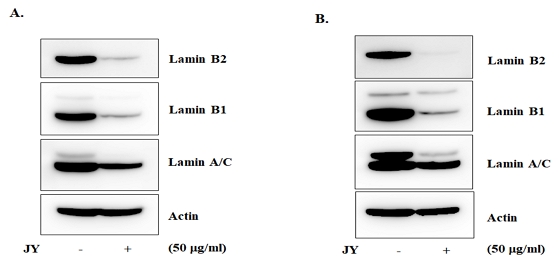
Juk-Yeo decreases other types of lamin proteins. (A) RAW 264.7 cells were treated without or with 50 ㎍/ml of JY. At 16 h after JY treatment, total cell lysate was prepared and various lamin protoeins, including lamin B1, B2, and lamin A/C, were analyzed by western blotting for each protein. Equal loading was ensured by western blotting for actin. (B) Similar experiment was performed with A549 cells. Total cell lysate was prepared from A549 cells treated with or without JY and then the levels of lamin B1, lamin B2, and lamin A/C were analyzed by western blotting for each protein. The experiments were performed at least three times, and representative results are shown.
Discussion
In this study, we show that Juk-Yeo (JY), Bambusae Caulis in Taeniam, could decrease the level of lamin B1. Throughout the study, we consistently found that JY decreased lamin B1 proteins in various animal cells including humans. JY did not block lamin B1 mRNA synthesis or increase the degradation of lamin B1 protein, both of which would lead to reduced lamin B1. Rather, we found that JY excreted lamin B1 out of cells, as we immunoprecipitated lamin B1 from the cell culture supernatant. Furthermore, not only lamin B1 but other types of lamin proteins including lamin B2 and lamin A/C were decreased by JY treatment. Although the significance of these effects of JY in Korean medicine remains unclear, its ability to reduce lamin proteins suggests expanding the range of medical conditions, or indications, treatable with JY, given that lamin proteins are involved in the aging process and rare genetic diseases.
Lamins are structural proteins found in the cell nucleus, participating in chromatin organization, regulation of gene expression, and cellular differentiation21). The most well-known disease associated with lamin B1 is Adult-onset autosomal Dominant Leukodystrophy (ADLD)22). ADLD is a progressive neurological disorder characterized by demyelination in the central nervous system (CNS). ADLD patients typically overexpress lamin B1 protein, which is due to LMNB1 gene duplication23). Emery-Dreifuss Muscular Dystrophy (EDMD) has been known to associate with mutations in lamin A/C or lamin B24). EDMD patients suffer from muscle weakness, joint contractures, and heart issues. Along with lamin B, lamin A/C is linked to aging and the progression of diseases, including cancers and degenerative conditions25). For instance, mutations in the LMNA gene can lead to laminopathies, a group of rare genetic disorders that include Hutchinson-Gilford Progeria Syndrome (HGPS)26). The mutations in the LMNA gene of HGPS patients lead to the production of a truncated form of lamin A, called progerin, resulting in accelerated aging and associated health issues27). Interestingly, normal aging cells also tend to accumulate progerin28). While low in normal individuals, the level of progerin tends to increase as aging, suggesting a role of progerin in natural aging. Although the role of progerin in normal aging is under investigation, JY can be developed as part of therapeutic regimens in treating rare genetic diseases and aging-related symptoms.
In order to decrease lamin B1, JY did not meddle with lamin B1 mRNA synthesis or lamin B1 protein degradation; rather, JY expelled lamin B1 from the cell. Because of the regulatory mechanisms for mRNA synthesis, it is hard to imagine the mechanism by which JY selectively block lamin B1 mRNA synthesis. However, it is conceivable if a chemical constituent of JY binds to lamin B1 protein, deforming lamin B1, then the lamin B1 complexed with the constituent could be destined to be degraded. Despite the possibility, we could not find any evidence that JY triggers the degradation of lamin B1 to lower its level in the cell. Instead, we found that JY induced the excretion of lamin B1 out of the cell. Although the precise mechanism for lamin B1 to be excreted remains unclear, a similar possibility is applicable: a chemical constituent of JY binds to lamin B1, redirecting the otherwise intranuclear lamin B1 outside the cell. It is unclear how selectively the chemical constituent of JY binds lamin B1. At least, we could eliminate the possibility that JY decreased all intracellular protein levels by randomly degrading proteins because JY did not alter the amounts of YY115), H316), and actin29). In addition, we could not find gross reduction of protein levels after JY treatment (data not shown). These results suggest the possibility that the constituent of JY prefers lamin B1 over other proteins. Preferable binding of the chemical constituent of JY to lamin B1 is likely because JY decreased other lamins, including lamin B2 and lamin A/C, as well. Since lamin proteins share a homologous domain such as central α-helical rod domain30), it is conceivable that the chemical constituent could bind to the domain shared among different lamins31). If this is the case, JY could reduce all the lamins in the cell at the same time. Then, other lamins could be excreted, similar to lamin B1. However, it remains unknown whether all the lamins are excreted by JY or only lamin B1 is excreted. This possibility is need to be tested.
In this study, we provide evidence that JY decreased the level of intranuclear lamin B1 and other classes of lamin proteins. Although the precise mechanism by which JY makes lamins excreted from the cells remains unknown, our data clearly show that JY decreased lamin B1 in the nucleus. Since the accumulation of altered lamin proteins has been emerging as an aging associated factor and rare genetic diseases, JY could be part of regimens that ameliorate symptoms caused by aging and lamin-associated genetic disorders.
Acknowledgments
본 논문은 저자 기여도 표기가 수정된 논문임.
This study was supported by the 2-year Research Grant of Pusan National University.
References
- Zhou BQ, Gao XM, Yang Y, Wang LC, Zhang W, Zhao XL, et al. Quality analysis of Caulis Bambusae In Taeniam from different origins by HPLC coupled with chemometrics. Chinese Traditional and Herbal Drugs. 2022;53(3).
-
Kim JY, Kim D, Kwon O. Effective screening for the anti-hypertensive of selected herbs used in the traditional Korean medicines. Appl Biol Chem. 2016;59(4).
[https://doi.org/10.1007/s13765-016-0190-7]

-
Lyu YS, Park JM, Ko IS, Kang HW, Lyu YS. The Anxiolytic, Anti-Depressive Effects Using Bambusae Caulis in Taeniam Extract in Rat Chronic Immobilization Stress Model. Journal of Oriental Neuropsychiatry. 2013;24(3).
[https://doi.org/10.7231/jon.2013.24.3.293]
-
Choi HJ, Gwak Y, Lee JY, Kwun MJ, Choi JY, Joo M. Bambusae Caulis in Taeniam Applicable for Medical Indications Associated with Inflammation. Journal of Physiology & Pathology in Korean Medicine. 2023;37(1).
[https://doi.org/10.15188/kjopp.2023.02.37.1.14]
-
Lim D, Cho Y, Kim W, Jeong S, Jang YP, Kim J. Original Research: Extract of Bambusae Caulis in Taeniam inhibits cigarette smoke-induced pulmonary and intestinal inflammation. Exp Biol Med. 2017;242(1).
[https://doi.org/10.1177/1535370216664429]
-
Eom HW, Park SY, Kim YH, Seong SJ, Jin ML, Ryu EY, et al. Bambusae Caulis in Taeniam modulates neuroprotective and anti-neuroinflammatory effects in hippocampal and microglial cells via HO-1- and Nrf-2-mediated pathways. Int J Mol Med. 2012;30(6).
[https://doi.org/10.3892/ijmm.2012.1128]
-
Jin GH, Park SY, Kim E, Ryu EY, Kim YH, Park G, et al. Anti-inflammatory activity of Bambusae Caulis in Taeniam through heme oxygenase-1 expression via Nrf-2 and p38 MAPK signaling in macrophages. Environ Toxicol Pharmacol. 2012;34(2).
[https://doi.org/10.1016/j.etap.2012.05.001]
-
Sies H, Jones DP. Reactive oxygen species (ROS) as pleiotropic physiological signalling agents. Nat Rev Mol Cell Biol. 2020 Jul 1;21(7):363-83.
[https://doi.org/10.1038/s41580-020-0230-3]
-
Capece D, Verzella D, Flati I, Arboretto P, Cornice J, Franzoso G. NF-κB: blending metabolism, immunity, and inflammation. Trends Immunol. 2022 Sep 1;43(9):757–75.
[https://doi.org/10.1016/j.it.2022.07.004]
-
Kim A, Im M, Yim NH, Jung YP, Ma JY. Aqueous Extract of Bambusae Caulis in Taeniam Inhibits PMA-Induced Tumor Cell Invasion and Pulmonary Metastasis: Suppression of NF-κB Activation through ROS Signaling. PLoS One. 2013;8(10).
[https://doi.org/10.1371/journal.pone.0078061]
-
Park SR, Kim KH, Kwun MJ, Lee JY, Won R, Han CW, et al. Differential Regulation of NF- B and Nrf2 by Bojungikki-Tang Is Associated with Suppressing Lung Inflammation. Evidence-based Complementary and Alternative Medicine. 2018;2018.
[https://doi.org/10.1155/2018/5059469]
-
Dechat T, Pfleghaar K, Sengupta K, Shimi T, Shumaker DK, Solimando L, et al. Nuclear lamins: Major factors in the structural organization and function of the nucleus and chromatin. Vol. 22, Genes and Development. 2008.
[https://doi.org/10.1101/gad.1652708]
-
Comai L, Reddy S. Recent advances in understanding the role of lamins in health and disease. Vol. 5, F1000Research. 2016.
[https://doi.org/10.12688/f1000research.9260.1]
-
Worman HJ. Nuclear lamins and laminopathies. Vol. 226, Journal of Pathology. 2012.
[https://doi.org/10.1002/path.2999]
-
Verheul TCJ, van Hijfte L, Perenthaler E, Barakat TS. The Why of YY1: Mechanisms of Transcriptional Regulation by Yin Yang 1. Vol. 8, Frontiers in Cell and Developmental Biology. 2020.
[https://doi.org/10.3389/fcell.2020.592164]
-
Hans F, Dimitrov S. Histone H3 phosphorylation and cell division. Vol. 20, Oncogene. 2001.
[https://doi.org/10.1038/sj.onc.1204326]
-
Linders AN, Dias IB, López Fernández T, Tocchetti CG, Bomer N, Van der Meer P. A review of the pathophysiological mechanisms of doxorubicin-induced cardiotoxicity and aging. Vol. 10, npj Aging. 2024.
[https://doi.org/10.1038/s41514-024-00135-7]
-
Tanida I, Minematsu-Ikeguchi N, Ueno T, Kominami E. Lysosomal turnover, but not a cellular level, of endogenous LC3 is a marker for autophagy. Autophagy. 2005;1(2).
[https://doi.org/10.4161/auto.1.2.1697]
-
Lee HK, Park SH, Nam MJ. Proteasome inhibitor MG132 induces apoptosis in human osteosarcoma U2OS cells. Hum Exp Toxicol. 2021;40(11).
[https://doi.org/10.1177/09603271211017972]
-
Gurung S, Perocheau D, Touramanidou L, Baruteau J. The exosome journey: from biogenesis to uptake and intracellular signalling. Vol. 19, Cell Communication and Signaling. 2021.
[https://doi.org/10.1186/s12964-021-00730-1]
-
Goldman R, Adam S, Goldman AE, Butin-Israeli V, Shimi T. The Lamins are Major Determinants of Nuclear Architecture. The FASEB Journal. 2012;26(S1).
[https://doi.org/10.1096/fasebj.26.1_supplement.201.3]
-
Potic A, Pavlovic AM, Uziel G, Kozic D, Ostojic J, Rovelli A, et al. Adult-onset autosomal dominant leukodystrophy without early autonomic dysfunctions linked to lamin B1 duplication: A phenotypic variant. J Neurol. 2013;260(8).
[https://doi.org/10.1007/s00415-013-6958-3]
-
Schuster J, Sundblom J, Thuresson AC, Hassin-Baer S, Klopstock T, Dichgans M, et al. Genomic duplications mediate overexpression of lamin B1 in adult-onset autosomal dominant leukodystrophy (ADLD) with autonomic symptoms. Neurogenetics. 2011;12(1).
[https://doi.org/10.1007/s10048-010-0269-y]
-
Dubik N, Mai S. Lamin A/C: Function in normal and tumor cells. Vol. 12, Cancers. 2020.
[https://doi.org/10.3390/cancers12123688]
-
Butin-Israeli V, Adam SA, Goldman AE, Goldman RD. Nuclear lamin functions and disease. Vol. 28, Trends in Genetics. 2012.
[https://doi.org/10.1016/j.tig.2012.06.001]
-
Batista NJ, Desai SG, Perez AM, Finkelstein A, Radigan R, Singh M, et al. The Molecular and Cellular Basis of Hutchinson–Gilford Progeria Syndrome and Potential Treatments. Vol. 14, Genes. 2023.
[https://doi.org/10.3390/genes14030602]
-
Cisneros B, García-Aguirre I, De Ita M, Arrieta-Cruz I, Rosas-Vargas H. Hutchinson-Gilford Progeria Syndrome: Cellular Mechanisms and Therapeutic Perspectives. Vol. 54, Archives of Medical Research. 2023.
[https://doi.org/10.1016/j.arcmed.2023.06.002]
-
Ashapkin VV, Kutueva LI, Kurchashova SY, Kireev II. Are there common mechanisms between the Hutchinson-Gilford progeria syndrome and natural aging? Vol. 10, Frontiers in Genetics. 2019.
[https://doi.org/10.3389/fgene.2019.00455]
-
Davidson PM, Cadot B. Actin on and around the Nucleus. Vol. 31, Trends in Cell Biology. 2021.
[https://doi.org/10.1016/j.tcb.2020.11.009]
-
Glass CA, Glass JR, Taniura H, Hasel KW, Blevitt JM, Gerace L. The alpha-helical rod domain of human lamins A and C contains a chromatin binding site. EMBO J. 1993;12(11).
[https://doi.org/10.1002/j.1460-2075.1993.tb06126.x]
-
Dittmer T, Misteli T. The lamin protein family. Genome Biol. 2011;12(5).
[https://doi.org/10.1186/gb-2011-12-5-222]