
청피 에탄올 추출물이 스트레스성 카테콜아민으로 유도한 간암세포의 전이를 억제하는 효과 및 기전 연구
Ⓒ The Society of Pathology in Korean Medicine, The Physiological Society of Korean Medicine
Abstract
Previous studies have highlighted the pivotal role of the β-adrenergic receptor (β-AR) signaling pathway in stimulating cancer metastasis induced by chronic stress. According to the theory of traditional Korean medicine, chronic stress can induce Qi stagnation. Based on the traditional role of premature citrus unshiu peel in moving Qi, we hypothesized that an ethanol extract of premature citrus unshiu peel (EPCU) can attenuate chronic stress-induced cancer progression. In this study, we investigated the potential role of EPCU on modulating the adrenergic agonists-induced metastatic properties of liver cancer cells. Our findings revealed that adrenergic agonists, including norepinephrine (NE), epinephrine (E), and isoproterenol (ISO), augmented the migratory capacity of Hep3B human hepatocellular carcinoma cells, which was completely abrogated by EPCU treatment in a concentration-dependent manner. Consistently, EPCU inhibited the E-induced invasive property of Hep3B cells in a dose-dependent manner. These results suggest that EPCU efficiently attenuates adrenergic agonists-induced metastatic abilities of liver cancer cells. As a molecular mechanism, EPF suppressed the phosphorylation of major components of β-AR signaling pathway, including Src, signal transducer and activator of transcription 3 (STAT3) and ERK, induced by E treatment. Taken together, our results demonstrate that EPCU impedes the adrenergic agonists-driven metastatic potential of cancer cells by inhibiting β-AR signaling pathway. This study provides basic evidence supporting the probable use of premature citrus unshiu peel to prevent metastasis in liver cancer patients under chronic stress.
Keywords:
Premature citrus unshiu peel, Chronic stress, β-adrenergic receptor signaling pathway, Liver cancer, Metastasis서 론
만성적 스트레스는 암의 개시와 진행을 촉진하는 주요한 인자이다1,2). 여러 임상연구 결과 만성적 스트레스 상황에 놓인 암환자가 그렇지 않은 암환자에 비해 높은 재발률과 사망률을 보이며, 전임상 연구에서도 만성적인 스트레스가 암의 성장과 혈관신생 및 전이를 촉진한다는 것이 보고되어 있다3-5). 또한 정신심리적인 상담이나 개입이 암환자의 생존율을 높이고 재발을 억제할 수 있는 것으로 알려져 있다6,7). 스트레스 상황에서 인체가 나타내는 반응은 크게 두 가지로서 첫번째는 시상하부-뇌하수체-부신피질축(hypothalamus-pituitary gland-adrenal cortex axis, HPA axis)을 통해 부신피질에서 코티솔(cortisol)이 분비되는 것이고, 두번째는 교감신경이 항진되면서 부신수질과 교감신경섬유 말단에서 에피네프린(epinephrine), 노르에피네프린(norepinephrine)과 같은 카테콜아민(catecholamine)이 분비되는 것이다8). 두 경로는 모두 인체의 면역작용을 억제함으로써 암을 촉진시키는 것으로 알려져 있다8). 이 중 스트레스에 의한 교감신경계 항진은 다양한 암종에 발현되는 베타 아드레날린 수용체(β-adrenergic receptor, β-AR)를 통해 신호를 전달한다9). β-AR 신호전달경로는 암치료제의 유망한 타겟으로서 암유전자 및 DNA 복구 유전자를 조절하고, 암세포의 증식과 전이를 촉진시키거나 세포사멸에 저항하는 유전자의 발현을 증가시켜 암을 악화시키는 것으로 알려져 있다10,11). 특히 프로프라놀롤(propranolol)과 같은 베타 아드레날린 수용체 억제제가 여러 암종에서 무재발생존기간(relapse-free survival)을 늘리고 전이를 억제하며 사망률을 감소시킴이 보고되어 새로운 암치료제로 각광받고 있다12-14). 따라서 만성적 스트레스로 인한 암의 진행을 억제하기 위한 전략으로서 β-AR 신호전달경로를 효과적으로 조절할 수 있는 약물의 개발이 필요한 실정이다.
간암은 2020년 기준 우리나라에서 암 발생률 7위를 차지하였으며, 5년 생존율은 38.7%로 예후가 불량한 암종에 속한다. 또한 2022년 기준 폐암 다음으로 가장 사망률이 높은 암에 해당한다15). 미국의 통계에서도 간암의 5년 생존율은 21%에 그쳐 췌장암 다음으로 가장 예후가 불량하게 나타났다16). B형 간염 바이러스, C형 간염 바이러스, 지방간, 알코올성 간경변, 흡연, 비만, 당뇨 등이 간암의 위험인자로 알려져 있다17). 일반적으로 간암을 치료하기 위해 간절제술, 간이식술, 고주파 열치료술, 에탄올 주입술, 경동맥화학색전술 등이 활용되고 있으며, 표적치료제로서 소라페닙(sorafenib)의 항암효과가 보고되어 있으나 다양한 부작용이 동반된다17). 게다가 간암 환자 중 대다수가 만성 간질환을 가지고 있어 간기능이 저하되어 있으므로 암치료가 쉽지 않은 실정이다17). 따라서 간암을 치료하기 위한 새로운 전략과 약물개발이 요청된다.
청피(靑皮)는 운향과(芸香科)에 속한 귤나무(Citrus unshiu Markovich)의 어린 과실 또는 미성숙 과실의 껍질이다. 한의학적으로 간담(肝膽)에 귀경(歸經)하고 소간파기(疏肝破氣)하는 효능이 있어 흉협위완동통(胸脇胃脘疼痛), 식적(食積), 산기(疝氣) 등을 치료하는 데 사용되어 왔다18). 최근 약리학적 연구에 따르면 청피는 항염증효과, 항천식효과, 뇌혈류순환 촉진효과, 간손상 개선효과, 항우울효과, 항암효과 등을 가지는 것으로 보고되었다19-24). 특히 유방암, 결장암, 위암 등 다양한 암종에서 암세포의 증식을 억제하고 apoptosis를 일으켜 항암작용을 가진다고 알려져 있다24-26). 그러나 청피가 간암세포의 전이능에 미치는 영향은 현재까지 연구된 바가 없다. 본 연구에서는 정신적 스트레스가 한의학적으로 간기울결(肝氣鬱結)을 일으켜 기혈(氣血)의 운행을 막아 담음(痰飮)과 어혈(瘀血) 등을 형성함으로써 간암의 주요한 원인이 된다27,28)는 점에 착안하여 소간파기시키는 청피가 스트레스로 인해 증가한 간암세포의 전이능을 조절할 것이라는 가설 하에 실험을 진행하였으며 유의한 결과를 얻었기에 보고하는 바이다.
재료 및 방법
1. 시료 제조
본 연구에 사용된 청피는 중국 사천이 원산지로 ㈜본초마루(Seoul, Korea)에서 구입하였다. 먼저 청피 20 g을 고운 분말로 파쇄한 후 80% 에탄올 200 ㎖을 넣고 초음파세척기에서 20분씩 총 3회 sonication 시켰다. 그 후 40℃에서 120 rpm으로 교반시키며 72시간 동안 1차 추출하였다. 1차 추출액을 모은 후 청피에 다시 80% 에탄올 100 ㎖를 넣고 동일한 방식으로 24시간 동안 2차 추출하였으며, 1차 추출액과 2차 추출액을 모아 원심분리 및 여과지를 통과시켜 찌꺼기를 제거하였다. 여과된 추출액을 감압농축시키고 72시간 동안 동결건조한 결과 4.56 g의 분말을 얻었으며(수율 22.8%), 해당 분말을 dimethylsulfoxide (DMSO; Amresco, Solon, OH, USA)에 100 ㎎/㎖로 녹여 –80℃에 보관하였다. 이를 EPCU(ethanol extract of premature citrus unshiu peel)로 명명하였다.
2. 세포 배양
Hep3B 인체 간암세포주는 동의대학교 최영현 교수님으로부터 분양받았다. Dulbecco's Modified Essential Medium (DMEM; WelGENE, Seoul, Korea) 배지 500 ㎖에 fatal bovine serum (FBS; WelGENE) 50 ㎖과 antibiotics (WelGENE) 5 ㎖을 첨가하여 배양액으로 사용하였으며, 37℃, 5% CO2 조건에서 배양하였다.
3. MTT assay
96 well plate에 Hep3B 세포를 3×10³개 분주하고 안정화시킨 후 EPCU를 농도별(0, 0.1, 1, 10, 100 ㎍/㎖)로 처리하였다. 24시간 후 세포배양액에 MTT 시약(Duchefa, Haarlem, The Netherlands)을 0.4 ㎎/㎖이 되도록 첨가하고 37℃에서 2시간 동안 배양하였다. Plate 바닥에 보라색 formazin이 형성된 것을 확인한 후 세포배양액을 모두 제거하고 DMSO를 100 ㎕씩 주입하였다. Plate를 부드럽게 tapping하면서 formazin을 완전히 용해시킨 후 microplate reader (Molecular Devices, Sunnyvale, CA, USA)를 사용하여 흡광도를 540 nm에서 측정하였다. 측정된 OD값을 기준으로 세포생존율을 계산하였다.
4. Transwell assay
Hep3B 세포의 이동능을 파악할 수 있는 transwell migration assay는 24 well transwell plate (8.0 ㎛ pore size; Corning, NY, USA)를 사용하여 시행하였다. 먼저 transwell plate의 insert 겉면을 0.1% gelatin (Sciencell, Carlsbad, CA, USA)으로 코팅한 후 실온에서 30분간 굳혔다. 그 다음 Hep3B 세포 2×10⁴개를 serum이 포함되지 않은 DMEM 배지 200 ㎕에 현탁하여 insert에 분주하면서 에피네프린(E, 10 μM; Sigma‐Aldrich, St. Louis, MO, USA), 노르에피네프린(NE, 10 μM; Sigma‐Aldrich), 이소프레날린(isoprenaline, IP, 10 μM; Sigma‐Aldrich) 및 EPCU(25-100 ㎍/㎖)를 처리하였다. Lower chamber에는 10% FBS가 포함된 DMEM 배지 500 ㎕를 분주하였다. 24시간 배양 후 insert를 methanol로 5분간 고정하고, hematoxylin (Sigma‐Aldrich)으로 30분간 염색하였다. 그 후 현미경(Carl Zeiss, Oberkochen, Germany)을 사용하여 염색된 세포를 촬영(×100 배율)하고 계수하였다. Hep3B 세포의 침윤능을 파악할 수 있는 transwell invasion assay는 insert의 안쪽 면을 300 g/mL Matrigel (BD Bioscience, San Jose, CA, USA)로 코팅한 점을 제외하고 transwell migration assay와 동일하게 진행하였다.
5. 웨스턴블롯
Hep3B 세포를 6 well plate에 분주하고 안정화시킨 후 EPCU를 농도별(25-100 ㎍/㎖)로 처리하였다. 24시간 후 에피네프린(10 μM)을 세포배양액에 추가하고 40분간 반응시킨 후 하베스트하였다. 세포에서 단백질을 추출하기 위해 RIPA buffer (Thermo Fisher Scientific, San Jose, CA, USA)에 protease inhibitor cocktail (Thermo Fisher Scientific)과 phosphatase inhibitors (1 mM Na3VO4, 100 mM NaF)를 첨가하여 lysis buffer로 사용하였다. 4℃에서 1시간 동안 세포를 lysis 시킨 후 4℃, 13500 rpm에 30분간 원심분리하여 얻은 상층액을 bicinchoninic acid (BCA) protein assay kit (Pierce Biotechnology, Rockford, IL, USA)를 사용하여 정량하였다. 각 조건당 20 ㎍의 단백질을 SDS-PAGE로 분리 및 transfer 하였으며, 3% bovine serum albumin (BSA, GenDEPOT, TX, USA)으로 실온에서 30분간 blocking 하였다. Phosphorylated STAT3 (p-STAT3), p-Src, p-ERK 항체는 모두 Cell Signaling Technology (Beverly, MA, USA)에서 구입하였으며, total STAT3 (t-STAT3), t-Src, t-ERK 및 actin 항체는 모두 Santa Cruz Biotechnology Inc. (Santa Cruz, CA, USA)에서 구입하였다. 1차 항체는 blocking buffer를 사용하여 1:1000으로 희석한 후 4℃에서 overnight 반응시켰다. Goat anti‑rabbit 2차 항체는 Enzo Life Sciences (Farmingdale, NY, USA)에서 구입하였으며, 3% skim milk를 사용하여 1:10000으로 희석한 후 1시간 동안 실온에서 반응시켰다. 단백질 발현은 D-Plus ECL Femto System (Donginbio, Seoul, Korea)을 사용하여 확인하였다. p-STAT3/t-STAT3. ratio는 각 band의 intensity를 ImageJ software를 통해 수치화한 후 actin으로 보정하여 계산하였다.
6. 통계 분석
모든 실험 결과는 평균(mean)±표준편차(SD)로 표시하였으며, Student’s t-test를 이용하여 P < 0.05인 것을 통계적으로 유의성 있다고 판단하였다.
결 과
1. Hep3B 인체 간암세포주의 증식에 영향을 미치지 않는 EPCU 농도 설정
먼저 EPCU가 Hep3B 인체 간암세포주의 증식에 영향을 미치지 않는 농도 조건을 설정하였다. 만약 EPCU가 세포독성을 나타낼 경우 그로 인해 항전이 효과가 나타날 가능성이 있기 때문이다. 세포사멸을 일으키지 않으면서 순수하게 암세포의 전이를 억제할 수 있는 농도구간을 확인하기 위하여 Hep3B 세포에 다양한 농도(0, 0.1, 1, 10, 100 ㎍/㎖)로 EPCU를 24시간 처리한 후 MTT assay를 시행하였다. 그 결과 Fig. 1에 나타난 바와 같이 최저농도인 EPCU 0.1 ㎍/㎖ 처리군에서 최고농도인 EPCU 100 ㎍/㎖ 처리군까지 세포생존율이 모두 90% 이상으로 나타나 세포증식에 영향을 미치지 않는 것으로 확인되었다, 따라서 EPCU 100 ㎍/㎖를 최고농도로 설정하여 이후 실험을 진행하였다.
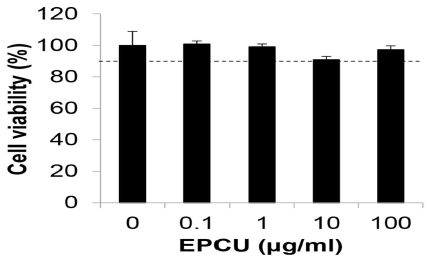
Effects of EPCU on the cell viability of Hep3B human liver cancer cells. Hep3B human liver cancer cells were treated with EPCU (0.1-100 ㎍/㎖) for 24 h. The cell viability was evaluated by MTT assay. The data are expressed as the means ± SD of 3 independent experiments. The dotted line indicates the cell viability of 90%. EPCU, ethanol extract of premature citrus unshiu peel.
2. 에피네프린(E)으로 유도한 Hep3B 세포의 이동능에 미치는 EPCU의 효과
다음으로 EPCU가 E로 유도한 Hep3B 세포의 이동을 억제할 수 있는지 transwell migration assay를 통해 확인하였다. 선행 연구에서 Hep3B 세포에 E를 농도별로 처리했을 때 10 μM이 Hep3B 세포의 이동능을 가장 현저히 증가시켰으므로29) 본 연구에서도 10 μM 농도로 E를 처리하였다. 그 결과 Fig. 2에 나타난 바와 같이 E에 의해 Hep3B 세포의 이동능이 216.37±22.32%까지 증가하였으며, EPCU 25 ㎍/㎖ 처리군에서는 79.64±10.36%, 50 ㎍/㎖ 처리군에서는 65.47±1.13%, 100 ㎍/㎖ 처리군에는 21.96±4.39%로 각각 감소하였다(Fig. 2A and 2B). 이러한 결과는 스트레스 상황에서 분비되는 E가 간암세포의 이동을 촉진할 수 있으며, 이를 EPCU가 농도의존적으로 억제할 수 있음을 시사한다.
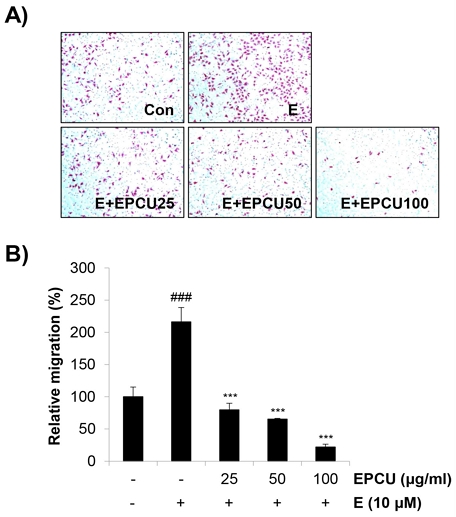
Effects of EPCU on epinephrine (E)-induced migration of Hep3B cells. Hep3B human liver cancer cells were plated in triplicate into the inserts of transwell plate and treated with E (10 μM) and EPCU (25-100 ㎍/㎖). Medium containing 10% FBS was used as a chemoattractant. The cells were incubated for 24 h for migration. (A) Cells that migrated through the membrane were stained and photographed under a microscope (×100 magnification). (B) The number of stained cells was counted. The data are expressed as the mean ± SD of three independent experiments. Significance was determined by the Student’s t-test (###P < 0.001 versus untreated cells; ***P < 0.001 versus E-treated cells). EPCU, ethanol extract of premature citrus unshiu peel; E, epinephrine.
3. 노르에피네프린(NE)으로 유도한 Hep3B 세포의 이동능에 미치는 EPCU의 효과
NE는 스트레스로 인한 교감신경계 항진과정에서 E와 더불어 분비되는 대표적 카테콜아민이다. EPCU가 E 뿐만 아니라 NE로 유도한 Hep3B 세포의 이동 역시 억제할 수 있는지 transwell migration assay를 통해 확인하였다. 이 때 NE는 1 μM 농도로 처리하였으며, 이는 선행 연구에서 Hep3B 세포에 NE를 농도별로 처리했을 때 1 μM이 가장 탁월한 이동능 증가효과를 보였기 때문이다29). 실험 결과 NE에 의해 Hep3B 세포의 이동능이 현저히 증가하여 195.52±1.94%까지 증가하였으며, EPCU 25 ㎍/㎖ 처리군에서는 30.66±7.25%, 50 ㎍/㎖ 처리군에서는 9.91±2.83%, 100 ㎍/㎖ 처리군에는 8.96±2.93%로 각각 이동능이 감소하였다(Fig. 3A and 3B). 상기한 결과는 E 뿐만 아니라 NE로 유도한 간암세포의 이동능 역시 EPCU가 농도의존적으로 억제할 수 있음을 보여준다.
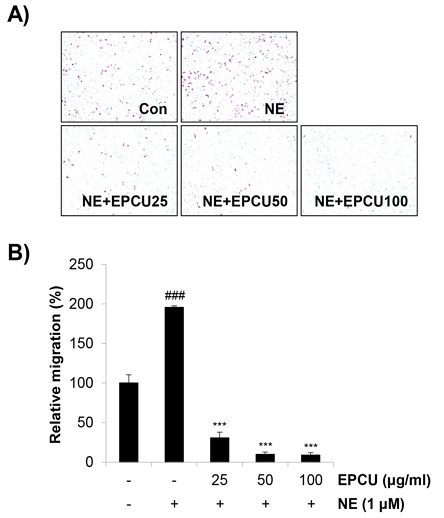
Effects of EPCU on norepinephrine (NE)-induced migration of Hep3B cells. Hep3B human liver cancer cells were plated in triplicate into the inserts of transwell plate and treated with NE (1 μM) and EPCU (25-100 ㎍/㎖). Medium containing 10% FBS was used as a chemoattractant. The cells were incubated for 24 h for migration. (A) Cells that migrated through the membrane were stained and photographed under a microscope (×100 magnification). (B) The number of stained cells was counted. The data are expressed as the mean ± SD of three independent experiments. Significance was determined by the Student’s t-test (###P < 0.001 versus untreated cells; ***P < 0.001 versus NE-treated cells). EPCU, ethanol extract of premature citrus unshiu peel; NE, norepinephrine.
4. 이소프레날린(IP)으로 유도한 Hep3B 세포의 이동능에 미치는 EPCU의 효과
스트레스성 카테콜아민인 E와 NE가 α-AR과 β-AR을 비선택적으로 활성화시킬 수 있는 반면 IP는 β-AR을 선택적으로 활성화시키는 작용제(agonist)이다. EPCU가 E/NE 뿐만 아니라 IP로 유도한 Hep3B 세포의 이동능을 억제할 수 있는지 transwell migration assay를 통해 확인하였다. 선행 연구결과에 따라 Hep3B 세포의 이동능을 가장 현저히 증가시켰던 10 μM을 IP 처리농도로 설정하였다29). 실험 결과 IP 처리에 의해 Hep3B 세포의 이동능이 현저히 증가하여 253.94±26.58%를 나타냈으며, EPCU 25 ㎍/㎖ 처리군에서는 261.82±11.71%으로 이동능 저해효과가 나타나지 않았으나, 50 ㎍/㎖ 처리군과 100 ㎍/㎖ 처리군에서는 이동능이 각각 163.64±23.79%, 40±5.77%로 나타나 EPCU의 탁월한 이동능 감소효과를 확인할 수 있었다(Fig. 4A and 4B). 이러한 결과는 E/NE 뿐만 아니라 IP로 유도한 간암세포의 이동능 역시 EPCU가 농도의존적으로 저해할 수 있음을 시사한다. IP는 β-AR 선택적 작용제이므로 상기한 결과는 EPCU가 β-AR 경로를 억제함으로써 간암세포의 이동능을 조절할 수 있음을 의미하는 것이다.
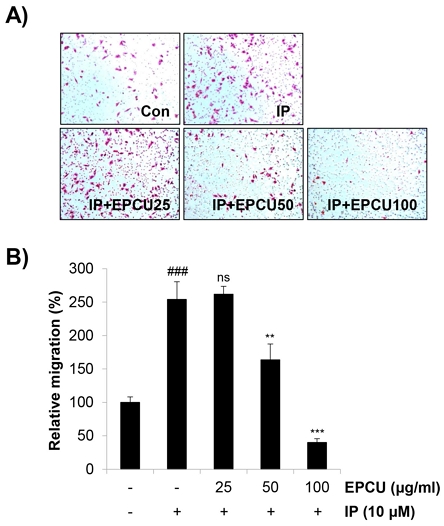
Effects of EPCU on isoprenaline (IP)-induced migration of Hep3B cells. Hep3B human liver cancer cells were plated in triplicate into the inserts of transwell plate and treated with IP (10 μM) and EPCU (25-100 ㎍/㎖). Medium containing 10% FBS was used as a chemoattractant. The cells were incubated for 24 h for migration. (A) Cells that migrated through the membrane were stained and photographed under a microscope (×100 magnification). (B) The number of stained cells was counted. The data are expressed as the mean ± SD of three independent experiments. Significance was determined by the Student’s t-test (###P < 0.001 versus untreated cells; ns, not significant; **P < 0.01; ***P < 0.001 versus IP-treated cells). EPCU, ethanol extract of premature citrus unshiu peel; IP, isoprenaline.
5. 에피네프린(E)으로 유도한 Hep3B 세포의 침윤능에 미치는 EPCU의 효과
다음으로 EPCU가 스트레스성 카테콜아민으로 유발한 간암세포의 침윤능을 억제할 수 있는지 transwell invasion assay를 통해 조사하였다. 이동능이 암세포가 고정된 위치를 떠나 다른 곳으로 이동할 수 있는 능력을 의미한다면 침윤능은 암세포가 주변의 세포외기질(extracellular matrix, ECM)을 뚫고 이동할 수 있는 능력을 의미한다. Hep3B 세포에 E (10μM)를 처리한 결과 침윤능이 현저히 증가하여 199.63±6.72%까지 증가하였으며, EPCU 50 ㎍/㎖ 처리군에서는 138.60±15.06%, 100 ㎍/㎖ 처리군에서는 90.44±12.04%로 각각 감소하여 EPCU의 탁월한 침윤능 저해효과를 확인하였다(Fig. 5A and 5B). 이러한 결과는 스트레스에 의해 분비되는 E가 간암세포의 이동 뿐만 아니라 침윤을 촉진할 수 있으며, 이를 EPCU가 농도의존적으로 저해할 수 있음을 의미한다.
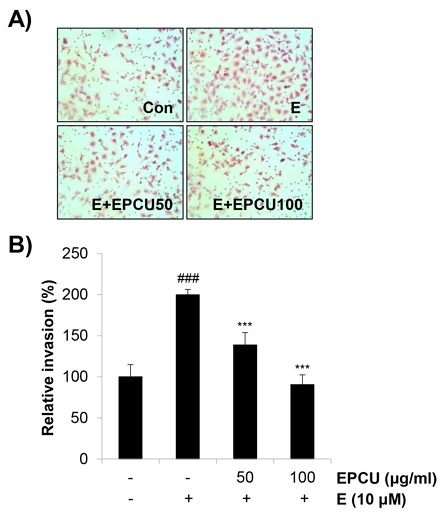
Effects of EPCU on epinephrine (E)-induced invasion of Hep3B cells. Hep3B human liver cancer cells were plated in triplicate into the inserts of transwell plate and treated with E (10 μM) and EPCU (50-100 ㎍/㎖). The inner membrane of the insert was coated with Matrigel. Medium containing 10% FBS was used as a chemoattractant. (A) After 24 h of incubation, the invaded cells were stained and photographed under a microscope (×100 magnification). (B) The number of stained cells was counted. The data are expressed as the mean ± SD of three independent experiments. Significance was determined by the Student’s t-test (###P < 0.001 versus untreated cells; ***P < 0.001 versus E-treated cells). EPCU, ethanol extract of premature citrus unshiu peel; E, epinephrine.
6. β-AR 신호전달경로에 미치는 EPCU의 효과
다음으로 EPCU가 스트레스성 카테콜아민으로 유도한 간암세포의 이동과 침윤을 억제할 수 있는 분자적 기전을 탐색하였다. β-AR 신호전달경로는 스트레스성 카테콜아민에 의해 활성화되며 암의 증식과 전이를 촉진하는 것으로 알려진 대표적 신호전달경로이다9-11). 이에 β-AR 신호전달경로의 주요한 매개체인 Src, STAT3, ERK의 활성화에 EPCU가 미치는 영향을 웨스턴블롯으로 조사하였다. Src, STAT3, ERK가 활성을 가지기 위해서는 모두 인산화되어야 하므로 이들의 인산화를 EPCU가 조절할 수 있는지에 초점을 맞춰 실험을 진행하였다. 그 결과 Fig. 6에 제시된 바와 같이 Src, STAT3, ERK의 인산화가 E (10μM) 처리에 의해 현저히 증가하는 것을 확인하였다. 이는 E가 β-AR 신호전달경로를 활성화시킴을 의미하는 것이다. 그러나 이들의 인산화는 EPCU 처리에 의해 모두 감소하여 불활성화되었다(Fig. 6). E와 EPCU 모두 Src, STAT3, ERK의 total 단백질 발현에는 영향을 미치지 않아 오로지 인산화만 조절함을 알 수 있었다(Fig. 6). 상기한 결과는 EPCU가 β-AR 신호전달경로를 억제함으로써 스트레스성 카테콜아민에 의한 간암세포의 이동과 침윤을 저해할 수 있음을 시사하는 것이다.
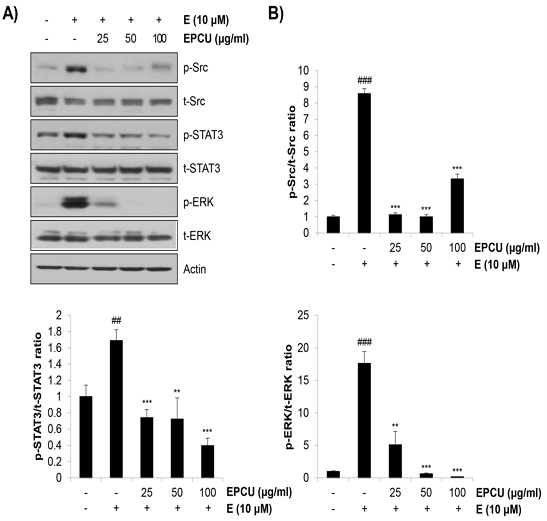
Effects of EPCU on the β-adrenergic receptor (β-AR) signaling pathway in Hep3B cells. Hep3B human liver cancer cells were pretreated with EPCU (25-100 ㎍/㎖) for 24 h and subsequently treated with E (10 M) 40 min before harvest. (A) The phosphorylation and total expression of the major components of the β-AR signaling pathway were detected by Western blot analysis. Actin was used as an internal control. (B) The ratio of phosphorylated/total protein was calculated using ImageJ software after normalization to actin. The data are expressed as the mean ± SD of three independent experiments. Significance was determined by the Student’s t-test (##P < 0.01, ###P < 0.001 versus untreated cells; **P < 0.01, ***P < 0.001 versus E-treated cells). EPCU, ethanol extract of premature citrus unshiu peel; E, epinephrine; β-AR, β-adrenergic receptor.
고 찰
만성적 스트레스는 한의학적으로 기울(氣鬱)을 일으킨다. 기울은 기를 움직이고 소설(疏泄)시키는 간(肝)을 중심으로 형성되기 쉬우며, 임상적으로 내향적이거나 민감한 성격의 소유자에게 간기울결(肝氣鬱結)이 잘 나타나는 것으로 알려져 있다27). 기울은 기혈(氣血)의 운행을 막아 담음(痰飮)과 어혈(瘀血) 등 병리적 산물을 만들고, 이들이 유형의 덩어리를 형성하는 것이 암의 핵심적인 병기라고 할 수 있다28). 중국의 여러 연구에서도 간기울결과 암 발병 간 밀접한 연관성을 보고하였고, 소간행기법(疏肝行氣法)을 주요 치법으로 제시하고 있다30). 특히 소간행기법이 가장 많이 활용되고 있는 암종은 간암으로서 간암의 가장 흔한 병기가 기체(氣滯)임이 보고된 바 있다31). 본 연구에서는 청피가 기울로 인한 간암의 진행과 악화를 억제할 수 있을 것이라는 가설로 실험을 진행하는데 그 근거는 다음과 같다. 첫째, 청피는 간담으로 귀경하며 소간파기시키는 효능이 있다18). 둘째, 최근 약리학적 연구에 따르면 청피는 항우울효과23)와 항암효과24-26)를 동시에 가지고 있다. 셋째, 대부분의 간암 환자가 만성적인 간질환 환자로서 간기능이 저하되어 있기 때문에 항암치료가 쉽지 않은 것이 현실이나 청피는 간손상을 개선하는 효과가 있다21). 이러한 기존 연구결과를 토대로 청피가 스트레스로 인한 간암의 전이를 효과적으로 저해할 것이라는 가설을 정립하였다.
본 연구에서 스트레스가 간암을 악화시키는 기전으로 초점을 맞춘 것은 바로 교감신경계 활성을 통한 β-AR 신호전달경로의 활성화이다. 간암은 β-AR을 발현하는 암종으로서 임상적으로 간세포암 환자의 치료적 절제술 이후 β2-AR의 과발현이 흔히 관찰되며, 이는 불량한 예후와 연관되어 있다32). 또한 β-AR 차단제는 간세포암 환자의 사망률을 감소시키는 경향을 보였다33). 본 연구자의 선행연구에서도 스트레스성 카테콜아민이 간암세포주의 이동능 및 침윤능을 증가시킴을 보고하였다29). 이러한 연구결과들은 간암의 악화과정에 β-AR 경로를 억제하는 것이 유망한 치료전략이 될 수 있음을 시사한다. 본 연구에서도 E, NE와 같은 스트레스성 카테콜아민이나 β-AR 작용제인 IP를 Hep3B 세포에 처리하자 세포의 이동능과 침윤능이 모두 증가하는 것을 확인하였다. 그러나 이러한 현상은 청피 추출물인 EPCU에 의해 모두 억제되어 EPCU가 스트레스로 인한 간암세포의 전이능을 효과적으로 저해할 수 있음을 시사하였다. 기존에 청피 추출물의 암 전이 억제효과를 보고한 연구로서 최 등34)은 청피 에탄올 추출물이 B16F10 마우스 피부암세포의 전이를 억제함을 in vitro와 in vivo에서 모두 밝혔으며, 이 등35)은 청피 발효추출물이 Panc-1 및 SNU-213 인체 췌장암세포의 이동능을 억제함을 in vitro에서 밝힌 바 있다. 기존 논문들은 모두 청피 추출물의 일반적인 암 전이 억제효과를 제안한 것이지만, 본 연구는 만성적인 스트레스 상황에서 청피 추출물이 암의 전이능을 억제할 수 있는지 밝히고자 한 것으로 스트레스라는 보다 구체적인 상황에서 청피 추출물의 항암효과를 밝혔다는 점이 시사점이라고 할 수 있다.
본 연구에서는 이러한 EPCU의 전이억제효과가 어떤 분자적 기전을 통해 나타나는지 β-AR 신호전달경로의 주요 매개체인 Src, STAT3, ERK의 활성을 중심으로 조사하였다. 먼저 Src은 비수용체 티로신 키나아제(non-receptor tyrosine kinase)로서 암세포의 이동능과 침윤능을 증가시키고 상피간엽이행(epithelial-mesenchymal transition, EMT)을 촉진하여 암전이를 일으키는 것으로 알려져 있다36,37). Src이 인산화시키는 주요 표적으로서 전사인자인 STAT3를 들 수 있는데, STAT3는 여러 암종에서 과활성화 되어있으며, 암의 발생과 전이를 촉진하는 유전자들의 발현을 조절하여 새로운 항암제 개발의 표적으로 각광받고 있다38). ERK는 암화과정에서 핵심적인 역할을 하는 Ras/Raf/MEK/mitogen-activated protein kinase (MAPK) 경로의 주요 구성원으로서 암의 성장과 진행에 필수적이다39). 본 연구에서는 Hep3B 세포에 E 처리 시 Src, STAT3, ERK의 인산화가 강력하게 유발되었으며, 이러한 현상이 EPCU에 모두 감소되는 것을 보여주었다. 상기한 결과는 스트레스성 카테콜아민에 의해 촉진된 간암세포의 전이를 억제하는 EPCU의 항암효과가 β-AR 신호전달경로 차단에 의한 것임을 보여준다.
아드레날린 수용체(AR)는 α-AR, β-AR 두 가지 아형으로 구분되며, 이들은 각각 α1, α2 및 β1, β2, β3로 분류된다. EPCU는 β-AR 선택적 작용제인 IP에 의한 Hep3B 세포의 이동능을 유의하게 억제했으므로 β-AR을 저해함으로써 항암효과를 나타내는 것으로 사료된다. 만약 EPCU가 α-AR을 타겟팅한다면 IP에 의해 증가한 암세포의 이동은 저해할 수 없을 것이기 때문이다. 다만 EPCU는 IP로 유도한 Hep3B 세포의 이동능보다 E/NE 처리로 유도한 이동능을 보다 현저히 감소시키는 경향을 보였는데, 이러한 결과는 EPCU가 β-AR 뿐만 아니라 α-AR도 함께 저해할 가능성이 있음을 시사한다. 즉, α-AR, β-AR에 비선택적으로 작용하는 E/NE 처리군에서는 EPCU가 α-AR과 β-AR을 모두 차단함으로써 보다 드라마틱한 억제효과가 나타난 것으로 사료된다. EPCU가 AR의 여러 타입 중 구체적으로 무엇을 타겟팅 하는지는 향후 추가 연구가 필요하다. 또한 EPCU에 포함된 여러 성분 중 어떤 성분에 의해 암세포 전이 억제효과가 매개되는지 밝히는 연구도 필요하다. 예를 들어 청피에 포함된 정유성분인 hesperidin은 간암세포의 사멸을 일으킬 뿐만 아니라 전이를 억제하는 것으로 알려져 있다40). 특히 hesperidin은 암세포에서 STAT3의 인산화를 억제하여 항암작용을 일으킨다는 보고41)도 있으므로 청피의 항암효과를 매개하는 성분으로 상정할 수 있다. D-limonene 역시 간암, 췌장암, 혈액암 등 다양한 암종에서 항암효과를 가지며, ERK 활성을 저해하는 것으로 알려져 청피의 항암효과를 매개하는 또다른 후보성분으로 사료된다42). 이들 성분 뿐만 아니라 청피에 포함된 다양한 성분들이 단독으로 혹은 복합적으로 작용하여 EPCU의 효과를 나타낼 것으로 예상되는 바, 네트워크 약리학과 같은 연구방법론을 사용하여 폭넓은 연구와 고찰을 할 필요가 있다.
결 론
본 연구는 스트레스로 인한 암의 악화과정을 기울의 관점에서 해석하고 청피의 소간파기시키는 효능에 착안하여 스트레스성 암 전이에 대한 청피의 항암효과를 밝히고자 하였다. 실험결과 청피 에탄올 추출물인 EPCU는 스트레스성 카테콜아민인 E/NE 및 IP에 의해 증가한 Hep3B 간암세포주의 이동능과 전이능을 탁월하게 감소시켰으며, 이는 β-AR 신호전달경로 차단에 의해 매개됨을 확인할 수 있었다. 이러한 연구결과는 만성적 스트레스 상황에서 기울의 경향이 명확한 간암환자에게 청피를 사용할 수 있는 기초적인 근거를 제공하는 것으로 향후 청피의 구체적인 활성성분과 타겟 분자를 규명하는 연구가 요청된다.
Acknowledgments
본 연구는 한국연구재단의 우수신진연구의 사업비로 수행되었음(No. NRF-2021R1C1C100506211).
References
-
Oh HM, Son CG. The Risk of Psychological Stress on Cancer Recurrence: A Systematic Review. Cancers 2021;13:5816.
[https://doi.org/10.3390/cancers13225816]

-
Batty GD, Russ TC, Stamatakis E, Kivimäki M. Psychological distress in relation to site specific cancer mortality: Pooling of unpublished data from 16 prospective cohort studies. BMJ 2017;356:j108.
[https://doi.org/10.1136/bmj.j108]
-
Kim-Fuchs C, Le CP, Pimentel MA, Shackleford D, Ferrari D, Angst E, Hollande F, Sloan EK. Chronic stress accelerates pancreatic cancer growth and invasion: A critical role for beta-adrenergic signaling in the pancreatic microenvironment. Brain Behav. Immun. 2014;40:40-7.
[https://doi.org/10.1016/j.bbi.2014.02.019]
-
Thaker PH, Han LY, Kamat AA, Arevalo JM, Takahashi R, Lu C, et al. Chronic stress promotes tumor growth and angiogenesis in a mouse model of ovarian carcinoma. Nat. Med. 2006;12:939-44.
[https://doi.org/10.1038/nm1447]
-
Chang A, Le CP, Walker AK, Creed, SJ, Pon CK, Albold S, et al. 2-Adrenoceptors on tumor cells play a critical role in stress-enhanced metastasis in a mouse model of breast cancer. Brain Behav. Immun. 2016;57:106-15.
[https://doi.org/10.1016/j.bbi.2016.06.011]
-
Gudenkauf LM, Ehlers SL. Psychosocial interventions in breast cancer survivorship care. Breast 2018;38:1–6.
[https://doi.org/10.1016/j.breast.2017.11.005]
-
Fawzy FI, Fawzy NW, Hyun CS, Elashoff R, Guthrie D, Fahey JL, et al. Malignant melanoma. Effects of an early structured psychiatric intervention, coping, and affective state on recurrence and survival 6 years later. Arch. Gen. Psychiatry 1993;50:681-9.
[https://doi.org/10.1001/archpsyc.1993.01820210015002]
-
Reiche EM, Nunes SO, Morimoto HK. Stress, depression, the immune system, and cancer. Lancet Oncol. 2004;5:617-25.
[https://doi.org/10.1016/S1470-2045(04)01597-9]
-
Cole SW, Sood AK. Molecular pathways: Beta-adrenergic signaling in cancer. Clin. Cancer Res. 2012;18:1201–1206.
[https://doi.org/10.1158/1078-0432.CCR-11-0641]
-
Mravec B, Horvathova L, Hunakova L. Neurobiology of Cancer: the Role of β-Adrenergic Receptor Signaling in Various Tumor Environments. Int. J. Mol. Sci. 2020;21(21):7958.
[https://doi.org/10.3390/ijms21217958]
-
Cui B, Peng F, Lu J, He B, Su Q, Luo H, et al. Cancer and stress: NextGen strategies. Brain Behav. Immun. 2021;93:368-83.
[https://doi.org/10.1016/j.bbi.2020.11.005]
-
Melhem-Bertrandt A, Chavez-Macgregor M, Lei X, Brown EN, Lee RT, Meric-Bernstam F. et al. Beta-blocker use is associated with improved relapse-free survival in patients with triple-negative breast cancer. J. Clin. Oncol. 2011;29:2645-52.
[https://doi.org/10.1200/JCO.2010.33.4441]
- Parada-Huerta E, Alvarez-Dominguez T, Uribe-Escamilla R, Rodriguez-Joya J, Ponce-Medrano JD, Padron-Lucio S, et al. Metastasis Risk Reduction Related with Beta-Blocker Treatment in MexicanWomen with Breast Cancer. Asian Pac. J. Cancer Prev. 2016;17:2953-7.
-
Udumyan R, Montgomery S, Fang F, Almroth H, Valdimarsdottir U, Ekbom A, et al. Beta-Blocker Drug Use and Survival among Patients with Pancreatic Adenocarcinoma. Cancer Res. 2017;77:3700-7.
[https://doi.org/10.1158/0008-5472.CAN-17-0108]
- National Cancer Information Center. https://www.cancer.go.kr/
-
Siegel RL, Miller KD, Wagle NS, Jemal A. Cancer statistics, 2023. CA Cancer J Clin. 2023;73(1):17-48.
[https://doi.org/10.3322/caac.21763]
-
Anwanwan D, Singh SK, Singh S, Saikam V, Singh R. Challenges in liver cancer and possible treatment approaches. Biochim. Biophys. Acta. Rev. Cancer 2020;1873(1):188314.
[https://doi.org/10.1016/j.bbcan.2019.188314]
- The Jointly Published Textbook Compilation Committee of Oriental College of Medicine Nationwide Department. Herbology. Seoul: Younglim press; 2004.
-
Ye YJ, Kim YS, Kang Ms. Effects of Citri Reticulatae Viride Pericarpium on 4-Hydroxynonenal-Induced Inflammation in PC12 Cells. J. Kor. Med. Obes. Res. 2016;16:79-84.
[https://doi.org/10.15429/jkomor.2016.16.2.79]
- Lee HJ. Effectiveness of Citri Reticulatae Viride Pericarpium in the Bronchial Asthma Animal Model: Assessment on the vascular endothelial growth factor (VEGF). Kor. J. Ori. Med. Physiol. Pathol. 2003;17(6):1475-8.
- Yang SG, Park HS. Effects of Aqua-acupuncture with Chungpi on CCI4-induced Rat’s Liver Injury. J. Acupunct. Res. 1998;15(1):431-45.
- Lee WS, Jeong HW. Experimental Effects of Fraction of Citri Reticulatae Viride Pericarpium extract on the Cerebral Hemodynamics in Cerebral Ischemia Pathologic-Modeling Rats. Kor. J. Ori. Med. Physiol. Pathol. 2001;15(6):899-904.
- Kwon YW, Lee TH. Antidepressant Effects of Citri Reticulatae Viride Pericarpium in the Forced Swimming Test. Kor. J. Herbology 2003;23(4):59-70.
-
Kim JE, Park SY, Choi CW, Kim KS, Kim KO, Wei TS, et al. Effects of Citri Reticulatae Viride Pericarpium on the Apoptotic Cell Death in Breast Cancer Cells. Kor. J. Obstet. Gynecol. 2015;28(2):40-54.
[https://doi.org/10.15204/jkobgy.2015.28.2.040]
- Lee SY. Apoptotic effect of herbal-acupuncture solution of Citri Reticulatae Viride Pericarpium in SNU-C4, human colon cancer cell. Master's Thesis at Daegu Haany University. 2004.
-
Kim MS. Effects of Citrus Reticulata on the Cell Detachment and Apoptosis in Human Gastric Cancer SNU-668 Cells. Doctoral Thesis at Semyung University. 2005.
[https://doi.org/10.1207/s15327914nc5101_11]
- The Textbook Compilation Committee of Pathology of Korean Medicine. Pathology of Korean Medicine. Seoul: Hanimunhwasa; 2019.
- Cho JK. Oriental Clinical Oncology. Daejeon: Jumin Publishing House; 2005.
-
Jeong JH, Park HJ, Park SH, Choi YH, Chi GY. β2-Adrenergic Receptor Signaling Pathway Stimulates the Migration and Invasion of Cancer Cells via Src Activation. Molecules 2022;27(18):5940.
[https://doi.org/10.3390/molecules27185940]
- Liang F, Sun J, Zhang Y, Han JH, Xu J. Liver Qi Stagnation-emotion Pathopoiesis and Malignant Tumor. J. Prac. Trad. Chin. Int. Med. 2016;30(5):42-4.
- Chen Z, Hou F, Sun K. Literature analysis of TCM syndromes of liver cancer. J. Anhui. TCM College 2002;21(2):24-26.
-
Yuan A, Li Z, Li X, Yi S, Wang S, Cai Y, et al. The mitogenic effectors of isoproterenol in human hepatocellular carcinoma cells. Oncol Rep. 2010;23(1):151-7.
[https://doi.org/10.3892/or_00000616]
-
Udumyan R, Montgomery S, Duberg AS, Fang F, Valdimarsdottir U, Ekbom A, et al. Beta-adrenergic receptor blockers and liver cancer mortality in a national cohort of hepatocellular carcinoma patients. Scand. J. Gastroenterol. 2020;55(5):597-605.
[https://doi.org/10.1080/00365521.2020.1762919]
-
Choi EO, Lee H, HwangBo H, Kwon DH, Kim MY, Ji SY, et al. Citrus unshiu peel suppress the metastatic potential of murine melanoma B16F10 cells in vitro and in vivo. Phytother. Res. 2019;33(12):3228-41.
[https://doi.org/10.1002/ptr.6497]
-
Lee J, Lee J, Kim M, Kim JH. Fermented Extraction of Citrus unshiu Peel Inhibits Viability and Migration of Human Pancreatic Cancers. J. Med. Food. 2018;21(1):5-12.
[https://doi.org/10.1089/jmf.2017.3984]
-
Zhang S, Yu D. Targeting Src family kinases in anti-cancer therapies: Turning promise into triumph. Trends Pharmacol. Sci. 2012;33:122-8.
[https://doi.org/10.1016/j.tips.2011.11.002]
-
Liu X, Feng R. Inhibition of epithelial to mesenchymal transition in metastatic breast carcinoma cells by c-Src suppression. Acta. Biochim. Biophys. Sin. 2010;42:496-501.
[https://doi.org/10.1093/abbs/gmq043]
-
El-Tanani M, Al Khatib AO, Aladwan SM, Abuelhana A, McCarron PA, Tambuwala MM. Importance of STAT3 signalling in cancer, metastasis and therapeutic interventions. Cell Signal. 2022;92:110275.
[https://doi.org/10.1016/j.cellsig.2022.110275]
-
Guo YJ, Pan WW, Liu SB, Shen ZF, Xu Y, Hu LL. ERK/MAPK signalling pathway and tumorigenesis. Exp. Ther. Med. 2020;19(3):1997-2007.
[https://doi.org/10.3892/etm.2020.8454]
-
Aggarwal V, Tuli HS, Thakral F, Singhal P, Aggarwal D, Srivastava S, et al. Molecular mechanisms of action of hesperidin in cancer: Recent trends and advancements. Exp Biol Med (Maywood). 2020;245(5):486-97.
[https://doi.org/10.1177/1535370220903671]
-
Kottaiswamy A, Kizhakeyil A, Padmanaban AM, Mirza FB, Vijay VR, Lee PS, et al. The Citrus Flavanone Hesperetin Induces Apoptosis in CTCL Cells via STAT3/Notch1/NFκB-Mediated Signaling Axis. Anticancer Agents Med. Chem. 2020;20(12):1459-68.
[https://doi.org/10.2174/1871521409666200324110031]
-
Araújo-Filho HG, Dos Santos JF, Carvalho MTB, Picot L, Fruitier-Arnaudin I, Groult H, et al Anticancer activity of limonene: A systematic review of target signaling pathways. Phytother Res. 2021;35(9):4957-70.
[https://doi.org/10.1002/ptr.7125]